
bolt Game Changer on the MTG Commander Game Changers list collections_bookmark Part of Fallout

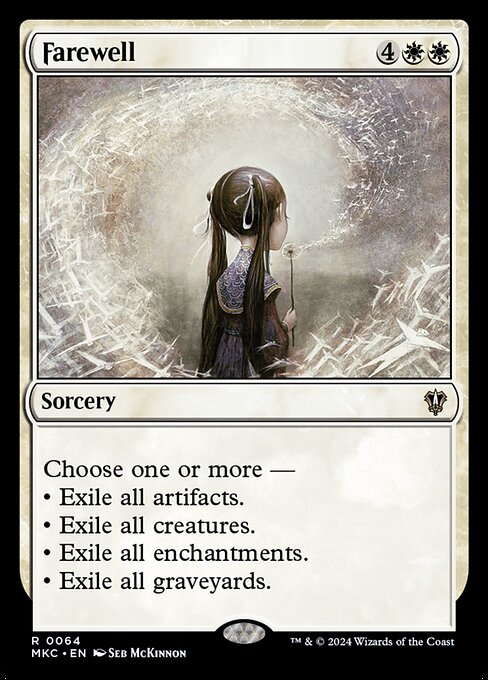
Farewell card art
Live Play Data

Farewell

{4} {W} {W} · Sorcery · Murders at Karlov Manor Commander (MKC)
10%
Live Inclusion
Times Brought
2328
Decks Running
1096
Median Cast Turn
8.0
Drawn → Played
58%
Format

Farewell appears in 10% of tracked Commander decks and, when drawn, reaches the stack 58% of the time, with a median first cast landing on turn 8.0.

Farewell is a six-mana white sorcery that exiles up to four permanent types and graveyards in a single spell. Across 2087 tracked multiplayer Commander games on Playgroup Live, it sits in 10% of decks and has been cast 320 times, making it one of the more data-rich sweepers in the dataset.

The draw-to-play rate of 58% tells an honest story about a late-game reset: when players find Farewell in hand, more than half the time they do get to fire it off. The median first cast landing on turn 8.0 is consistent with the mana cost. Getting 6 mana together takes time, and most casts cluster between turns 6 and 9. The 28% on-curve rate confirms this is a card players hold, not slam, waiting for the board state to justify the six-mana ask.

White is the format's primary color for exile-based removal, and Farewell is its broadest sweeper. Its ability to hit artifacts, creatures, enchantments, and graveyards simultaneously makes it the choice for decks that want one answer to cover many threat types. The data shows it spread across 841 distinct players, with no single player dominating the sample.

At a glance
  • 10% of tracked Commander decks include Farewell
  • 58% of drawn Farewell copies reached the stack before the game ended
  • T8.0 median first-cast turn across all observed games
  • 28% of casts landed exactly on curve at turn 6
  • 26% of drawn copies were cast on the same turn they were drawn
  • 841 distinct players have brought Farewell to a tracked game

First-cast turn

n=320
0%
T1
1%
T2
1%
T3
4%
T4
8%
T5
61%
T6-9
25%
T10+
Median 8.0 P25 6 · P75 10 · max 23
On curve 28% (46 / 320 cast on T6) Cast same turn as drawn 26%

The "good card" funnel

2331 brought · 841 players
Brought to game
2331
Ever drawn
555
Reached battlefield
320
Still on board at game end
37
58%

Of 2331 Farewell copies brought to multiplayer games, 555 were drawn, and 320 of those reached the stack, showing that the 6-mana cost is the bottleneck rather than player reluctance to cast it.

≥ +2.2pp

Players who cast this card win 29% of the time (n=281) , vs 22% when it never left the library (n=1501).

When players drew this card but left it in hand, they won 31% (n=212) — about the same as leaving it in the library. Those players survived long enough to draw it, so the gap above is about the card resolving, not just about surviving.

Observed gap +7.5pp; 95% confidence interval +2.2pp to +12.8pp. Correlational, not causal: powerful payoffs also get cast more often in games you are already winning.

Final zone distribution

621 instances
3.9%
Library
6.0%
Battlefield
40.3%
Graveyard
14.7%
Exile

The vast majority of Farewell copies never leave the library, a structural feature of 100-card singleton decks where any single card appears in fewer than one in a hundred draws. The graveyard is the dominant final zone for the copies that do get cast, as expected for a sorcery.

Commanders that played this card

in tracked games

No single commander dominates Farewell's homes. The top entry holds 1096 total decks in the set, but the list spans five different color combinations, signaling that white-inclusive decks treat Farewell as a format-wide staple rather than a build-around.

Card text
Farewell card

Farewell

{4} {W} {W}
Sorcery
Choose one or more — • Exile all artifacts. • Exile all creatures. • Exile all enchantments. • Exile all graveyards.
Murders at Karlov Manor Commander (MKC) · Rare · Illustrated by Seb McKinnon

Frequently Asked

How often is Farewell drawn in a Commander game?
In 2087 tracked games where Farewell was in the deck, it was drawn 24% of the time. That is a normal draw rate for a singleton in a 100-card deck. Of those 555 drawn copies, 58% were cast before the game concluded. The remainder mostly reflects games that ended before a player could deploy a 6-mana spell, not a choice to hold it.
What turn does Farewell usually get cast?
Median first cast is turn 8.0, with the bulk of casts landing between turns 6 and 9 (p25 to p75). The distribution peaks around turns 7 and 8 in multiplayer games. Only 28% of casts hit exactly on the mana-value curve of turn 6, which reflects how rarely players draw Farewell in their opening hand. When they do hold it, the median wait from draw to cast is 3 turns, and just 26% slam it immediately.
Does casting Farewell actually correlate with winning?
In 281 tracked participations where Farewell was cast, the normalized win rate was 29%. In participations where it sat in the library, the rate was 22%. The delta is +7.5 percentage points. Both sample sizes are large enough to treat this as a directional signal. The lift is modest but consistent: Farewell appears to correlate with winning at a slightly higher rate than not casting it, though the effect is not large enough to claim it as the deciding factor in most games.
Is Farewell banned in any major format?
Farewell is legal in Commander, Legacy, Modern, Pioneer, Vintage, Historic, and Timeless. It is not legal in Standard, Pauper, or Pauper Commander. It has no ban or restriction in the formats where it is legal. In Commander it is unrestricted and widely played as a catch-all sweeper.
Which commanders most often run Farewell?
Across the tracked dataset, Tidus, Yuna's Guardian leads with the most Farewell decks, followed by Y'shtola, Night's Blessed, Giada, Font of Hope, and Oloro, Ageless Ascetic. The spread covers Bant, Esper, and mono-white commanders, confirming that Farewell is treated as a generalist white staple rather than a card synergistic with any one strategy. The full top-ten list covers five different color combinations.
How concentrated is the Farewell data across players?
Farewell data comes from 841 distinct players, and the single heaviest contributor accounts for just 3% of all tracked instances. That is well below the threshold where one player's habits could skew the aggregate numbers. The spread gives reasonable confidence that the draw, cast, and win-rate figures reflect the card's behavior across a diverse sample of pods and play styles rather than one outlier.