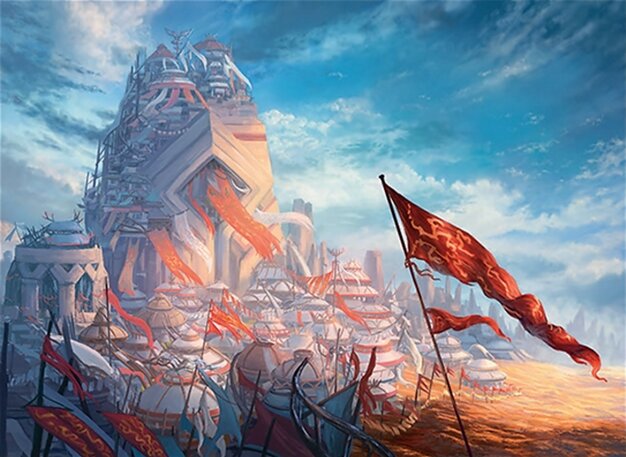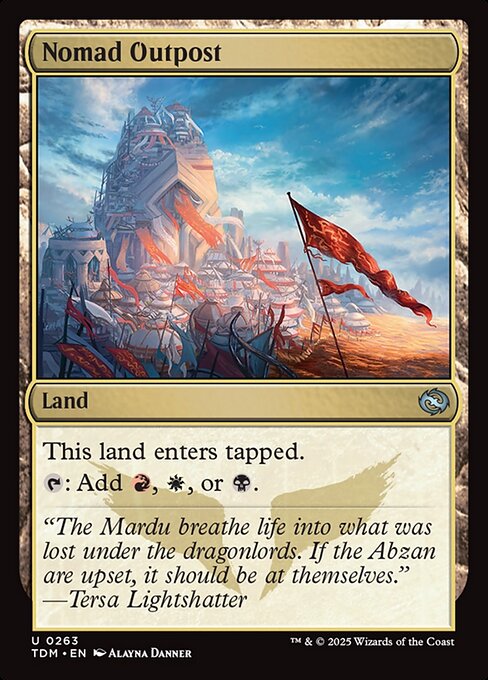
Nomad Outpost
Nomad Outpost appears in 3.8% of all tracked Commander decks, but among Mardu ({B}{R}{W}) pilots it's a genuine staple. When drawn, 63% of copies reach the battlefield, with a median first-cast turn of 4.
Nomad Outpost is a niche card with a clear home: it sits in 90 of the 2,373 distinct Commander decks tracked on Playgroup Live, an inclusion rate of 3.8%. That number is low in isolation, but it reflects the card's strict color requirement. Every commander in its top-10 list shares the Mardu wedge ({B}{R}{W}), and within that slice Nomad Outpost is a fixture.
The draw-to-play rate of 63% is slightly below average for a land. Lands are almost never intentionally held, so that figure mostly reflects games where the card was drawn very late and the player never had a turn to play it. When it does hit the table, it sticks: 90% battlefield stickiness, as you'd expect from a land. The median first-cast turn of 4 also tells a familiar story. Enters-tapped lands drawn in the opening hand tend to be played around turns 1-2; the rest of the distribution spreads across mid-game draws.
One number to watch carefully: the win rate when cast is 15%, compared to 37.3% when it stayed in the library. The delta is large, but both buckets are small (20 and 110 observations respectively). That gap is a directional signal, not a verdict. It may reflect that Nomad Outpost sees more play in slower, tap-land-tolerant decks that struggle in a fast meta, rather than any direct cost the land imposes.
- 3.8% overall inclusion rate across all tracked Commander decks
- 90 distinct decks in the tracked dataset run Nomad Outpost
- 63% of drawn copies are cast before the game ends
- T4 median first-cast turn
- 90% battlefield stickiness once played
- 10 commanders in the top list, all sharing the Mardu wedge
First-cast turn
n=20The "good card" funnel
140 brought140 copies were brought to games, 30 were drawn (21.4%), 20 of those were cast, and 18 were still on the battlefield when the game ended. A straightforward land pipeline with no surprising drop-off.
Players who cast this card win 15% of the time (n=20) , vs 37% when it never left the library (n=110).
Final zone distribution
140 instances110 of 140 tracked Nomad Outpost instances never left the library, the expected outcome for a singleton land in a 100-card deck. The 18 copies still on the battlefield at game end represent the card doing exactly what it was built to do.
Top commanders running this card
by deck count-
1
Mr. House, President and CEO
14 decks
-
2
Terra, Herald of Hope
12 decks
-
3
Zurgo, Thunder's Decree
12 decks
-
4
Fire Lord Zuko
8 decks
-
5
Edgar Markov
7 decks
-
6
Olivia, Opulent Outlaw
7 decks
-
7
Caesar, Legion's Emperor
6 decks
-
8
Isshin, Two Heavens as One
6 decks
-
9
The First Sliver
6 decks
-
10
Zurgo Stormrender
6 decks
All ten commanders in the list share the Mardu ({B}{R}{W}) color identity, making this one of the tightest commander-distribution clusters on the site. Nomad Outpost is essentially a Mardu-only card.
How often is Nomad Outpost drawn in a Commander game? ▾
In 140 deck-participations tracked on Playgroup Live, Nomad Outpost was drawn 30 times. That is a draw rate of 21.4%, which is close to the expected baseline for a singleton in a 100-card deck. Of those 30 drawn instances, 20 were cast, giving a draw-to-play rate of 63%.
What is the cast vs. library win-rate delta, and what does it mean? ▾
When Nomad Outpost was cast, the normalized win rate for that participant was 15%. When it stayed unplayed in the library, the win rate was 37.3%. The raw delta is -22 percentage points. Both buckets are small (20 and 110 observations), so treat this as an early directional signal rather than a firm conclusion. A plausible explanation is that Mardu decks relying on enters-tapped fixing tend to be slower, mid-range builds that lose more often to fast tables regardless of the land itself.
What turn does Nomad Outpost typically enter the battlefield? ▾
The median first-cast turn is 4, with the 25th percentile at turn 2 and the 75th at turn 7. The distribution shows a clear early spike: 9 of 20 tracked casts happened on turns 1 or 2, suggesting those copies were in opening hands. The rest spread across mid-to-late game turns, with one recorded as late as turn 12.
Which commanders most often run Nomad Outpost? ▾
Every commander in the top 10 shares the Mardu ({B}{R}{W}) color identity, confirming the card's role as wedge-specific fixing. Mr. House, President and CEO leads with 14 decks, followed by Terra, Herald of Hope and Zurgo, Thunder's Decree at 12 each. The one exception in the list is The First Sliver (5-color), which can legally include any land.
Is Nomad Outpost legal in Commander? ▾
Yes. Nomad Outpost is legal in Commander, as well as Legacy, Modern, Pioneer, Standard, and most other constructed formats. It is not legal in Pauper or Pauper Commander, where uncommon cards are excluded.
Why would a player choose Nomad Outpost over other Mardu three-color lands? ▾
Nomad Outpost produces all three Mardu colors from a single land slot, which matters in decks that need to hit specific mana pips on curve. The tradeoff is that it always enters tapped, slowing your first few turns. In practice, Playgroup Live data shows 90% of cast copies stay on the battlefield for the rest of the game, so once it resolves it reliably does its job as a late-game mana source.