
collections_bookmark Part of The Lost Caverns of Ixalan
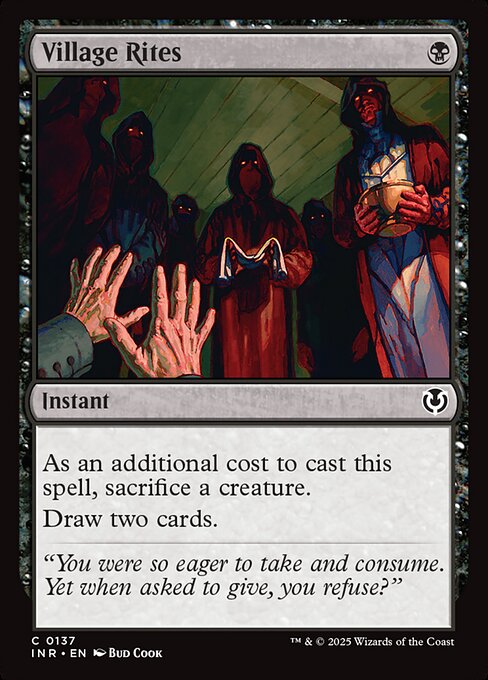
Village Rites card art
Live Play Data

Village Rites

{B} · Instant · Innistrad Remastered (INR)
8%
Live Inclusion
Times Brought
1517
Decks Running
842
Median Cast Turn
6.0
Drawn → Played
69%
Format

69% of drawn Village Rites copies are cast before the game ends, with a median first-cast turn of 6.0 across 1442 tracked Commander games on Playgroup Live.

Village Rites converts a creature sacrifice into two fresh cards for a single black mana. Across 1442 tracked multiplayer Commander games on Playgroup Live, 69% of drawn copies reached the cast step, a strong execution rate for a reactive instant that demands a live creature as payment.

The median first-cast turn of 6.0 reflects the card's nature: players hold it until the right sacrifice target is available, whether that's a creature already destined for removal, a token at end of its usefulness, or a recursive threat about to head to the graveyard anyway. The hand-to-cast median of 2 turns confirms players don't slam it immediately. They wait for the right moment. The data is well-spread across 679 distinct players, with the single heaviest contributor accounting for just 1% of all instances, which gives the numbers reasonable breadth.

The commander distribution skews toward sacrifice-synergy archetypes: Teysa Karlov, Edgar Markov, Meren of Clan Nel Toth, and Marrow-Gnawer all populate the top slots. That pattern is consistent with what Village Rites does best: turning mandatory or incidental creature loss into raw card advantage at instant speed for the cheapest possible mana investment.

At a glance
  • 8% of tracked Commander decks include Village Rites
  • 69% of drawn copies are cast before the game ends
  • T6.0 median first-cast turn across tracked games
  • 22% draw rate, consistent with a singleton in a 100-card deck
  • 679 distinct players have brought Village Rites to a tracked game

First-cast turn

n=228
0%
T1
1%
T2
5%
T3
15%
T4
16%
T5
50%
T6-9
13%
T10+
Median 6.0 P25 5 · P75 8 · max 15
On curve 0% (0 / 228 cast on T1) Cast same turn as drawn 28%

The "good card" funnel

1521 brought · 679 players
Brought to game
1521
Ever drawn
332
Reached battlefield
228
Still on board at game end
7
69%

Of 1521 Village Rites brought to tracked games, 332 were drawn, and 228 of those were cast, representing a 69% draw-to-cast conversion rate before games concluded.

≥ -4.3pp

Players who cast this card win 24% of the time (n=214) , vs 23% when it never left the library (n=1002).

When players drew this card but left it in hand, they won 21% (n=87) — about the same as leaving it in the library. Those players survived long enough to draw it, so the gap above is about the card resolving, not just about surviving.

Observed gap +1.6pp; 95% confidence interval -4.3pp to +7.5pp. Correlational, not causal: powerful payoffs also get cast more often in games you are already winning.

Final zone distribution

378 instances
3.4%
Library
1.9%
Battlefield
64.0%
Graveyard
10.1%
Exile

The overwhelming majority of Village Rites instances finish in the graveyard, exactly as expected for an instant that resolves and is consumed. The tiny battlefield count is a data artifact, not a meaningful zone.

Commanders that played this card

in tracked games

The commander list spans mono-black sacrifice, white-black aristocrats, and green-black tokens, reflecting how broadly Village Rites fits any archetype that generates expendable creatures.

Card text
Village Rites card

Village Rites

{B}
Instant
As an additional cost to cast this spell, sacrifice a creature. Draw two cards.
Innistrad Remastered (INR) · Common · Illustrated by Bud Cook

Frequently Asked

How often is Village Rites drawn and cast in a Commander game?
In 1442 tracked multiplayer Commander games where Village Rites was in the deck, it was drawn 22% of the time. That rate is typical for a singleton in a 100-card deck. Of those drawn copies, 69% were cast before the game concluded. The remaining drawn copies largely reflect games that ended before the player found the right sacrifice window.
What turn does Village Rites typically get cast?
Median first-cast turn is 6.0, with the distribution concentrated between turns 4 and 8. The card costs only one black mana, but casting it requires a creature to sacrifice, so the realistic cast window is tied to board state rather than available mana. Players hold it a median of 2 turns after drawing before casting, consistent with waiting for a creature to become expendable.
Does Village Rites help you win more often?
The cast win rate sits at 24% across 214 observations, while the library win rate is 23%. The delta is negative and the sample has an associated standard error, so the current data does not support a confident directional claim. The more honest read is that Village Rites is a role-player in decks whose overall game plan wins games, rather than a card that independently lifts win probability.
Is Village Rites legal in Commander?
Yes. Village Rites is legal in Commander, Duel Commander, Brawl, Legacy, Modern, Pioneer, Pauper, Pauper Commander, Vintage, Historic, Timeless, Gladiator, and Oathbreaker. It is not legal in Standard, Alchemy, or Penny Dreadful. It has no format bans to worry about.
What commanders use Village Rites most?
On Playgroup Live, the top commanders paired with Village Rites are Teysa Karlov, Sephiroth (Fabled SOLDIER), Silverquill the Disputant, Edgar Markov, and Marrow-Gnawer. The pattern is consistent: these are sacrifice-synergy or token-based commanders where creatures frequently die or become available to sacrifice, making Village Rites a free-roll refill on card advantage.
Why run Village Rites over similar black draw spells?
Village Rites costs one mana and draws two cards, which is among the most efficient rates available in black at instant speed. The cost is real: you must sacrifice a creature. But in Commander archetypes built around sacrifice outlets, token generation, or recursive creatures, that cost is either negligible or actively beneficial. The 69% cast rate among drawn copies suggests players in those decks rarely find themselves holding a dead card.