
collections_bookmark
Part of Teenage Mutant Ninja Turtles

Live Play Data
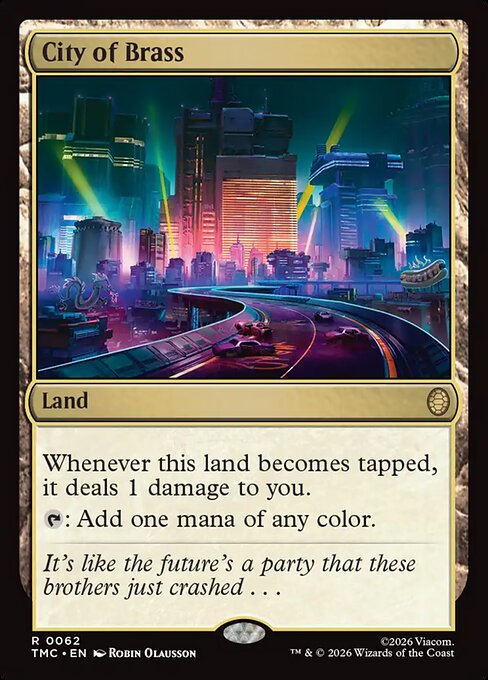
City of Brass
Land
·
Teenage Mutant Ninja Turtles Eternal (TMC)
8%
Live Inclusion
Times Brought
8878
Decks Running
3971
Median Cast Turn
4.0
Drawn → Played
70%
Format
First-cast turn
n=1526
17%
T1
13%
T2
15%
T3
14%
T4
12%
T5
25%
T6-9
4%
T10+
Median
4.0
P25
2
· P75
6
· max
20
Cast same turn as drawn
52%
The "good card" funnel
8879 brought · 2169 playersBrought to game
8879
Ever drawn
2193
Reached battlefield
1526
Still on board at game end
1386
Once cast, 91% of this card is still on the battlefield at game end. This reflects how often it survives removal, not just whether it's a permanent.
≥ +1.8pp
Players who cast this card win 31% of the time (n=1389) , vs 27% when it never left the library (n=5469).
When players drew this card but left it in hand, they won 35% (n=578).
Read this as correlation, not as the card's contribution. Casting a card means you lived long enough to cast it, so this gap widens with mana value across every card we track.
Observed gap +4.3pp; 95% confidence interval +1.8pp to +6.8pp. Correlational, not causal: powerful payoffs also get cast more often in games you are already winning.
Final zone distribution
2478 instances3.3%
Library
55.9%
Battlefield
16.7%
Graveyard
6.7%
Exile
Commanders that played this card
in tracked games-
1
The Ur-Dragon




 109 decks
-
2
Leonardo, the Balance
107 decks
-
3
Y'shtola, Night's Blessed
86 decks
-
4
Atraxa, Praetors' Voice
67 decks
-
5
Kaalia of the Vast
60 decks
-
6
Heroes in a Half Shell
55 decks
-
7
Edgar Markov
52 decks
-
8
Kinnan, Bonder Prodigy
51 decks
-
9
Vivi Ornitier
50 decks
-
10
Jodah, the Unifier
46 decks
Card text
City of Brass
Land
Whenever this land becomes tapped, it deals 1 damage to you.
 : Add one mana of any color.
: Add one mana of any color.
Teenage Mutant Ninja Turtles Eternal (TMC)
·
Rare
·
Illustrated by Robin Olausson
Frequently Asked
Why isn't there more data on this card?
Playgroup Live collects per-card gameplay data from real Commander games. Play counts appear once a card reaches 100 tracked games, and the full charts need a sample of at least 25 observed games that is not dominated by a single pilot. Until this card clears those bars you're seeing only the basic counts. Stats refresh nightly.
How is Playgroup Live card data collected?
Players using Playgroup Live import their decklists before a game and log card actions as they play. Each cast, zone change, and resolution is recorded as a real game event. Stats on this site are computed from those events, not from decklist scrapes or theorycrafting. Playgroup has recorded 730,000+ Commander games overall, and this card-level play data comes from the Playgroup Live seats playing virtual cards, a subset of that corpus.