collections_bookmark Part of Commander Masters auto_awesome #24 in Red Commander Staples
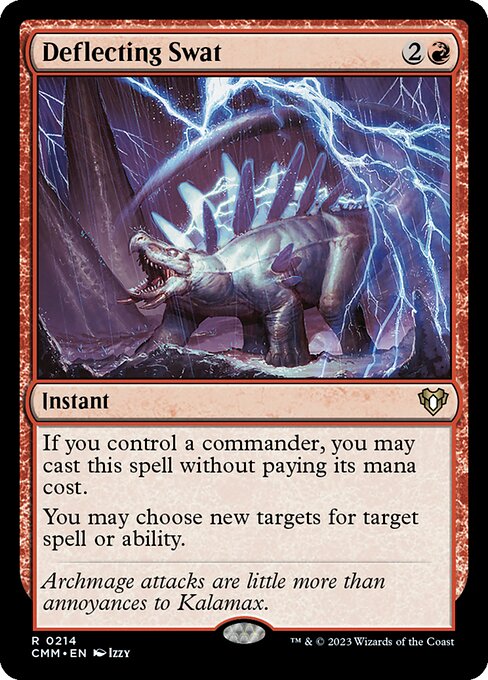
Deflecting Swat card art
Live Play Data

Deflecting Swat

{2} {R} · Instant · Commander Masters (CMM)
17%
Live Inclusion
Times Brought
2182
Decks Running
1076
Median Cast Turn
6
Drawn → Played
53%
Format

Deflecting Swat appears in 17% of tracked Commander decks and is cast on a median turn of 6, well after the free-cast window opens, confirming players hold it as reactive insurance rather than rushing it out.

Deflecting Swat sits in 17% of the 6292 Commander decks tracked on Playgroup Live, a rate consistent with a powerful but color-restricted reactive spell. Its free-cast clause, active whenever you control a commander, is the core reason it earns a slot: a zero-cost redirect can blunt a counterspell, redirect a removal spell, or flip a wheel onto the table that targeted you.

The play pattern shows up clearly in the timing data. Median first cast lands on turn 6, and players sit on drawn copies for a median of 2.5 turns before casting. Only 22% of casts happen on the same turn the card is drawn. That patience is the tell: this is a permission piece held until the right threat appears, not a card you slam on curve.

At 53%, roughly half of drawn copies reach the stack before the game ends. For an instant with a conditional free-cast, that figure reflects both game-length attrition and deliberate holding. The data spans 676 distinct players, with no single player accounting for more than 22% of instances, so the signal is well-distributed across the tracked population.

At a glance
  • 17% of tracked Commander decks include Deflecting Swat
  • T6 median first-cast turn, consistent with holding it as reactive protection
  • 53% of drawn copies reach the stack before the game ends
  • 22% of casts fire on the same turn the card is drawn, confirming deliberate holds
  • 676 distinct players have brought it to a tracked game, spreading the data well
  • 36% normalized win rate in games where Deflecting Swat was cast

First-cast turn

n=257
0%
T1
0%
T2
3%
T3
8%
T4
17%
T5
58%
T6-9
14%
T10+
Median 6 P25 5 · P75 8 · max 16
On curve 3% (8 / 257 cast on T3) Cast same turn as drawn 22%

The "good card" funnel

2185 brought · 676 players
Brought to game
2185
Ever drawn
487
Reached battlefield
257
Still on board at game end
16
53%

Of 2185 copies brought to games, 487 were drawn, 257 of those were cast, and the card almost always ends the game in the graveyard, as expected for an instant that resolves and goes to the bin.

≥ +3.0pp

Players who cast this card win 36% of the time (n=250) , vs 28% when it never left the library (n=1475).

When players drew this card but left it in hand, they won 27% (n=219) — about the same as leaving it in the library. Those players survived long enough to draw it, so the gap above is about the card resolving, not just about surviving.

Observed gap +8.9pp; 95% confidence interval +3.0pp to +14.9pp. Correlational, not causal: powerful payoffs also get cast more often in games you are already winning.

Final zone distribution

565 instances
3.4%
Library
2.8%
Battlefield
48.1%
Graveyard
6.2%
Exile

Nearly all Deflecting Swats end in the graveyard after resolving or in hand after being held all game; the tiny library remainder reflects how rarely a card this reactive gets shuffled away unseen.

Commanders that played this card

in tracked games

The top commanders span mono-red aggro through five-color piles, showing that Deflecting Swat is selected for the free-cast clause itself rather than any single commander synergy.

Frequently Asked

How often is Deflecting Swat drawn in a Commander game?
Across 1756 tracked multiplayer games where Deflecting Swat was in the deck, it was drawn 22% of the time. That is typical for a singleton in a 100-card deck. Of 487 instances that reached a player's hand, 53% were cast before the game ended. The remainder is mostly a game-length effect: instants held for the right moment sometimes never find it.
What turn does Deflecting Swat usually get cast?
Median first cast is turn 6, with the middle 50% of casts falling between turns 5 and 8. Almost no instances land on turn 3 (the card's mana cost), reflecting that players virtually never hard-cast it early. The free-cast condition requires a commander in play, so the actual casting window opens once a commander has resolved, typically mid-game. Only 3% of casts were on-curve for a 3-mana spell.
Does casting Deflecting Swat actually improve your win rate?
In 250 participations where Deflecting Swat was cast, the normalized win rate is 36%, compared to 28% in the 1475 participations where it stayed in the library. That is a +8.9 percentage-point gap. Both sample sizes are large enough to treat this as a directional signal, though Playgroup Live's dataset should be read as an early indicator rather than a definitive proof. Decks that deploy their free interaction tend to be ahead in the game to begin with, which complicates clean causal claims.
Is Deflecting Swat banned anywhere?
Yes. Deflecting Swat is banned in Duel Commander, Tournament Legend Rules (TLR), and Brawl. Its free-cast clause is considered too efficient in lower-life, faster formats where a commander enters play earlier and the cost of holding up three mana is proportionally higher. It remains legal and unrestricted in regular Commander (multiplayer), Oathbreaker, Legacy, Vintage, Historic, Timeless, Gladiator, and Competitive Brawl.
Why do so many different commanders run Deflecting Swat?
The card's color identity is mono-red, so it fits into any deck that includes red. Its value scales with how reliably your commander is on the battlefield: aggressive commanders that stick around give you a near-permanent free counter. The top commanders in the tracked data span mono-red aggro, Gruul midrange, Mardu tempo, and five-color piles, which reflects how broadly the free-cast clause applies rather than a narrow synergy home.
How well-distributed is the data for Deflecting Swat?
The tracked data comes from 676 distinct players, and no single contributor accounts for an outsized share of instances. That spread is a meaningful quality signal: the draw-rate, cast-turn, and win-rate figures are not driven by one prolific player's preferred deck. Playgroup Live's dataset of 1756 games is still growing, so treat the numbers as directional rather than statistically conclusive.