collections_bookmark Part of Commander Legends: Battle for Baldur's Gate
Dimir Aqueduct card art
Live Play Data

Dimir Aqueduct

Land · Duskmourn: House of Horror Commander (DSC)
11%
Live Inclusion
Times Brought
1117
Decks Running
575
Median Cast Turn
4
Drawn → Played
73%
Format

11% of Playgroup Live Commander decks in the Dimir color space include Dimir Aqueduct. When drawn, 73% of copies are cast, with a median first-cast turn of 4.

Dimir Aqueduct sits in 11% of tracked Commander decks on Playgroup Live, appearing across 575 of the 5239 distinct decks that have seen live play. That figure reflects a real slice of the Dimir and adjacent meta: the card is a deliberate inclusion in a meaningful share of every blue-black build that shows up at tracked tables.

The draw-to-play rate of 73% tells you that when the Aqueduct reaches a hand, it almost always hits the battlefield before the game closes. Median first cast lands on turn 4, consistent with an early land drop that gets bounced back alongside a fetch or enters-the-battlefield land to generate incremental value. The bounce-a-land downside is clearly not deterring players from slotting it immediately. Data from 503 distinct players means the signal is well-spread, with no single contributor accounting for an outsized share of observations.

Dimir Aqueduct is legal in Commander, Duel Commander, Pauper Commander, Legacy, Modern, Vintage, and Oathbreaker. It is a budget dual land whose enters-tapped clause and bounce cost are real but manageable in the mid-game, making it a reliable color fixer in lower-powered Dimir builds.

At a glance
  • 11% of tracked Commander decks include Dimir Aqueduct
  • 73% of drawn copies are cast before the game ends
  • T4 median first-cast turn
  • 91% battlefield stickiness once it resolves
  • 503 distinct players have brought this card to a tracked game, indicating a well-spread dataset
  • 26% draw rate, in line with a singleton land in a 100-card deck

First-cast turn

n=211
13%
T1
18%
T2
13%
T3
11%
T4
11%
T5
26%
T6-9
8%
T10+
Median 4 P25 2 · P75 7 · max 16
Cast same turn as drawn 43%

The "good card" funnel

1118 brought · 503 players
Brought to game
1118
Ever drawn
288
Reached battlefield
211
Still on board at game end
192
73%

Of 1118 Dimir Aqueducts brought to tracked games, 288 were drawn, 211 of those were cast, and the large majority remained on the battlefield at end of game.

≥ +1.0pp

Players who cast this card win 28% of the time (n=188) , vs 20% when it never left the library (n=668).

When players drew this card but left it in hand, they won 24% (n=69) — about the same as leaving it in the library. Those players survived long enough to draw it, so the gap above is about the card resolving, not just about surviving.

Observed gap +7.7pp; 95% confidence interval +1.0pp to +14.4pp. Correlational, not causal: powerful payoffs also get cast more often in games you are already winning.

Final zone distribution

335 instances
2.1%
Library
57.3%
Battlefield
20.3%
Graveyard
4.2%
Exile

Nearly every tracked Dimir Aqueduct ends the game on the battlefield, a high stickiness figure reflecting that lands are rarely removed once they resolve.

Commanders that played this card

in tracked games

Captain N'ghathrod heads the list, but the commander distribution spans dozens of distinct Dimir and adjacent strategies, showing the card earns its slot as a general color fixer rather than a build-around piece.

Card text
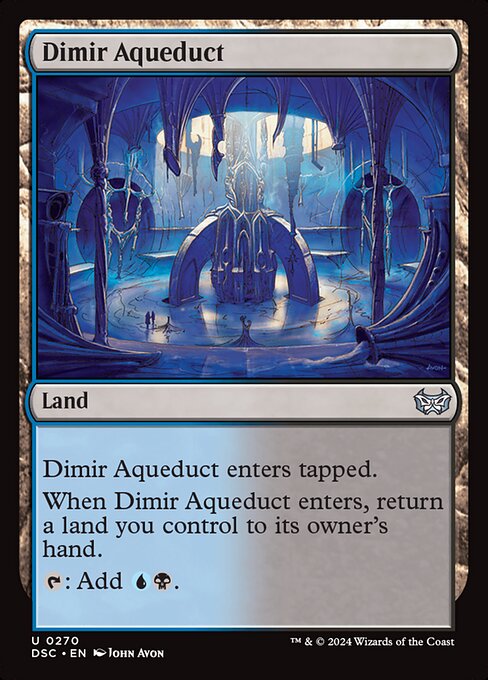
Dimir Aqueduct card

Dimir Aqueduct

Land
This land enters tapped. When this land enters, return a land you control to its owner's hand. {T}: Add {U}{B}.

Duskmourn: House of Horror Commander (DSC) · Uncommon · Illustrated by John Avon

Frequently Asked

How often is Dimir Aqueduct drawn in a Commander game?
Across 1076 tracked games where the card was in the deck, it was drawn 26% of the time. That is consistent with a singleton land in a 100-card deck. Of 288 drawn copies, 73% were cast before the game ended. The remainder were mostly held in hand when a game concluded, not voluntarily withheld.
What turn does Dimir Aqueduct usually enter the battlefield?
Median first cast is turn 4, with the 25th percentile at turn 2 and the 75th percentile at turn 6. The most common cast turn is turn 2, suggesting players frequently lead with a basic land on turn 1 and drop the Aqueduct on turn 2, bouncing that basic back to hand. Early casts on turn 1 also appear in the distribution, likely from opening-hand sequences that use the bounced land immediately.
Does casting Dimir Aqueduct correlate with winning?
In 188 participations where the Aqueduct reached the battlefield, the normalized win rate was 28%. In 668 participations where it never left the library, the win rate was 20%. The delta is +7.7 percentage points. Both sample buckets are sizable, but the confidence interval still crosses zero on this dataset, so treat it as a directional signal rather than a proven effect: the Aqueduct correlates modestly with wins when it resolves.
Is the bounce-a-land downside a real cost?
In practice, players treat the bounce clause as a feature rather than a pure drawback. Returning a tapped basic to hand sets up a replay for enters-the-battlefield triggers or resets a land that was stuck tapped. The 43% same-turn cast rate shows that roughly half of all drawn copies are cast immediately on the draw turn, with a median of 1 turn spent in hand before being played. Players are not holding it back to mitigate the downside.
Which commanders most often run Dimir Aqueduct?
Captain N'ghathrod leads the list with the highest deck count among tracked commanders, followed by Alela, Cunning Conqueror and Aminatou, Veil Piercer. The spread covers classic Dimir strategies, mill, faeries, zombies, and a handful of Esper and five-color builds. The distribution across many different commanders suggests the card earns its slot as a color fixer rather than as a synergy piece for any single strategy.
Is Dimir Aqueduct legal in Commander and Pauper Commander?
Yes to both. The card is legal in Commander, Duel Commander, Pauper Commander, Oathbreaker, Legacy, Modern, Vintage, and Premodern. It is not legal in Standard, Pioneer, Alchemy, Historic, Brawl, or Timeless. Its uncommon printing makes it ineligible for Pauper (60-card), but Pauper Commander uses a different rarity threshold for the 99, where it is legal.