
collections_bookmark Part of Commander Masters

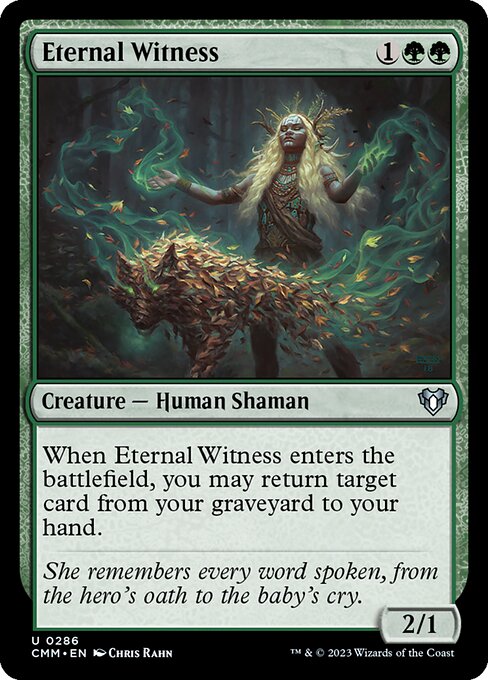
Eternal Witness card art
Live Play Data

Eternal Witness

{1} {G} {G} · Creature — Human Shaman · Commander Masters (CMM)
10%
Live Inclusion
Times Brought
638
Decks Running
347
Median Cast Turn
6
Drawn → Played
67%
Format

Eternal Witness appears in 10% of tracked Commander decks on Playgroup Live, and when drawn it reaches the battlefield 67% of the time, with a median first-cast turn of 6.

Eternal Witness sits in 10% of the 3460 distinct Commander decks tracked through live play on Playgroup Live, spread across 290 unique players. No single contributor dominates the sample: the heaviest individual account for just 4% of all tracked instances, a sign the data reflects a genuinely broad player base.

The card's core value proposition shows up in the numbers. Of 160 drawn copies, 67% reached the battlefield before the game ended, and the median first cast lands on turn 6. Players hold it an average of roughly 2 turns in hand before casting, consistent with deliberate sequencing around a relevant graveyard target. The win-rate lift when cast versus when the card stays in the library is +11.2 percentage points, an early directional signal on a well-sampled base of 106 cast observations and 445 library observations.

Eternal Witness is a mono-green uncommon and a long-standing Commander staple, valued for its enter-the-battlefield trigger that returns any card from the graveyard to hand. Its graveyard recursion slots cleanly into creature-heavy green strategies, sacrifice loops, and any deck that leans on the graveyard as a second hand. The top commander list on Playgroup Live spans green pairings from Golgari to five-color, confirming the card's format-wide reach.

At a glance
  • 10% of tracked Commander decks include Eternal Witness
  • 67% of drawn copies reached the battlefield before the game ended
  • T6 median first-cast turn across tracked games
  • 47% battlefield stickiness once cast, lower than average for a creature
  • 290 unique players have brought this card to a tracked game
  • +11.2pp win-rate lift when cast vs. when left in the library (directional)

First-cast turn

n=107
0%
T1
1%
T2
7%
T3
3%
T4
16%
T5
61%
T6-9
12%
T10+
Median 6 P25 5 · P75 8 · max 13
On curve 8% (8 / 107 cast on T3) Cast same turn as drawn 29%

The "good card" funnel

640 brought · 290 players
Brought to game
640
Ever drawn
160
Reached battlefield
107
Still on board at game end
50
67%

Of 640 copies brought to games, 160 were drawn and 107 of those were cast, with the gap between drawing and casting largely driven by players waiting for the right graveyard target.

≥ +2.6pp

Players who cast this card win 34% of the time (n=106) , vs 23% when it never left the library (n=445).

When players drew this card but left it in hand, they won 29% (n=50) — about the same as leaving it in the library. Those players survived long enough to draw it, so the gap above is about the card resolving, not just about surviving.

Observed gap +11.2pp; 95% confidence interval +2.6pp to +19.8pp. Correlational, not causal: powerful payoffs also get cast more often in games you are already winning.

Final zone distribution

178 instances
2.2%
Library
28.1%
Battlefield
39.3%
Graveyard
3.9%
Exile

Most observed copies of Eternal Witness end the game in the graveyard or on the battlefield, a sharp contrast to the typical singleton that simply never leaves the library. That pattern reflects how actively players sequence and recur this card.

Commanders that played this card

in tracked games

The top-commander list spans more than six distinct color pairs, from mono-green to five-color, confirming that Eternal Witness is not a build-around card for one archetype but a broadly adopted green staple.

Frequently Asked

How often is Eternal Witness drawn in a Commander game?
Across 593 tracked multiplayer games where Eternal Witness was in the deck, it was drawn 25% of the time. That figure is typical for a singleton in a 100-card deck. Of 160 copies that reached a player's hand, 67% were cast before the game concluded. The rest went uncast, most likely because the game ended before a casting opportunity arose.
What turn does Eternal Witness typically hit the battlefield?
The median first-cast turn in Playgroup Live data is 6, and the distribution clusters between turns 5 and 8. Eternal Witness costs 3 mana, so most casts land well after the card's mana value would suggest, reflecting the reality that players are waiting for a meaningful graveyard target rather than slamming it as soon as they have the mana. The same-turn cast rate is 29%, meaning most players hold it at least one turn after drawing it.
Does casting Eternal Witness actually improve your win rate?
In 106 tracked participations where Eternal Witness was cast, the normalized win rate was 34%. In 445 participations where it stayed in the library, the win rate was 23%. That is a +11.2 percentage-point delta. Both sample buckets are reasonably sized, so this is a consistent directional signal, but Playgroup Live's dataset is still growing and we would not call it conclusive.
Is Eternal Witness legal in Commander?
Yes. Eternal Witness is legal in Commander, Duel Commander, Legacy, Modern, Vintage, Historic, Timeless, and several other formats. It is not legal in Pioneer, Standard, Pauper, Pauper Commander, or Alchemy. It is not banned in any format where it is legal.
Which commanders most often run Eternal Witness in tracked games?
In Playgroup Live's multiplayer Commander data, the top commanders paired with Eternal Witness include Meren of Clan Nel Toth (14 decks), Aesi, Tyrant of Gyre Strait (10 decks), and Yarok, the Desecrated (8 decks). The list spans Golgari, Simic, Sultai, Jund, and five-color shells, showing the card is not locked into any single archetype. Meren leads the count, which makes sense given her graveyard synergy with Eternal Witness's enter-the-battlefield trigger.
How concentrated is the Eternal Witness data across players?
The data is well distributed. 290 distinct players have brought Eternal Witness to a tracked game, and the single heaviest contributor accounts for just 4% of all instances. That low concentration is a meaningful strength of this dataset: the numbers reflect broad play patterns rather than one or two prolific users skewing the sample.