
collections_bookmark Part of Commander Masters
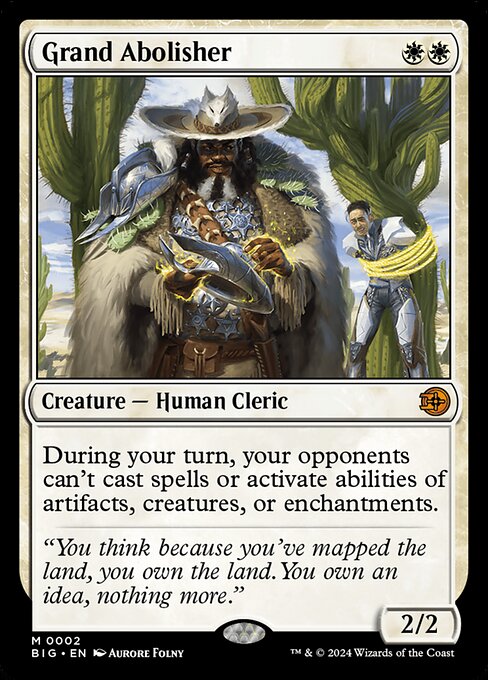
Grand Abolisher card art
Live Play Data

Grand Abolisher

{W} {W} · Creature — Human Cleric · The Big Score (BIG)
7%
Live Inclusion
Times Brought
854
Decks Running
424
Median Cast Turn
5.0
Drawn → Played
71%
Format

71% of drawn Grand Abolishers are cast before the game ends, and decks that resolved it posted a 29% win rate across 138 tracked participations on Playgroup Live.

Grand Abolisher sits in 7% of tracked Commander decks on Playgroup Live, a focused White staple whose 2-mana cost and disruptive ability make it a natural fit for White-heavy combo and control shells. Of the 200 times it has been drawn across 779 tracked games, 71% reached the battlefield.

The card's effect is straightforward and powerful: during your turn, opponents cannot cast spells or activate artifact, creature, or enchantment abilities. That makes it one of the cleanest ways to protect a combo turn in Commander. The median first-cast turn of 5.0 reflects that players tend to wait for the right moment rather than slamming it into open countermagic. The hand-to-cast data backs this up: drawn copies sit in hand for a median of 1 turn before being played, and only 34% are cast on the exact turn they are drawn.

The win-rate picture is directional. Participations where Grand Abolisher was cast show a 29% normalized win rate versus 25% when it remained in the library, a +3.8 percentage-point gap. Both buckets are reasonably sampled, but the dataset is still growing, so treat this as an early signal rather than a settled conclusion. The commander spread is healthy: 313 distinct players have brought the card to a tracked game, and no single contributor accounts for more than a small share of instances.

At a glance
  • 7% of tracked Commander decks include Grand Abolisher
  • 71% of drawn copies reach the battlefield before the game ends
  • T5.0 median first-cast turn
  • 51% battlefield stickiness once cast
  • +3.8pp win-rate lift when cast versus when it stays in the library
  • 313 distinct players have brought Grand Abolisher to a tracked game

First-cast turn

n=142
6%
T1
13%
T2
9%
T3
17%
T4
13%
T5
34%
T6-9
9%
T10+
Median 5.0 P25 3 · P75 7 · max 17
On curve 18% (18 / 142 cast on T2) Cast same turn as drawn 34%

The "good card" funnel

854 brought · 313 players
Brought to game
854
Ever drawn
200
Reached battlefield
142
Still on board at game end
72
71%

Of 854 Grand Abolishers brought to tracked games, 200 were drawn, 142 of those were cast, and roughly half of resolved copies stayed on the battlefield through the end of the game.

≥ -3.8pp

Players who cast this card win 29% of the time (n=138) , vs 25% when it never left the library (n=579).

When players drew this card but left it in hand, they won 25% (n=54) — about the same as leaving it in the library. Those players survived long enough to draw it, so the gap above is about the card resolving, not just about surviving.

Observed gap +3.8pp; 95% confidence interval -3.8pp to +11.4pp. Correlational, not causal: powerful payoffs also get cast more often in games you are already winning.

Final zone distribution

222 instances
2.3%
Library
32.4%
Battlefield
28.4%
Graveyard
14.9%
Exile

Most undrawn Grand Abolishers never leave the library, which is a structural feature of 100-card singleton rather than a statement about the card's power. The copies that do resolve show a meaningful battlefield presence.

Commanders that played this card

in tracked games

Kaalia of the Vast leads at 16 decks, but the list spans mono-White aggro, Esper control, and five-color piles, showing that Grand Abolisher's appeal extends across any strategy that can run White and wants a protected turn.

Frequently Asked

How often is Grand Abolisher drawn in a Commander game?
Across 779 tracked games where Grand Abolisher was in the deck, it was drawn 23% of the time. That is consistent with what you expect for a singleton in a 100-card deck. Of 200 drawn copies, 71% were cast before the game concluded. The remainder were largely instances where the game ended before the player found the right window.
What turn does Grand Abolisher typically get cast?
Median first-cast turn is 5.0. The mode in the cast distribution sits at turn 4, but the spread is wide: the 25th percentile lands on turn 3 and the 75th on turn 8. That range reflects how context-dependent the card is. Players protecting a combo line will deploy it as soon as the mana is available, while others hold it until their critical turn.
Does casting Grand Abolisher actually improve win rate?
Early data is directional. Participations where Grand Abolisher was cast show a 29% normalized win rate, compared with 25% for participations where it stayed in the library. That is a +3.8 percentage-point gap. With 138 cast observations and 579 library observations, the signal is consistent but not yet conclusive. Read it as a positive early indicator.
Which commanders most often run Grand Abolisher?
On Playgroup Live, Kaalia of the Vast leads with 16 decks, followed by Y'shtola, Night's Blessed at 12 and Oloro, Ageless Ascetic at 10. The common thread is White access and a combo or high-value creature plan that benefits from a protected turn. The spread across 313 unique players and many different commanders suggests the card is not propped up by one dedicated builder.
Is Grand Abolisher legal in Commander?
Yes. Grand Abolisher is legal in Commander, as well as in Legacy, Modern, Pioneer, Vintage, Historic, and several other formats. It is not legal in Pauper or Pauper Commander due to its mythic rarity. It is also not legal in PreDH, which cuts off at a set publication date before the card's printing.
How sticky is Grand Abolisher once it hits the battlefield?
51% of cast copies finish the game on the battlefield. That is a moderate stickiness number for a 2-mana creature in Commander, where removal and board wipes are common. A meaningful share ends up in the graveyard or exile, reflecting the threat it poses once opponents recognize it is protecting a combo turn. Players who resolve it at the right moment often win before opponents can answer it.