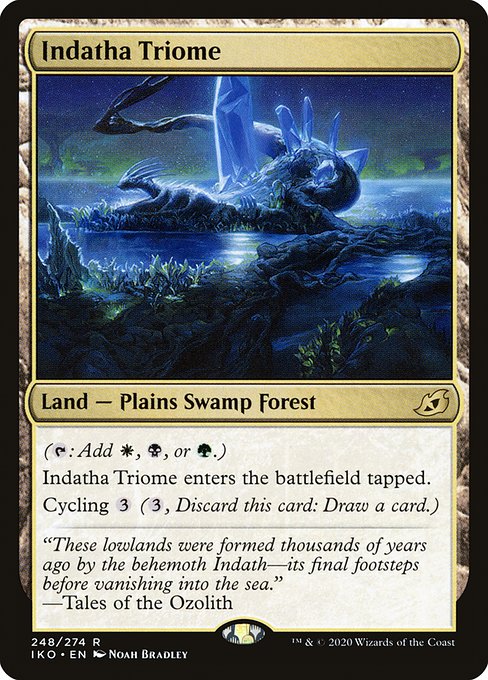
Indatha Triome card art
Live Play Data

Indatha Triome

Land — Plains Swamp Forest · Ikoria: Lair of Behemoths (IKO)
22%
Live Inclusion
Times Brought
836
Decks Running
374
Median Cast Turn
3
Drawn → Played
84%
Format

Indatha Triome is in 22% of tracked Commander decks on Playgroup Live. When drawn, 84% of copies are played before the game ends, with a median first-cast turn of 3.

Indatha Triome sits in 22% of Commander decks tracked on Playgroup Live, appearing across 374 of 1687 distinct decks that have played a recorded game. That makes it a reliable fixture in any White-Black-Green shell and in the many five-color piles that happen to touch all three colors.

The key behavioral number is draw-to-play: 84% of drawn copies are played before the game ends. That figure is high for a tapped land. It reflects both how immediately useful a three-color fixer is and how readily players snap it onto the table even at the cost of entering tapped. Median first play lands on turn 3, with the distribution skewed early by players who keep it in their opening hand.

The cycling clause is the card's safety valve. A Triome stuck late in the game can convert into a fresh draw rather than sit as a redundant land drop. That flexibility almost certainly drives the strong draw-to-play rate. The commander spread here tilts heavily toward five-color strategies, which need every three-color fixer they can get.

At a glance
  • 22% of tracked Commander decks include Indatha Triome
  • 84% of drawn copies are played before the game ends
  • T3 median first-play turn
  • 89% battlefield stickiness once played
  • 348 distinct players have brought Indatha Triome to a tracked game, a well-spread dataset
  • 34% draw rate per game where it is in the deck

First-cast turn

n=243
29%
T1
16%
T2
10%
T3
7%
T4
11%
T5
21%
T6-9
6%
T10+
Median 3 P25 1 · P75 6 · max 15
Cast same turn as drawn 70%

The "good card" funnel

838 brought · 348 players
Brought to game
838
Ever drawn
288
Reached battlefield
243
Still on board at game end
216
84%

Of 838 Indatha Triomes brought to tracked games, 288 were drawn, 243 of those were played onto the battlefield, and the large majority stayed there through end of game.

≥ +1.6pp

Players who cast this card win 32% of the time (n=224) , vs 24% when it never left the library (n=447).

When players drew this card but left it in hand, they won 31% (n=37) — about the same as leaving it in the library. Those players survived long enough to draw it, so the gap above is about the card resolving, not just about surviving.

Observed gap +8.2pp; 95% confidence interval +1.6pp to +14.8pp. Correlational, not causal: powerful payoffs also get cast more often in games you are already winning.

Final zone distribution

311 instances
5.5%
Library
69.5%
Battlefield
13.5%
Graveyard
3.2%
Exile

The vast majority of Indatha Triome copies end the game on the battlefield after being played as a land, with relatively few left unplayed in the library. That's consistent with a fixer you slot in and use immediately rather than hold.

Commanders that played this card

in tracked games

Five-color strategies dominate the commander list, with Tom Bombadil and The Ur-Dragon leading, reflecting that the Triome's three-color coverage is most valuable in the broadest color identities.

Card text
Indatha Triome card

Indatha Triome

Land — Plains Swamp Forest
({T}: Add {W}, {B}, or {G}.) This land enters tapped. Cycling {3} ({3}, Discard this card: Draw a card.)

Ikoria: Lair of Behemoths (IKO) · Rare · Illustrated by Noah Bradley

Frequently Asked

How often is Indatha Triome drawn in a Commander game?
Across 790 tracked multiplayer games where Indatha Triome was in the deck, it was drawn 34% of the time. That rate is typical for a singleton in a 100-card deck. Of the 288 instances that reached a hand, 84% were played before the game ended. The cycling ability means a late-drawn copy can convert into a fresh card rather than sit unused, which likely contributes to that high play rate.
What turn does Indatha Triome usually hit the battlefield?
Median first-play turn is 3 in multiplayer games. The distribution is front-loaded: a cluster of copies land on turn 1 from opening hands, then another wave arrives in turns 5-7 from mid-game draws. The mean sits above the median because occasional very late plays pull it upward. In Playgroup Live's duel data the median is turn 2, reflecting the faster pace of two-player games.
Is the win-rate lift when Indatha Triome is cast meaningful?
In 224 observed participations where the card was played, the normalized win rate is 32%, compared to 24% in participations where it stayed in the library. That gap is +8.2 percentage points and is a directional positive signal. Both buckets have healthy sample sizes, which gives the number more weight than many individual-card signals on Playgroup Live, but call it encouraging rather than conclusive. Color fixing alone is rarely the deciding factor in a win.
Is Indatha Triome legal in Commander?
Yes. Indatha Triome from Ikoria: Lair of Behemoths is legal in Commander, Legacy, Modern, Pioneer, Vintage, and several other formats. It is not legal in Standard, Pauper, or Pauper Commander. In Commander specifically it counts as a Plains, Swamp, and Forest simultaneously, which means it interacts with basic-land tutors like Farseek in those formats that allow it.
Which commanders most often run Indatha Triome?
The top commanders on Playgroup Live are five-color strategies: Tom Bombadil, The Ur-Dragon, The First Sliver, Esika, and Atraxa all appear near the top. Abzan (White-Black-Green) commanders like Betor, Ancestor's Voice and Felothar the Steadfast also show strong representation. That split makes sense: the Triome produces exactly Abzan's three colors and slots cleanly into five-color piles as one of the most efficient three-color fixers available.
How concentrated is the Indatha Triome data among a few players?
The dataset is well-spread. 348 distinct players have brought Indatha Triome to a tracked game, and the single heaviest contributor accounts for only 3% of all instances. That spread reduces the risk of one player's preferences skewing the aggregate numbers, and it is one of the stronger aspects of the current dataset for this card.