collections_bookmark Part of Modern Horizons 3
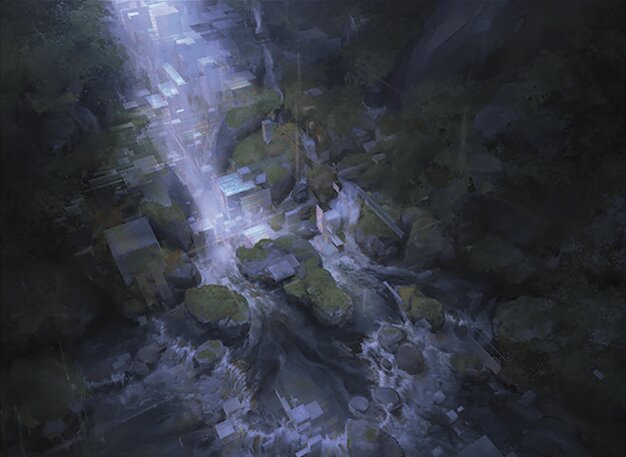
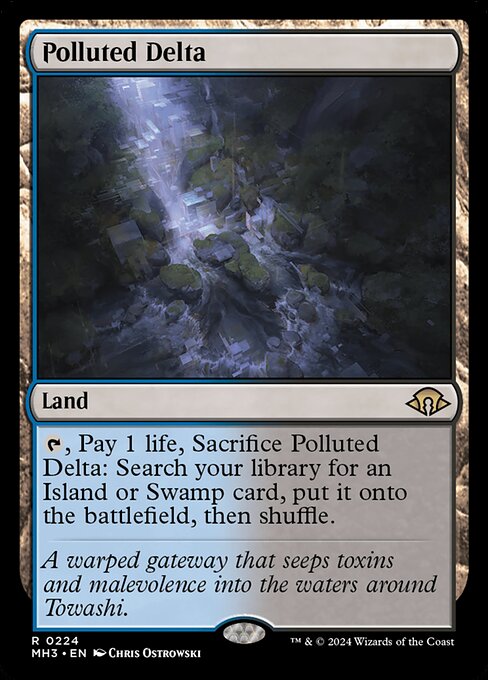
Polluted Delta card art
Live Play Data

Polluted Delta

Land · Modern Horizons 3 (MH3)
10%
Live Inclusion
Times Brought
1655
Decks Running
861
Median Cast Turn
4.0
Drawn → Played
67%
Format

Polluted Delta lands in 10% of tracked Commander decks and, when drawn, reaches the battlefield 67% of the time, with a median first-use turn of 4.0.

Polluted Delta sits in 10% of the 8540 Commander decks tracked on Playgroup Live, appearing across 861 distinct lists. That number covers only decks with a Blue or Black color identity, so the penetration rate within eligible archetypes is considerably higher than the headline figure suggests.

As a fetch land, Polluted Delta behaves differently from almost any other card in the format. It enters the battlefield and immediately sacrifices itself to find an Island or Swamp, which means its "stickiness" metric is structurally near zero by design, not by weakness. The 67% draw-to-play rate tells the real story: when players draw it, it resolves quickly. The median first-use turn is 4.0, and the mode is turn 1, reflecting how many players keep opening hands that contain it and fire it immediately to thin the deck and fix mana.

The commander distribution is broad. 518 distinct players have brought Polluted Delta to tracked games, and no single player accounts for more than a small fraction of the dataset, which gives the numbers here reasonable spread across archetypes ranging from five-color goodstuff to tight Dimir control builds.

At a glance
  • 10% of tracked Commander decks include Polluted Delta
  • 67% of drawn copies reach the battlefield before the game ends
  • T4.0 median first-use turn, with turn 1 as the single most common cast turn
  • 26% draw rate per game, consistent with a singleton in a 100-card deck
  • 518 distinct players have brought this card to a tracked game, showing broad spread
  • 1656 total instances brought to tracked games across all participations

First-cast turn

n=284
27%
T1
15%
T2
7%
T3
11%
T4
11%
T5
25%
T6-9
4%
T10+
Median 4.0 P25 1 · P75 6 · max 14
Cast same turn as drawn 58%

The "good card" funnel

1656 brought · 518 players
Brought to game
1656
Ever drawn
425
Reached battlefield
284
Still on board at game end
24
67%

Of 1656 Polluted Deltas brought to tracked games, 425 were drawn, 284 of those were activated, and the overwhelming majority moved immediately to the graveyard as the fetch resolved.

≥ +3.1pp

Players who cast this card win 34% of the time (n=271) , vs 25% when it never left the library (n=1100).

When players drew this card but left it in hand, they won 33% (n=138) — about the same as leaving it in the library. Those players survived long enough to draw it, so the gap above is about the card resolving, not just about surviving.

Observed gap +8.5pp; 95% confidence interval +3.1pp to +13.9pp. Correlational, not causal: powerful payoffs also get cast more often in games you are already winning.

Final zone distribution

490 instances
3.5%
Library
4.9%
Battlefield
64.3%
Graveyard
10.8%
Exile

The graveyard dominates Polluted Delta's final-zone chart by design. Every activation sends it there directly, so the library figure represents copies that were never drawn and the battlefield count is near zero, which is exactly how a fetch land is supposed to behave.

Commanders that played this card

in tracked games

The Ur-Dragon leads at 28 decks, but the list spans five-color goodstuff, Dimir control, and Esper midrange, reflecting how evenly Polluted Delta distributes across any archetype that touches Island or Swamp.

Frequently Asked

How often is Polluted Delta drawn in a Commander game?
Across 1236 tracked multiplayer games where Polluted Delta was in the deck, it was drawn 26% of the time. That rate is typical for a singleton in a 100-card deck. Of those 425 drawn copies, 67% were used before the game ended. The relatively quick turnaround reflects how rarely players hold a fetch land in hand for long once they have a fetchable land to grab.
What turn does Polluted Delta usually get used?
The median first-use turn is 4.0, but the distribution is skewed heavily toward early turns. Turn 1 is the single most common activation point, driven by players who keep opening hands containing the fetch and crack it immediately for mana fixing and deck thinning. The interquartile range runs from turn 1 through turn 6, meaning half of all activations happen in that window.
Why is Polluted Delta's battlefield stickiness so low?
Polluted Delta sacrifices itself as part of its own activation. It enters the battlefield, taps, costs 1 life, and goes to the graveyard in the same action that puts a land into play. A near-zero stickiness reading is the expected outcome for any fetch land, not a sign of the card being removed by opponents. The graveyard is the normal final destination for a resolved Polluted Delta.
Does casting Polluted Delta correlate with winning?
In 271 participations where Polluted Delta was used, the normalized win rate was 34%. In 1100 participations where it stayed in the library, the win rate was 25%. The +8.5 percentage-point gap is a directional early signal that activating the fetch correlates with better outcomes, likely because it indicates the deck is functioning and fixing its mana. Both sample sizes are large enough to treat this as meaningful, though broader dataset growth will sharpen the picture.
Which commanders most commonly run Polluted Delta?
The Ur-Dragon leads the top-commanders list with 28 decks in the tracked dataset, reflecting five-color Dragon builds that want consistent access to blue and black mana. Esika, Kenrith, and other five-color commanders follow. Tight two-color Dimir commanders like Wilhelt, the Rotcleaver and Yuriko, the Tiger's Shadow also appear prominently. The spread across archetypes is wide, which is consistent with the card's colorless identity making it splashable in any deck that needs Islands or Swamps.
Is Polluted Delta legal in Commander?
Yes. Polluted Delta is legal and unrestricted in Commander, as well as in Legacy, Modern, Vintage, Duel Commander, and several other formats. It is banned in Pioneer and Historic, where its combination of mana fixing and deck thinning was deemed too powerful for those environments. In Commander its colorless color identity means it slots into any deck, though its functional value is concentrated in builds that run Islands and Swamps.