auto_awesome #25 in Colorless Commander Staples
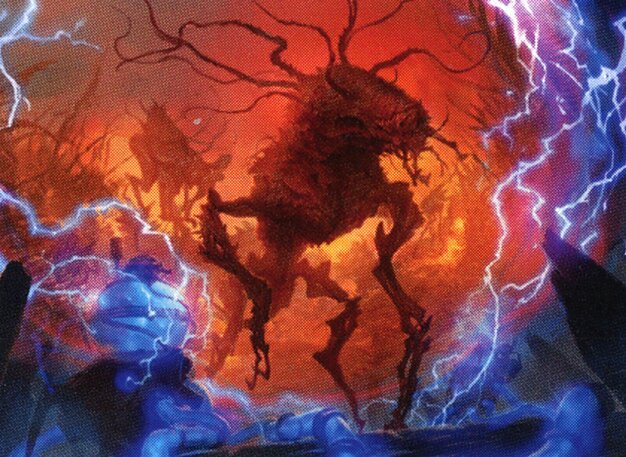
Portal to Phyrexia card art
Live Play Data

Portal to Phyrexia

{9} · Artifact · The Brothers' War (BRO)
2%
Live Inclusion
Times Brought
583
Decks Running
301
Median Cast Turn
7
Drawn → Played
70%
Format

48% of tracked games where Portal to Phyrexia resolved ended in a win for its controller. That's +24.7 percentage points above the baseline win rate when it stayed in the library.

Portal to Phyrexia is a 9-mana colorless artifact from The Brothers' War that enters demanding three creature sacrifices from each opponent, then reanimates a creature from any graveyard every upkeep. On Playgroup Live, 48% of participations where it reached the battlefield ended in a win for its controller, a +24.7-point lift over the 24% baseline recorded when the card never left the library.

That delta rests on 100 cast observations and 382 library observations, enough to clear the lower bound of the confidence interval above zero. The direction is clear: when Portal resolves, the game tilts hard toward the caster. Median first cast lands on turn 7, and 85% of casts arrived ahead of the card's natural 9-mana curve, reflecting how heavily ramp-dependent decks accelerate into it.

Portal to Phyrexia is colorless, so it slots into any Commander deck. Its natural home is high-CMC ramp strategies. The top commander associations on Playgroup Live skew toward colorless and artifact-matters commanders, consistent with the card's reputation as a finisher for big-mana shells.

At a glance
  • 48% win rate when Portal to Phyrexia resolves
  • +24.7pp win-rate lift over the library baseline
  • T7 median first-cast turn
  • 70% of drawn copies reach the battlefield
  • 71% battlefield stickiness once cast
  • 85% of casts landed ahead of the 9-mana curve via ramp

First-cast turn

n=107
1%
T1
0%
T2
2%
T3
6%
T4
10%
T5
66%
T6-9
15%
T10+
Median 7 P25 6 · P75 8 · max 13
On curve 85% (6 / 107 cast on T9) Cast same turn as drawn 41%

The "good card" funnel

583 brought · 262 players
Brought to game
583
Ever drawn
152
Reached battlefield
107
Still on board at game end
76
70%

Of 583 Portal to Phyrexias brought to games, 152 were drawn and 107 of those were cast, with 71% sticking on the battlefield through the end of the game.

≥ +15.3pp

Players who cast this card win 48% of the time (n=100) , vs 24% when it never left the library (n=382).

When players drew this card but left it in hand, they won 23% (n=42) — about the same as leaving it in the library. Those players survived long enough to draw it, so the gap above is about the card resolving, not just about surviving.

Observed gap +24.7pp; 95% confidence interval +15.3pp to +34.1pp. Correlational, not causal: powerful payoffs also get cast more often in games you are already winning.

Final zone distribution

168 instances
3.0%
Library
45.2%
Battlefield
18.5%
Graveyard
7.1%
Exile

Most tracked copies of Portal to Phyrexia end games on the battlefield or in hand, a contrast to low-CMC cards where the library dominates the final-zone chart.

Commanders that played this card

in tracked games

Colorless commanders dominate the top slots, with Ultron and Zhulodok leading. The spread across more than ten distinct commanders signals that Portal fits multiple archetypes rather than a single niche.

Card text
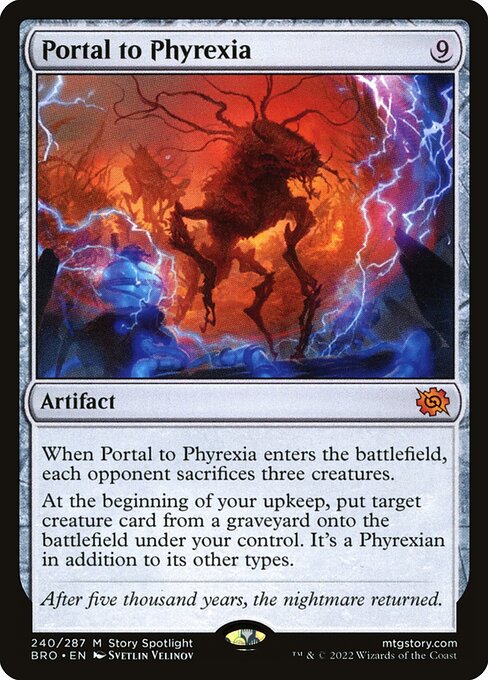
Portal to Phyrexia card

Portal to Phyrexia

{9}
Artifact
When this artifact enters, each opponent sacrifices three creatures of their choice. At the beginning of your upkeep, put target creature card from a graveyard onto the battlefield under your control. It's a Phyrexian in addition to its other types.
The Brothers' War (BRO) · Mythic · Illustrated by Svetlin Velinov

Frequently Asked

How often does Portal to Phyrexia win the game when it resolves?
In 100 tracked participations where Portal to Phyrexia reached the battlefield, the controller won 48% of the time on a 4-player normalized basis. Participations where it stayed in the library show a 24% win rate across 382 observations. The +24.7-point delta is the clearest single signal in the data that casting this card meaningfully shifts game outcomes.
What turn does Portal to Phyrexia usually get cast?
Median first cast lands on turn 7, with the interquartile range spanning turns 6 to 8. 85% of casts arrived earlier than the card's 9-mana cost would suggest. That's almost entirely a ramp effect. Decks running Portal lean heavily on mana acceleration to pull it forward by two or three turns. The hand-to-cast median confirms players sit on it for a couple of turns after drawing it before they have the mana to fire.
How often is Portal to Phyrexia drawn and cast once drawn?
Portal is drawn 26% of the time across tracked games, consistent with a singleton in a 100-card deck. Of drawn copies, 70% were cast before the game ended. The same-turn cast rate is 41%, meaning most players wait at least a turn after drawing it. The 9-mana cost is the obvious reason: players draw it before they can afford it and hold it until they can.
Is Portal to Phyrexia banned anywhere?
Portal to Phyrexia is legal in Commander, Legacy, Modern, Pioneer, Vintage, Historic, Timeless, Duel Commander, Gladiator, Brawl, Oathbreaker, and Competitive Brawl. It is not legal in Standard, Pauper, or Pauper Commander. It carries no bans in any format where it is currently legal.
How sticky is Portal to Phyrexia once it hits the battlefield?
71% of cast copies were still on the battlefield at the game's end. That's a reasonable stickiness figure for a 9-mana artifact with no built-in protection. When it does leave play before the game ends, graveyard and exile are roughly comparable exit routes based on the final-zone distribution. Removal exists, but opponents who have already sacrificed three creatures to the ETB trigger often can't threaten it immediately.
Which commanders most often run Portal to Phyrexia?
The top commander associations on Playgroup Live are Ultron, Artificial Malevolence and Zhulodok, Void Gorger, both colorless commanders that reward high-mana artifacts. Molecule Man and Tony Stark also appear prominently. The spread across 262 unique players, with no single player exceeding 26% of all tracked instances, suggests the data reflects a genuine cross-section of Portal pilots rather than one prolific ringer.