
collections_bookmark Part of Commander Masters
Read the Bones card art
Live Play Data

Read the Bones

{2} {B} · Sorcery · Duskmourn: House of Horror Commander (DSC)
5%
Live Inclusion
Times Brought
832
Decks Running
476
Median Cast Turn
5.5
Drawn → Played
63%
Format

5% of tracked Commander decks run Read the Bones. When drawn, 63% of copies reach the cast step, with a median first-cast turn of 5.5.

Read the Bones is a common-rarity black sorcery that punches well above its price tag: scry 2, draw 2, lose 2 life for three mana. 5% of the 9766 tracked Commander decks on Playgroup Live run it, spread across 476 distinct lists.

The data is well-spread. 419 unique players have brought the card to a tracked game, and the single heaviest contributor accounts for just 1% of all instances. That breadth gives the directional signals here more weight than they would carry from a narrow sample. When a copy enters a player's hand, 63% of those copies are cast before the game ends. Median first cast lands on turn 5.5, squarely in the midgame where black decks are looking to refuel.

Read the Bones occupies the budget slot in the black card-draw hierarchy. Decks that want Sign in Blood effects at common rarity, or that have synergies with life-loss (Sheoldred, the Apocalypse is the top commander home in this dataset), reach for it consistently. It is legal in Commander, Legacy, Modern, Pioneer, Pauper, and Pauper Commander, among others.

At a glance
  • 5% of tracked Commander decks include Read the Bones
  • 23% draw rate across tracked game participations
  • 63% of drawn copies are cast before the game ends
  • T5.5 median first-cast turn
  • 419 unique players have brought this card to a tracked game
  • 120 total casts recorded across all tracked games

First-cast turn

n=120
1%
T1
4%
T2
16%
T3
18%
T4
12%
T5
43%
T6-9
8%
T10+
Median 5.5 P25 4 · P75 8 · max 14
On curve 21% (19 / 120 cast on T3) Cast same turn as drawn 30%

The "good card" funnel

835 brought · 419 players
Brought to game
835
Ever drawn
189
Reached battlefield
120
Still on board at game end
2
63%

Of 835 copies brought to tracked games, 189 were drawn, 120 of those were cast, and nearly all resolved copies went straight to the graveyard as expected for a sorcery.

≥ -3.2pp

Players who cast this card win 25% of the time (n=116) , vs 21% when it never left the library (n=537).

When players drew this card but left it in hand, they won 24% (n=60) — about the same as leaving it in the library. Those players survived long enough to draw it, so the gap above is about the card resolving, not just about surviving.

Observed gap +4.6pp; 95% confidence interval -3.2pp to +12.4pp. Correlational, not causal: powerful payoffs also get cast more often in games you are already winning.

Final zone distribution

211 instances
3.3%
Library
0.9%
Battlefield
63.5%
Graveyard
8.5%
Exile

The overwhelming majority of Read the Bones copies end the game in the graveyard, exactly where a resolved sorcery belongs. The handful remaining in hand or exile reflect late draws and occasional exile effects.

Commanders that played this card

in tracked games

Sheoldred, the Apocalypse leads with 19 decks, followed by a cluster of aggressive black and black-adjacent strategies. The spread across 10 distinct commanders suggests broad adoption rather than niche synergy.

Card text
Read the Bones card

Read the Bones

{2} {B}
Sorcery
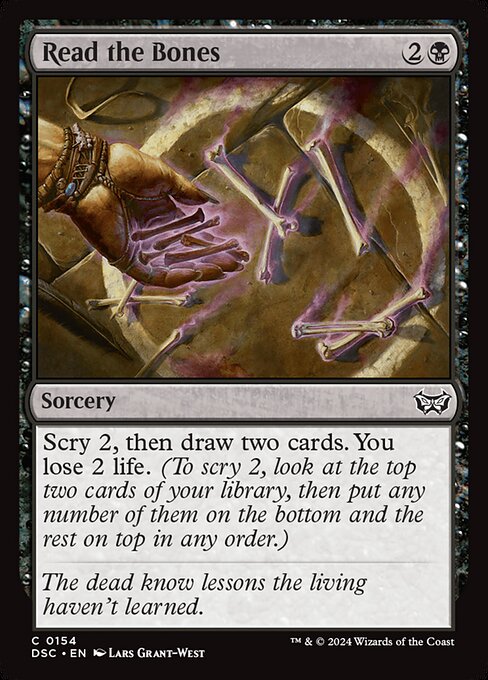
Scry 2, then draw two cards. You lose 2 life. (To scry 2, look at the top two cards of your library, then put any number of them on the bottom and the rest on top in any order.)
Duskmourn: House of Horror Commander (DSC) · Common · Illustrated by Lars Grant-West

Frequently Asked

How often is Read the Bones drawn in a Commander game?
In 805 tracked multiplayer Commander games where Read the Bones was in the deck, the draw rate is 23%. That is typical for a singleton in a 100-card deck. Of 189 instances that reached a player's hand, 63% were cast before the game concluded. The remainder were mostly copies drawn in the late game where time ran out before they could be cast.
What turn does Read the Bones typically get cast?
Median first cast is turn 5.5, with the middle 50% of casts landing between turn 4 and turn 8. The distribution shows a cluster in turns 3 and 4, which lines up with players casting it on curve, and a secondary cluster around turns 7-9 as drawn-late copies hit the board. Only 21% of casts land exactly on curve, which mostly reflects that the card is often drawn after its mana value turn rather than held deliberately.
Does casting Read the Bones actually help you win?
The cast win rate is 25% (across 116 participations), compared to 21% when the card stayed in the library. The raw delta is directional but small, and the confidence interval at this sample size crosses zero. Read it as an early signal that casting it does not hurt and may help, rather than a definitive causal claim. Both buckets have healthy sample sizes, so the picture will sharpen as more games are logged.
Which commanders play Read the Bones most often?
Sheoldred, the Apocalypse leads with 19 tracked decks, which makes sense: Sheoldred rewards life-loss effects, turning the 2-life cost of Read the Bones into a mild upside for opponents and a card-draw engine for you. Edgar Markov (14 decks), Kaalia of the Vast (13 decks), and Kardur, Doomscourge (13 decks) round out the top four. The spread across aggressive black and black-adjacent strategies confirms the card's role as a flexible refueling tool.
Is Read the Bones banned anywhere?
Read the Bones is legal in Commander, Pauper Commander, Legacy, Modern, Pioneer, Pauper, Vintage, Duel Commander, Brawl, Historic, Gladiator, Timeless, and Oathbreaker. It is not legal in Standard or Penny Dreadful. There are no bans or restrictions on this card in any of the formats where it is available.
How concentrated is this card's play data among specific players?
The concentration numbers are a clear strength of this dataset. 419 distinct players have brought Read the Bones to a tracked game on Playgroup Live, and the single heaviest contributor accounts for only 1% of all instances. With that spread, the statistics are not being skewed by one or two power users running the card in dozens of games. The draw rate, cast turn, and win-rate figures reflect a broad cross-section of the tracked player base.