
collections_bookmark Part of Duskmourn: House of Horror
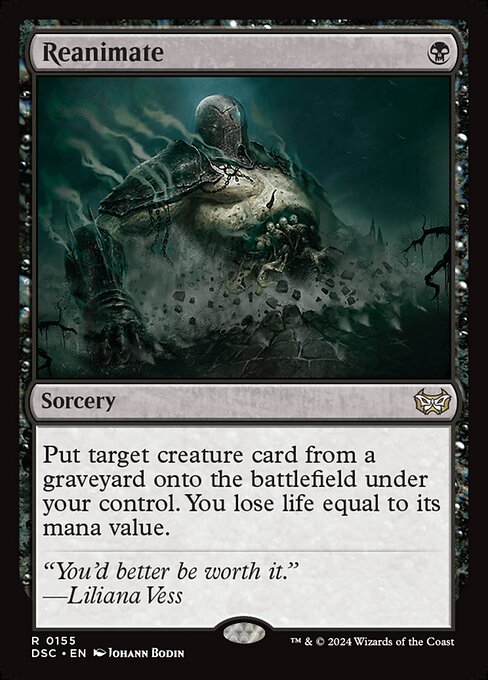
Reanimate card art
Live Play Data

Reanimate

{B} · Sorcery · Duskmourn: House of Horror Commander (DSC)
17%
Live Inclusion
Times Brought
789
Decks Running
458
Median Cast Turn
6
Drawn → Played
57%
Format

Reanimate sits in 17% of tracked Commander decks on Playgroup Live, resolves at a median turn of 6, and is cast 57% of the time it reaches a player's hand.

Reanimate is one of the oldest and most efficient reanimation spells in Magic: a single black mana to steal any creature from any graveyard, offset only by a life payment equal to the target's mana value. On Playgroup Live, 17% of tracked Commander decks run it, spread across 458 distinct lists and 348 unique players, with no single player accounting for more than 4% of tracked instances.

The median first-cast turn is 6, which reflects the card's actual gameplay: Reanimate is almost never cast the moment it's drawn. The hand-to-cast median is 2 turns of waiting, and 32% of drawn copies are cast on the same turn they arrive. Players are holding it for the right graveyard target rather than slamming it immediately. Of all copies drawn, 57% eventually reach the stack before the game ends.

As a one-mana black sorcery with no color identity restrictions beyond black, Reanimate slots cleanly into any black Commander deck that expects creatures in graveyards. Its top commanders on Playgroup Live range from value-grind strategies like Henzie "Toolbox" Torre to high-powered lists like K'rrik, Son of Yawgmoth, confirming it as a tool that scales with the power level of its targets rather than demanding a specific archetype.

At a glance
  • 17% of tracked Commander decks include Reanimate
  • T6 median first-cast turn across tracked games
  • 57% of drawn copies reach the stack before the game ends
  • 32% of drawn copies are cast the same turn they are drawn
  • 348 unique players have brought Reanimate to a tracked game
  • 27% normalized win rate in games where Reanimate resolved

First-cast turn

n=111
2%
T1
0%
T2
5%
T3
9%
T4
17%
T5
61%
T6-9
6%
T10+
Median 6 P25 5 · P75 8 · max 17
On curve 2% (2 / 111 cast on T1) Cast same turn as drawn 32%

The "good card" funnel

799 brought · 348 players
Brought to game
799
Ever drawn
194
Reached battlefield
111
Still on board at game end
5
57%

Of 799 Reanimates brought to games, 194 were drawn, 111 of those were cast, and the large drop from brought to drawn is normal for a singleton in a 100-card deck.

≥ -3.7pp

Players who cast this card win 27% of the time (n=111) , vs 23% when it never left the library (n=526).

When players drew this card but left it in hand, they won 20% (n=78) — about the same as leaving it in the library. Those players survived long enough to draw it, so the gap above is about the card resolving, not just about surviving.

Observed gap +4.6pp; 95% confidence interval -3.7pp to +12.9pp. Correlational, not causal: powerful payoffs also get cast more often in games you are already winning.

Final zone distribution

236 instances
3.8%
Library
2.1%
Battlefield
58.1%
Graveyard
10.2%
Exile

Reanimate resolves to the graveyard by design, so the final-zone chart is dominated by graveyard finishes. Most copies in the library simply were never drawn, a structural reality of 100-card singleton.

Commanders that played this card

in tracked games

Seventeen different commanders appear in the top-ten list and no single commander dominates, which reflects how broadly Reanimate fits across black strategies rather than belonging to one archetype.

Frequently Asked

How often is Reanimate drawn in a Commander game?
Across 687 tracked games where Reanimate was in the deck, it was drawn 24% of the time. That is consistent with typical singleton draw rates in a 100-card deck. Of 194 instances that reached a player's hand, 57% were cast before the game concluded. The remainder reflects copies drawn late enough that the game ended first, or situations where no suitable target existed in any graveyard.
What turn does Reanimate typically resolve?
The median first-cast turn is 6, with the 25th percentile at turn 5 and the 75th percentile at turn 8. The distribution clusters around turns 5 through 7. That mid-game timing makes sense: players are usually waiting for a high-value creature to hit a graveyard before pulling the trigger. The same-turn cast rate of 32% confirms most players hold it for the right moment rather than casting it immediately.
Does casting Reanimate actually improve your odds of winning?
In 111 participations where Reanimate was cast, the normalized win rate is 27%. In participations where it stayed in the library, the rate is 23%. That is a +4.6 percentage-point gap. The sample is large enough to be directional, but the confidence interval crosses zero, so treat this as an early signal rather than a definitive conclusion. The lift is plausible given the card's power level but is not yet confirmed by this dataset alone.
Is Reanimate legal in Commander?
Yes. Reanimate is legal and unrestricted in Commander, Vintage, Legacy, and several other formats. It is banned in Duel Commander, Historic, and Gladiator, where its one-mana cost and lack of targeting restriction made it too efficient for those environments. In multiplayer Commander, the life loss is a meaningful cost when targets carry high mana values, which is part of why it is widely included but not universally considered oppressive.
Which commanders most often run Reanimate?
On Playgroup Live, Terra, Herald of Hope leads the raw deck count, followed by Henzie "Toolbox" Torre, both Sauron variants, and Sephiroth, Fabled SOLDIER. The spread is wide: the top commander accounts for only 17 decks out of 458 total. That breadth reflects Reanimate's flexibility. It fits any black shell that generates or expects graveyard targets, rather than demanding a dedicated reanimator archetype.
How concentrated is Reanimate's data across players?
348 distinct players have brought Reanimate to at least one tracked game on Playgroup Live. The single heaviest contributor accounts for 4% of all tracked instances. That is well below the 15% threshold where concentration would distort the numbers meaningfully. The data here represents a broad cross-section of the Playgroup Live community rather than a handful of dedicated graveyard enthusiasts.