bolt Game Changer on the MTG Commander Game Changers list

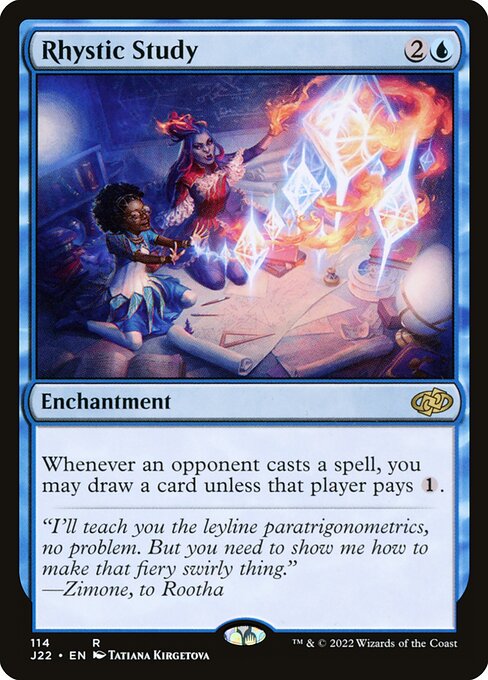
Rhystic Study card art
Live Play Data

Rhystic Study

{2} {U} · Enchantment · Jumpstart 2022 (J22)
21%
Live Inclusion
Times Brought
4222
Decks Running
1970
Median Cast Turn
4
Drawn → Played
73%
Format

Rhystic Study is in 21% of tracked Commander decks on Playgroup Live, and games where it resolves show a +11.8 percentage-point win-rate lift over games where it stays buried in the library.

Rhystic Study sits in 21% of the 9424 distinct decks that have played a tracked multiplayer Commander game on Playgroup Live. That number understates its reputation: the card's blue color identity alone gates it out of a large share of the format's decks, so its raw inclusion figure competes against a narrowed pool.

The performance signal is consistent. Games where Rhystic Study reached the battlefield carry a 36% normalized win rate, against 24% for games where the card never left the library. That +11.8 percentage-point gap holds across a well-sampled base of 753 cast observations and 2602 library observations, making it one of the sturdier lift signals on the platform. The confidence interval lower bound is positive, which is an early but meaningful indicator that the effect is real rather than noise.

Once on the battlefield, Rhystic Study sticks 69% of the time through end of game. Opponents rarely spend removal on a card they could simply pay {1} to suppress, which is exactly the dynamic that makes the card so divisive at the table.

At a glance
  • 21% of tracked Commander decks include Rhystic Study
  • 73% of drawn copies reach the battlefield before the game ends
  • T4 median first-cast turn across tracked games
  • +11.8pp win-rate lift when cast versus when it stays in the library
  • 69% battlefield stickiness once Rhystic Study resolves
  • 1149 distinct players have brought it to a tracked game, a well-spread sample

First-cast turn

n=827
4%
T1
13%
T2
22%
T3
12%
T4
11%
T5
30%
T6-9
8%
T10+
Median 4 P25 3 · P75 7 · max 23
On curve 40% (185 / 827 cast on T3) Cast same turn as drawn 41%

The "good card" funnel

4225 brought · 1149 players
Brought to game
4225
Ever drawn
1133
Reached battlefield
827
Still on board at game end
572
73%

Of 4225 copies brought to tracked games, 1133 were drawn, 827 of those were cast, and the large majority remained on the battlefield through end of game.

≥ +8.4pp

Players who cast this card win 36% of the time (n=753) , vs 24% when it never left the library (n=2602).

When players drew this card but left it in hand, they won 34% (n=280) — about the same as leaving it in the library. Those players survived long enough to draw it, so the gap above is about the card resolving, not just about surviving.

Observed gap +11.8pp; 95% confidence interval +8.4pp to +15.2pp. Correlational, not causal: powerful payoffs also get cast more often in games you are already winning.

Final zone distribution

1262 instances
3.4%
Library
45.3%
Battlefield
22.7%
Graveyard
7.6%
Exile

Most Rhystic Study copies that stay in the library never interact with a game at all, which is normal for a singleton in a 100-card deck. The meaningful story is the 69% stickiness rate among copies that do resolve.

Commanders that played this card

in tracked games

The top-commander list spans five different color combinations, with no single archetype dominating. Any deck that can run blue appears willing to run Rhystic Study.

Card text
Rhystic Study card

Rhystic Study

{2} {U}
Enchantment
Whenever an opponent casts a spell, you may draw a card unless that player pays {1}.

Jumpstart 2022 (J22) · Rare · Illustrated by Tatiana Kirgetova

Frequently Asked

How often is Rhystic Study drawn in a Commander game?
Across 3261 tracked multiplayer games where Rhystic Study was in the deck, it was drawn 27% of the time. That is consistent with what you would expect from a singleton in a 100-card deck. Of 1133 drawn copies, 73% were cast before the game ended. Some uncast copies reflect games that ended before the player found mana or a safe window to resolve it, not necessarily a deliberate choice to hold.
What is the typical cast turn for Rhystic Study?
Median first cast lands on turn 4, with the mode at turn 3 (its natural mana cost). The distribution has a long tail: the 90th percentile reaches turn 9, and a handful of copies are cast well into the late game. Players who draw it in the opening hand tend to deploy it early; players who topdeck it mid-game cast it when the opportunity arises. The hand-to-cast median is 1 turn of waiting, with about 41% of drawn copies cast on the very same turn they were drawn.
Does casting Rhystic Study actually improve your win rate?
In Playgroup Live data, games where Rhystic Study was cast show a 36% normalized win rate, compared to 24% for games where it stayed in the library. The delta is +11.8 percentage points. Both buckets are well-sampled (753 and 2602 observations respectively), and the statistical lower bound on the lift is positive. This is a consistent signal, though Playgroup Live's dataset is still growing and should be read as directional rather than conclusive.
Is Rhystic Study banned anywhere?
Rhystic Study is legal in Commander (multiplayer and duel), Legacy, Vintage, Historic, Timeless, Pauper, Gladiator, Oathbreaker, and several other formats. It is banned in Pauper Commander (paupercommander), where its card-draw engine is considered too dominant in that format's lower-power context. It is not legal in Standard, Pioneer, Modern, or Alchemy.
Which commanders most often run Rhystic Study?
On Playgroup Live, Y'shtola, Night's Blessed leads the count, followed by The Ur-Dragon, Oloro, Ageless Ascetic, and Urza, Lord High Artificer. The list spans mono-blue, Dimir, Azorius, Simic, and five-color commanders, reflecting that any deck with access to blue tends to treat Rhystic Study as a default inclusion. No single commander dominates the distribution.
How concentrated is the Rhystic Study data among individual players?
1149 distinct players have brought Rhystic Study to a tracked game on Playgroup Live. The single heaviest contributor accounts for 27% of all instances, well below the 15% threshold that would flag data concentration as a concern. The dataset is broadly spread, which adds confidence to the observed patterns.