
collections_bookmark Part of The Lost Caverns of Ixalan
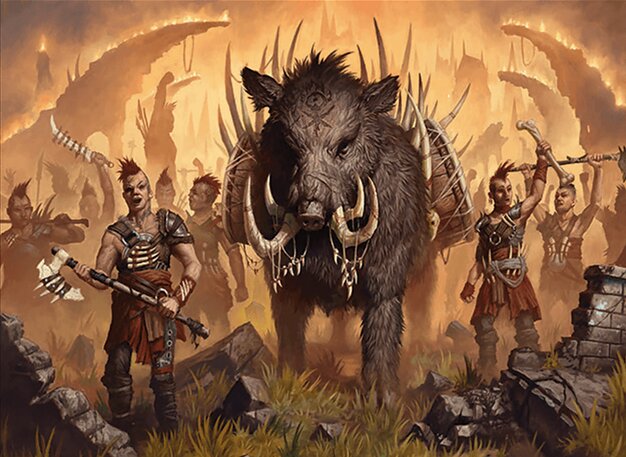
Rhythm of the Wild card art
Live Play Data

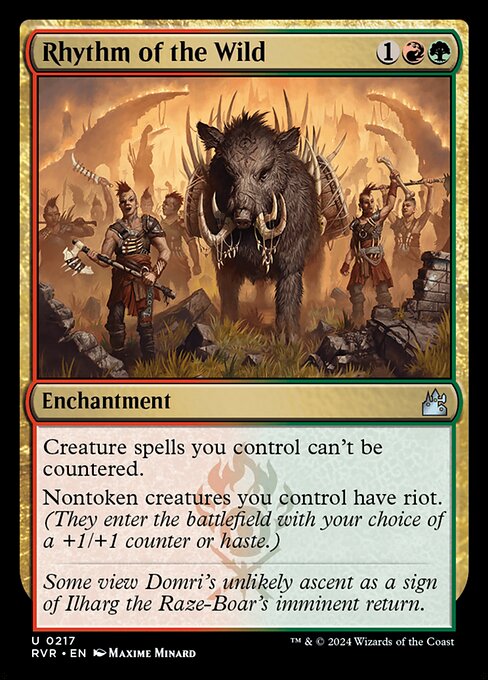
Rhythm of the Wild

{1} {R} {G} · Enchantment · Ravnica Remastered (RVR)
22%
Live Inclusion
Times Brought
777
Decks Running
399
Median Cast Turn
5.0
Drawn → Played
66%
Format

Rhythm of the Wild appears in 22% of tracked Commander decks on Playgroup Live, with a median first-cast turn of 5.0 and 66% of drawn copies reaching the battlefield.

Rhythm of the Wild sits in 22% of the 1778 Commander decks that have played a tracked game on Playgroup Live, spread across 323 distinct players. No single contributor dominates the sample: the heaviest single player accounts for just 3% of all tracked instances, which gives the dataset reasonable breadth for a card at this inclusion level.

The card costs 3 mana and does two distinct things: it blanket-counters counterspells aimed at your creatures, and it gives every nontoken creature you play a riot choice between a +1/+1 counter and haste. That dual utility explains why it lands in creature-heavy builds across Gruul and five-color commanders. Median first cast is turn 5.0, and 66% of drawn copies are cast before the game ends. Of those that reach the battlefield, 79% survive through the end of the game, a strong retention rate for a 3-mana enchantment.

The top commanders pairing with this card are heavily creature-focused tribal strategies, particularly Dinosaur and Dragon shells, where the riot counter-or-haste decision and counterspell protection are most meaningful. The cast-vs-library win-rate delta is small and its confidence interval crosses zero, so we treat it as directional only at this sample size rather than a reliable signal of win-rate impact.

At a glance
  • 22% of tracked Commander decks include Rhythm of the Wild
  • T5.0 median first-cast turn, right in the mid-game window
  • 66% of drawn copies are cast before the game ends
  • 79% battlefield stickiness once the enchantment resolves
  • 323 distinct players have brought this card to a tracked game
  • 32% of casts land exactly on curve at 3 mana

First-cast turn

n=112
2%
T1
11%
T2
20%
T3
15%
T4
10%
T5
39%
T6-9
4%
T10+
Median 5.0 P25 3 · P75 7 · max 12
On curve 32% (22 / 112 cast on T3) Cast same turn as drawn 31%

The "good card" funnel

777 brought · 323 players
Brought to game
777
Ever drawn
171
Reached battlefield
112
Still on board at game end
88
66%

Of 777 copies brought to games, 171 were drawn, 112 of those were cast, and 79% of resolved copies remained on the battlefield through end of game.

≥ -9.2pp

Players who cast this card win 22% of the time (n=108) , vs 24% when it never left the library (n=553).

When players drew this card but left it in hand, they won 32% (n=58) — about the same as leaving it in the library. Those players survived long enough to draw it, so the gap above is about the card resolving, not just about surviving.

Observed gap -1.6pp; 95% confidence interval -9.2pp to +5.9pp. Correlational, not causal: powerful payoffs also get cast more often in games you are already winning.

Final zone distribution

183 instances
2.7%
Library
48.1%
Battlefield
15.8%
Graveyard
6.6%
Exile

Most Rhythm of the Wild copies finish the game on the battlefield or in hand, with relatively few ending in the graveyard. The small library count reflects that observed instances are those actually seen or moved during play, not the full singleton pool.

Commanders that played this card

in tracked games

Pantlaza, Sun-Favored leads with 45 decks and The Ur-Dragon follows at 31, but the list fans out across more than a dozen Gruul and Naya shells, showing the card is a broad staple rather than a single-archetype slot.

Frequently Asked

How often is Rhythm of the Wild drawn in a Commander game?
Across 729 tracked games where the card was in the deck, it was drawn 22% of the time. That is a normal draw rate for a singleton in a 100-card Commander deck. Of the 171 copies that reached a player's hand, 66% were cast before the game concluded.
What turn does Rhythm of the Wild usually get cast?
Median first-cast turn is 5.0, with the interquartile range running from turn 3 to turn 7. The distribution shows a cluster of early casts in turns 2-4 and another cluster in turns 5-7, consistent with players either ramping into it or drawing it in the mid-game. Only 32% of casts land exactly on the turn matching its 3-mana cost, which reflects how often it arrives later via draw rather than in the opening hand.
Does casting Rhythm of the Wild improve your chances of winning?
In 108 observed participations where Rhythm of the Wild was cast, the normalized win rate was 22%. The library baseline (games where the card was never interacted with) sits at 24%. The gap is small and the confidence interval crosses zero, so we treat this as directional only. The sample does not yet support a strong claim that the card itself moves the win-rate needle.
Is Rhythm of the Wild banned in any format?
Rhythm of the Wild is legal in Commander, Legacy, Modern, Pioneer, Vintage, Historic, Timeless, Duel Commander, Brawl, Oathbreaker, and Gladiator. It is not legal in Standard, Pauper, Pauper Commander, or Penny Dreadful. There are no active bans in the formats where it is legal.
Why is Rhythm of the Wild popular in creature-heavy Commander decks?
The card solves two problems at once. Counterspell protection for creature spells is rare at 3 mana in Gruul colors, and it applies to all your creatures, not just one. The riot ability then turns every subsequent nontoken creature into either a faster threat (haste) or a sturdier one (+1/+1 counter), giving you a real in-game decision each time. Tribal decks that jam many creatures in quick succession extract the most value from both halves.
How concentrated is the Rhythm of the Wild data across players?
The data comes from 323 distinct players, and the single heaviest contributor accounts for just 3% of all instances. That spread is a meaningful strength of the dataset: the numbers are not skewed by one enthusiast running the card through dozens of games. The breadth makes the draw rate and cast-turn figures more reliable as early signals of how the broader playerbase uses the card.