collections_bookmark Part of Commander Masters

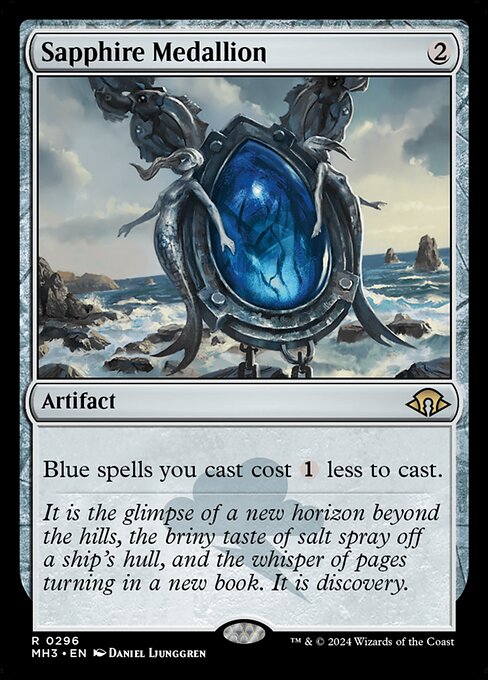
Sapphire Medallion card art
Live Play Data

Sapphire Medallion

{2} · Artifact · Modern Horizons 3 (MH3)
3%
Live Inclusion
Times Brought
433
Decks Running
223
Median Cast Turn
4
Drawn → Played
79%
Format

79% of drawn Sapphire Medallions are cast before the game ends, and decks that resolved it show a +11.3 percentage-point win-rate lift over decks where it stayed in the library.

Sapphire Medallion sits in 3% of tracked Commander decks on Playgroup Live, a niche number that reflects its hard requirement: your deck must be heavily blue to extract value from a blanket {1} cost reduction. Among those blue-heavy builds, it lands in 223 of the 7698 decks in the dataset.

The cast rate tells a clear story. Of the 141 times Sapphire Medallion reached a player's hand, 79% of those copies were cast before the game concluded. Median first cast lands on turn 4, though the distribution is wide: a cluster of turn-1 and turn-2 casts from opening hands, and a long tail stretching into the mid-game for late draws. Once it resolves, it sticks: 88% of cast copies remain on the battlefield through end of game, which is consistent with a cheap artifact that opponents rarely prioritize for removal.

The commander spread confirms the expected homes. Mono-blue and blue-heavy commanders dominate the top slots, with spell-slinger and artifact-matters strategies appearing most often. The card's colorless color identity means it is technically available to any Commander deck, but the cost reduction only fires on blue spells, so it is a functional inclusion only for blue-heavy lists.

At a glance
  • 3% of tracked Commander decks include Sapphire Medallion
  • 79% of drawn copies are cast before the game ends
  • T4 median first-cast turn across all tracked games
  • 88% battlefield stickiness once cast
  • 191 distinct players have brought this card to a tracked game
  • +11.3pp win-rate lift when cast versus when it stays in the library

First-cast turn

n=111
11%
T1
23%
T2
11%
T3
10%
T4
11%
T5
31%
T6-9
5%
T10+
Median 4 P25 2 · P75 6 · max 15
On curve 33% (25 / 111 cast on T2) Cast same turn as drawn 53%

The "good card" funnel

433 brought · 191 players
Brought to game
433
Ever drawn
141
Reached battlefield
111
Still on board at game end
98
79%

Of 433 Sapphire Medallions brought to games, 141 were drawn, 111 of those were cast, and the large majority remained on the battlefield through end of game, a tight cast-to-stick conversion for a 2-mana artifact.

≥ +2.5pp

Players who cast this card win 32% of the time (n=109) , vs 21% when it never left the library (n=265).

When players drew this card but left it in hand, they won 44% (n=30) — about the same as leaving it in the library. Those players survived long enough to draw it, so the gap above is about the card resolving, not just about surviving.

Observed gap +11.3pp; 95% confidence interval +2.5pp to +20.2pp. Correlational, not causal: powerful payoffs also get cast more often in games you are already winning.

Final zone distribution

153 instances
2.6%
Library
64.1%
Battlefield
16.3%
Graveyard
2.0%
Exile

Most Sapphire Medallions never leave the library, a structural feature of 100-card singleton rather than a sign of weakness. The copies that do reach play stay on the battlefield at a high rate, consistent with opponents deprioritizing a 2-mana cost-reducer for removal.

Commanders that played this card

in tracked games

Mono-blue commanders take the top spots, and nearly every commander in the list carries blue in their color identity. The spread across more than a dozen different commanders suggests the card is a broad role-player in blue rather than a build-around for one specific strategy.

Frequently Asked

How often is Sapphire Medallion drawn in a Commander game?
Across 401 tracked games where Sapphire Medallion was in a deck, it was drawn 33% of the time. That draw rate is typical for a singleton in a 100-card deck. Of the 141 copies that reached a hand, 79% were cast before the game ended. The remainder were largely cases where the game concluded before the player had a window to cast it.
What turn does Sapphire Medallion usually hit the battlefield?
The median first-cast turn is 4. The distribution is bimodal: a meaningful cluster of casts on turns 1 and 2, representing copies found in opening hands and cast immediately, and a second concentration spanning turns 5 through 8 for copies drawn in the mid-game. At 2 mana, it curves out early when it shows up early, but late draws often arrive after the mana-intensive turns where the discount matters most.
Does casting Sapphire Medallion actually improve your win rate?
In 109 tracked participations where Sapphire Medallion was cast, the normalized win rate was 32%. In the 265 participations where it never left the library, the rate was 21%. The +11.3 percentage-point gap is a directional positive signal. Both sample sizes are above 15, which moves this from anecdote toward a consistent early signal, though the dataset is not large enough to call it conclusive.
Why does Sapphire Medallion show up mostly in mono-blue or heavily blue decks?
The card reduces the cost of blue spells only. A deck with 30 blue spells gets many opportunities to recoup the initial 2-mana investment in a single game. A deck with only a handful of blue spells may never break even on the mana spent to cast the Medallion. This is why the top commanders on Playgroup Live are dominated by mono-blue and blue-heavy identities like Urza, Bruvac, and Vnwxt.
Is Sapphire Medallion legal in Commander?
Yes. Sapphire Medallion is legal in Commander and has no restrictions in that format. It is also legal in Legacy, Modern, Vintage, and several other formats. It is not legal in Standard, Pioneer, Pauper, or Pauper Commander.
How concentrated is the Sapphire Medallion data across players?
The data is well-spread. 191 distinct players have brought Sapphire Medallion to a tracked game on Playgroup Live, and the single heaviest contributor accounts for only 5% of all instances. That low concentration means the stats reflect a broad player base rather than one prolific pilot skewing the numbers.