
collections_bookmark Part of Duskmourn: House of Horror
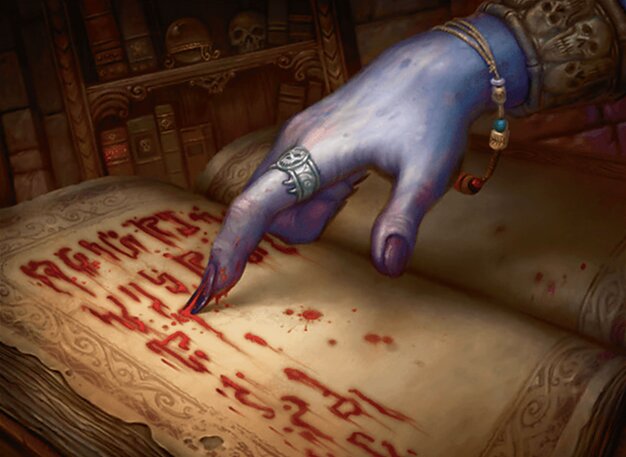
Sign in Blood card art
Live Play Data

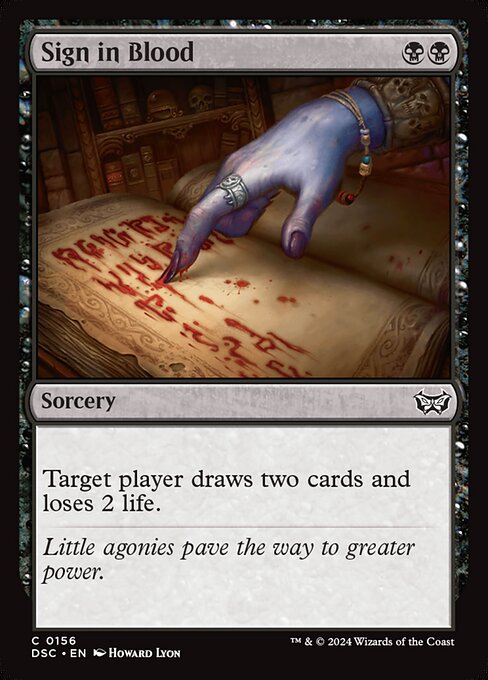
Sign in Blood

{B} {B} · Sorcery · Duskmourn: House of Horror Commander (DSC)
8%
Live Inclusion
Times Brought
962
Decks Running
559
Median Cast Turn
6.0
Drawn → Played
68%
Format

Sign in Blood reaches the battlefield in 68% of games where it's drawn, with a median first-cast turn of 6.0 across 917 tracked Commander games on Playgroup Live.

Sign in Blood is a mono-black staple that converts 2 mana and 2 life into two cards. Across 917 tracked multiplayer Commander games on Playgroup Live, it appears in 559 of 7082 tracked decks, putting its live-play inclusion rate at 8%.

When the card reaches a player's hand, 68% of those copies are cast before the game ends. Median first cast lands on turn 6.0, reflecting a pattern where players tend to hold it for a moment rather than slamming it on curve. The on-curve rate is low, but 34% of drawn-and-cast copies were cast the same turn they were drawn, suggesting opportunity cost drives the timing more than deliberate holding.

Sign in Blood sits at the budget end of black card draw, competing with Phyrexian Arena, Night's Whisper, and Read the Bones. Its flexibility, including the option to target opponents at low life, keeps it relevant across a wide range of black-focused commanders. The commander distribution here is notably broad: 463 distinct players have brought it to a tracked game, and no single player accounts for more than a small fraction of the data.

At a glance
  • 8% of tracked Commander decks include Sign in Blood
  • 21% draw rate across tracked participations
  • 68% of drawn copies are cast before the game ends
  • T6.0 median first-cast turn
  • 13% on-curve cast rate, typical for a card rarely in the opening hand
  • 463 distinct players have brought it to a tracked game, signaling well-spread data

First-cast turn

n=140
2%
T1
11%
T2
8%
T3
12%
T4
15%
T5
41%
T6-9
11%
T10+
Median 6.0 P25 4 · P75 8 · max 17
On curve 13% (15 / 140 cast on T2) Cast same turn as drawn 34%

The "good card" funnel

970 brought · 463 players
Brought to game
970
Ever drawn
207
Reached battlefield
140
Still on board at game end
2
68%

Of 970 Sign in Blood copies brought to games, 207 were drawn, and 140 of those resolved as casts before the game ended.

≥ -3.3pp

Players who cast this card win 27% of the time (n=131) , vs 23% when it never left the library (n=622).

When players drew this card but left it in hand, they won 30% (n=61) — about the same as leaving it in the library. Those players survived long enough to draw it, so the gap above is about the card resolving, not just about surviving.

Observed gap +4.2pp; 95% confidence interval -3.3pp to +11.7pp. Correlational, not causal: powerful payoffs also get cast more often in games you are already winning.

Final zone distribution

236 instances
1.3%
Library
0.8%
Battlefield
72.9%
Graveyard
8.9%
Exile

Most Sign in Blood copies end up in the graveyard after resolving, as expected for a sorcery. The tiny battlefield count and near-zero library residual confirm the card is doing its job: it resolves, draws cards, and goes to the yard.

Commanders that played this card

in tracked games

The top commander list spans mono-black and black-red builds, from Valgavoth to Sheoldred to Marrow-Gnawer, reflecting how broadly Sign in Blood slots into any deck with access to black mana.

Frequently Asked

How often is Sign in Blood drawn in a Commander game?
In 917 tracked games where Sign in Blood was in the deck, it was drawn 21% of the time. That is consistent with a singleton in a 100-card deck. Of 207 copies that reached a hand, 68% were cast before the game concluded.
What turn does Sign in Blood usually get cast?
Median first-cast turn is 6.0, with the middle 50% of casts landing between turns 4 and 7. The on-curve rate is 13%, which is low mostly because this card rarely shows up in opening hands. When it does reach a hand, 34% of cast copies go down the same turn they were drawn.
Does casting Sign in Blood actually improve your odds of winning?
The data here is directional, not conclusive. Participations where Sign in Blood was cast show a win rate of 27% versus 23% for participations where it sat in the library all game. The delta is a modest positive signal, but the confidence interval crosses zero at this sample size. Treat it as early evidence rather than a firm conclusion.
Is Sign in Blood banned anywhere?
Sign in Blood is legal in Commander, Duel Commander, Pauper Commander, Legacy, Modern, Pioneer, Vintage, Historic, Timeless, Gladiator, Brawl, and Oathbreaker. It is not legal in Standard, Alchemy, Penny Dreadful, Premodern, or Old School. No major format has banned it outright.
Which commanders most often run Sign in Blood?
Among tracked decks, Valgavoth, Harrower of Souls leads the list by raw deck count, followed by Kuja, Genome Sorcerer and Sheoldred, the Apocalypse. The distribution is spread across pure mono-black commanders and black-red combinations, which fits the card's single black pip requirement and life-payment synergy with life-loss payoff commanders.
How reliable is the Sign in Blood data on Playgroup Live?
The dataset covers 917 multiplayer Commander games with 236 observed instances of the card being actively seen or moved. Data comes from 463 distinct players, and no single contributor exceeds a small share of observations. That spread strengthens the signal compared to datasets dominated by one or two heavy users. Even so, Playgroup Live is a live-tracked rather than self-reported dataset, so treat all figures here as directional rather than statistically definitive.