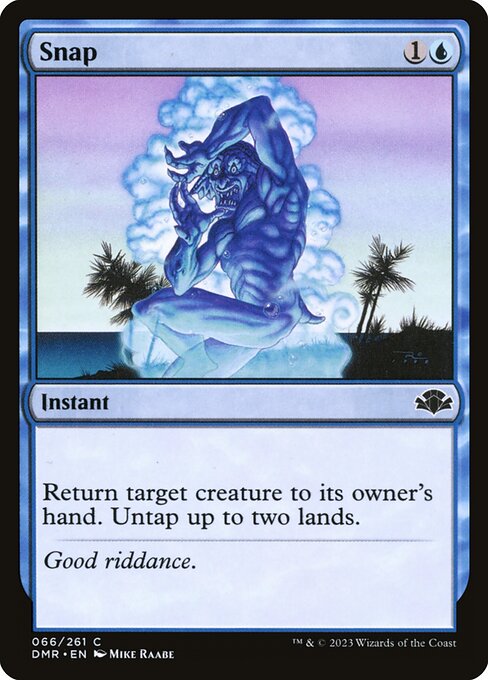


Snap card art
Live Play Data

Snap

{1} {U} · Instant · Dominaria Remastered (DMR)
6%
Live Inclusion
Times Brought
478
Decks Running
267
Median Cast Turn
6.0
Drawn → Played
78%
Format

78% of drawn Snap copies are cast before the game ends, and games where Snap resolved show a +18.5 percentage-point win-rate lift over games where it sat untouched in the library.

Snap is a 2-mana blue instant that bounces a creature and untaps two lands, effectively making it free to cast mid-turn when you have enough mana open. Across 455 multiplayer Commander games tracked on Playgroup Live, it appears in 267 of 4849 distinct decks, an inclusion rate of 6%. That is a niche card, not a staple, and the data reflects deliberate deckbuilding choices rather than reflexive inclusion.

The draw-to-play rate of 78% is the sharpest signal here. When Snap reaches a player's hand, it is cast before the game ends at a high clip. Median first cast lands on turn 6.0, well past the curve, which matches Snap's role as a reactive answer held for the right moment rather than an early accelerant. The concentration data is healthy: 243 distinct players have brought Snap to a tracked game, and the single heaviest contributor accounts for just 2% of all instances, so no one player is skewing the numbers.

Snap sits squarely in blue spell-slinging and tempo builds. Commanders that reward casting instants repeatedly, or that benefit from bouncing their own creatures for enters-the-battlefield value, are the natural homes. The untap-two-lands rider is what separates Snap from generic bounce spells: in the right shell it generates positive mana on the turn it is cast, enabling extra actions in the same window.

At a glance
  • 6% of tracked Commander decks include Snap, a deliberate niche pick
  • 78% of drawn copies are cast before the game ends
  • T6.0 median first-cast turn, consistent with a reactive hold-for-the-right-moment role
  • 243 distinct players have brought Snap to a tracked game, giving the data healthy spread
  • +18.5pp win-rate lift in games where Snap resolved versus games where it never left the library

First-cast turn

n=120
1%
T1
1%
T2
6%
T3
13%
T4
20%
T5
50%
T6-9
9%
T10+
Median 6.0 P25 5 · P75 7 · max 19
On curve 2% (1 / 120 cast on T2) Cast same turn as drawn 33%

The "good card" funnel

479 brought · 243 players
Brought to game
479
Ever drawn
154
Reached battlefield
120
Still on board at game end
3
78%

Of 479 Snaps brought to games, 154 were drawn, and 120 of those were cast, a high conversion rate that marks this as a card players cast promptly when the opportunity arrives.

≥ +9.3pp

Players who cast this card win 45% of the time (n=119) , vs 26% when it never left the library (n=280).

When players drew this card but left it in hand, they won 30% (n=33) — about the same as leaving it in the library. Those players survived long enough to draw it, so the gap above is about the card resolving, not just about surviving.

Observed gap +18.5pp; 95% confidence interval +9.3pp to +27.7pp. Correlational, not causal: powerful payoffs also get cast more often in games you are already winning.

Final zone distribution

173 instances
1.7%
Library
1.7%
Battlefield
67.6%
Graveyard
13.9%
Exile

Snap resolves to the graveyard by design, so the graveyard is the dominant final zone. The small share ending in hand or exile reflects countered spells, discard, or exile-based interaction before resolution.

Commanders that played this card

in tracked games

The commander list is spread across blue-red, blue-black, and mono-blue shells, with no single commander dominating. That breadth reflects Snap's flexibility as a tempo tool wherever blue has access to enough instants or creature-bounce payoffs.

Frequently Asked

How often is Snap drawn and cast in a Commander game?
Across 455 tracked games where Snap was in the deck, it was drawn 32% of the time. Of the 154 copies that reached a hand, 78% were cast before the game ended. The median first-cast turn is 6.0, which reflects Snap's role as a reactive spell held for a key moment rather than something slammed on curve.
What turn does Snap usually get cast?
The median first-cast turn is 6.0, with the 25th percentile at turn 5 and the 75th percentile at turn 7. The distribution clusters between turns 4 and 7, consistent with a mid-game removal or tempo play. Very few copies land in the first two turns, which makes sense: Snap is rarely in an opening hand, and even when it is, holding it for the right target is often correct.
Does casting Snap actually help you win?
In 119 participations where Snap resolved, the normalized win rate was 45%. In 280 participations where Snap never left the library, the win rate was 26%. That is a +18.5 percentage-point gap. The lower bound of the confidence interval clears zero, which gives this lift more weight than a directional-only reading, though the sample is still modest and we would call it an early signal rather than a definitive conclusion.
Is Snap legal in Commander?
Yes. Snap is legal in Commander, Duel Commander, Legacy, Vintage, Pauper, Pauper Commander, and Oathbreaker. It is not legal in Modern, Pioneer, Standard, Brawl, or Alchemy. In Legacy it sees play in combo shells precisely because of the free-mana rider. In Commander, that same rider makes it a strong fit in blue instant-heavy or spell-chaining builds.
Which commanders run Snap most often?
Among Playgroup Live tracked decks, the top homes for Snap are Vivi Ornitier, Alela Cunning Conqueror, and Fire Lord Azula. The list spans blue-red, blue-black, and three-color shells, but all share a theme of casting multiple spells per turn or rewarding instants. Mono-blue commanders like Orvar the All-Form and Vnwxt Verbose Host also appear, leaning into the self-bounce or spell-count angle.
How concentrated is the Snap data across players?
243 distinct players have brought Snap to a tracked game on Playgroup Live. The single heaviest contributor accounts for just 2% of all instances. That is well below the threshold where one player's preferences could meaningfully skew aggregate numbers, so the stats reflect a broad spread of deckbuilding choices rather than one prolific pilot.