collections_bookmark Part of Commander Masters
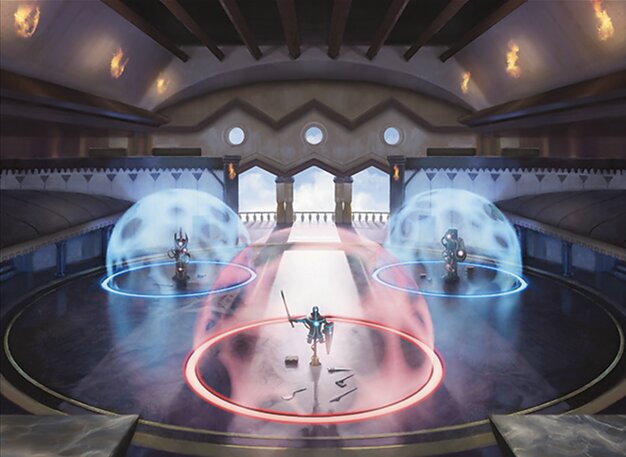
Training Center card art
Live Play Data

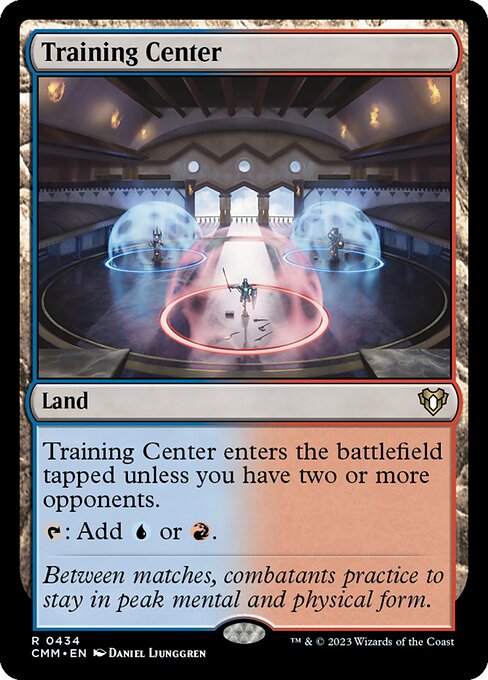
Training Center

Land · Commander Masters (CMM)
21%
Live Inclusion
Times Brought
753
Decks Running
380
Median Cast Turn
4.0
Drawn → Played
75%
Format

Training Center sits in 21% of tracked multiplayer Commander decks on Playgroup Live, enters untapped in the vast majority of its games, and 75% of drawn copies reach the battlefield.

Training Center is a blue-red dual land from the "Stranger Lands" cycle, entering untapped whenever you have two or more opponents. That condition is satisfied in nearly every multiplayer Commander pod, making it a reliable untapped dual for Izzet and allied color identities. Across 679 tracked games on Playgroup Live, 21% of decks in the dataset run it.

The play pattern is consistent: 75% of drawn copies are played before the game ends, and the median first-play turn is 4.0. Once it hits the battlefield, it stays. Lands resolve cleanly and rarely get removed, which is exactly what the 92% stickiness figure reflects. The data are spread across 315 distinct players, and the single heaviest contributor accounts for just 3% of all tracked instances, a sign that the numbers here are not skewed by one person's habits.

Training Center fits wherever Izzet mana is needed without the tax of a tapland. The top commander distribution on Playgroup Live confirms this: Izzet ({U}{R}) and Grixis ({U}{B}{R}) commanders dominate the list, from dedicated spell-slinger builds to multicolor good-stuff decks. If your commander is blue-red, this is a structural land slot, not a flex pick.

At a glance
  • 21% of tracked multiplayer Commander decks include Training Center
  • 75% of drawn copies are played before the game ends
  • T4.0 median first-play turn
  • 92% battlefield stickiness once the land enters play
  • 315 distinct players have brought Training Center to a tracked game
  • 25% draw rate, expected for a singleton in a 100-card deck

First-cast turn

n=142
20%
T1
15%
T2
13%
T3
8%
T4
10%
T5
28%
T6-9
6%
T10+
Median 4.0 P25 2 · P75 6 · max 13
Cast same turn as drawn 67%

The "good card" funnel

755 brought · 315 players
Brought to game
755
Ever drawn
190
Reached battlefield
142
Still on board at game end
131
75%

Of 755 Training Center copies brought to multiplayer games, 190 were drawn, 142 of those were played onto the battlefield, and the large majority of played copies stayed there through the end of the game.

≥ -5.5pp

Players who cast this card win 28% of the time (n=139) , vs 26% when it never left the library (n=516).

When players drew this card but left it in hand, they won 30% (n=48) — about the same as leaving it in the library. Those players survived long enough to draw it, so the gap above is about the card resolving, not just about surviving.

Observed gap +2.0pp; 95% confidence interval -5.5pp to +9.5pp. Correlational, not causal: powerful payoffs also get cast more often in games you are already winning.

Final zone distribution

207 instances
3.4%
Library
63.3%
Battlefield
15.0%
Graveyard
4.3%
Exile

The overwhelming majority of Training Center copies finish the game on the battlefield. Lands almost never get destroyed in Commander, so a high battlefield retention rate is structural rather than surprising, but it does confirm the card resolves and does its job in virtually every game it is drawn.

Commanders that played this card

in tracked games

The commander list is heavily concentrated in Izzet and Grixis color identities, which is exactly what you would expect for a land that produces only blue and red mana. No single commander dominates the count, suggesting Training Center is a broadly adopted mana-base staple rather than a build-around for one specific deck.

Frequently Asked

How often is Training Center drawn in a Commander game?
In 679 tracked multiplayer games where Training Center was in the deck, it was drawn 25% of the time. That is within the normal range for a singleton in a 100-card deck. Of 190 copies that reached a player's hand, 75% were played before the game ended. The remainder were mostly drawn too late in games that concluded before the player could take another land drop.
What turn does Training Center typically enter the battlefield?
Median first-play turn is 4.0 in multiplayer games. The distribution is front-loaded: a cluster of copies hit on turns 1-2 from opening hands, with the rest spread across the mid-game. The hand-to-cast data shows 67% of drawn copies are played on the same turn they are drawn, which is typical for lands since players almost always take their land drop immediately.
Does playing Training Center correlate with winning?
In 139 participations where Training Center entered the battlefield, the normalized win rate is 28%, compared to 26% in participations where it stayed in the library. The difference is a directional +2.0 percentage points. Both buckets are sampled across a moderate number of games, so treat this as an early signal rather than a firm conclusion. A land entering untapped on turn 1 correlates with smoother draws overall, which likely contributes to the pattern.
Is Training Center legal in Commander?
Yes. Training Center is legal in Commander, as well as in Legacy, Vintage, Oathbreaker, and the two-player Duel Commander format. It is not legal in Modern, Pioneer, Standard, Pauper, Brawl, or most other constructed formats. Its home is definitively Commander and Legacy, where untapped dual lands for zero mana cost are extremely valuable.
Which commanders most commonly run Training Center?
On Playgroup Live, the top multiplayer commanders pairing with Training Center include Lynde Cheerful Tormentor, Magnus the Red, and Vivi Ornitier, each appearing in multiple tracked decks. The list is dominated by Izzet ({U}{R}) and Grixis ({U}{B}{R}) color identities, which is expected given that Training Center produces only blue and red mana. Commanders requiring both colors treat it as a near-automatic include.
How reliable is the Training Center data on Playgroup Live?
The multiplayer dataset covers 679 games and 380 distinct decks, with 315 unique players contributing data. The single heaviest contributor represents just 3% of all instances, indicating the sample is broadly distributed rather than dominated by one player's results. Playgroup Live's dataset is still growing, so treat all directional win-rate findings as early signals. Inclusion and play-pattern data (draw rate, play turn) are more stable at this sample size.