auto_awesome #18 in Dimir Commander Staples
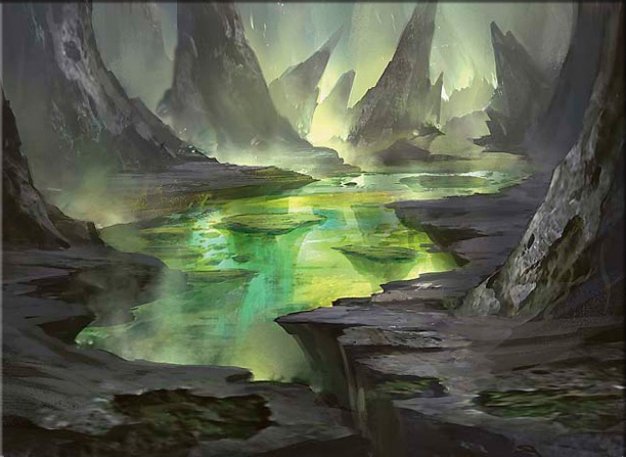
Underground Sea card art
Live Play Data

Underground Sea

Land — Island Swamp · Vintage Masters (VMA)
13%
Live Inclusion
Times Brought
1169
Decks Running
540
Median Cast Turn
3.0
Drawn → Played
90%
Format

90% of drawn Underground Seas are played before the game ends, and decks that resolved it won 32% of the time compared to 24% when it stayed buried, an early signal of a +7.8 percentage-point lift.

Underground Sea sits in 13% of tracked Commander decks on Playgroup Live, with 540 of 4312 distinct decks bringing it to a live game. When it reaches a player's hand, 90% of those copies get played before the game ends, one of the highest draw-to-play rates of any land in the dataset.

The win-rate signal is worth noting, though both sample sizes matter. Participations where Underground Sea resolved show a 32% win rate (n=353), against 24% for games where it never left the library (n=595). That's a +7.8 percentage-point gap. With sample sizes in this range the effect is directional rather than conclusive, but it points consistently in one direction across what we've tracked so far.

The card's reputation precedes the data. Underground Sea is a Reserved List dual land, fetchable, and produces both blue and black with no drawback. It sees play across 5-color piles and dedicated Dimir or Grixis shells alike. The spread of commanders in the top-10 list reflects that breadth: five-color commanders dominate simply because they have the most decks in the pool.

At a glance
  • 13% of tracked Commander decks include Underground Sea
  • 90% of drawn copies are played before the game ends
  • T3.0 median turn Underground Sea first enters play
  • 88% battlefield stickiness once it resolves
  • +7.8pp win-rate lift observed when Underground Sea resolves vs. stays in library
  • 387 distinct players have brought Underground Sea to a tracked game

First-cast turn

n=392
27%
T1
18%
T2
12%
T3
10%
T4
9%
T5
20%
T6-9
3%
T10+
Median 3.0 P25 1 · P75 5 · max 11
Cast same turn as drawn 63%

The "good card" funnel

1180 brought · 387 players
Brought to game
1180
Ever drawn
435
Reached battlefield
392
Still on board at game end
347
90%

Of 1180 Underground Seas brought to games, 435 were drawn, 392 reached the battlefield, and the large majority stayed there through the end of the game.

≥ +2.4pp

Players who cast this card win 32% of the time (n=353) , vs 24% when it never left the library (n=595).

When players drew this card but left it in hand, they won 23% (n=37) — about the same as leaving it in the library. Those players survived long enough to draw it, so the gap above is about the card resolving, not just about surviving.

Observed gap +7.8pp; 95% confidence interval +2.4pp to +13.2pp. Correlational, not causal: powerful payoffs also get cast more often in games you are already winning.

Final zone distribution

481 instances
5.2%
Library
72.1%
Battlefield
11.0%
Graveyard
6.4%
Exile

Most Underground Seas that enter a game finish on the battlefield rather than in the library, reflecting how reliably players draw and deploy this dual land before games conclude.

Commanders that played this card

in tracked games

Five-color commanders dominate the top spots by raw deck count, but that reflects population size more than any special affinity for Underground Sea specifically.

Card text
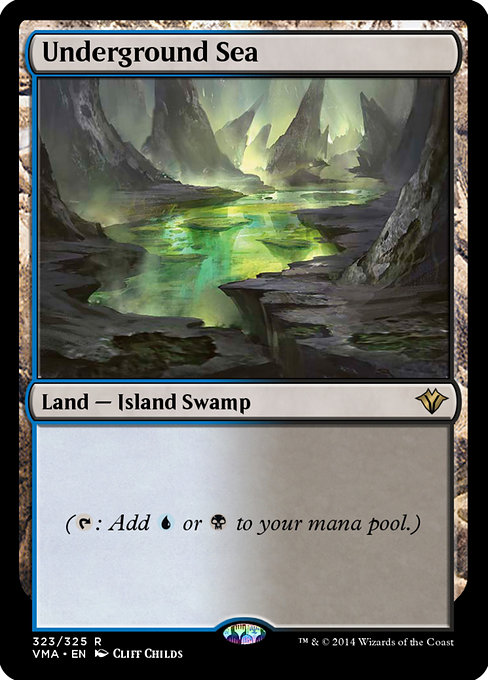
Underground Sea card

Underground Sea

Land — Island Swamp
({T}: Add {U} or {B}.)
Vintage Masters (VMA) · Rare · Illustrated by Cliff Childs

Frequently Asked

How often is Underground Sea drawn in a Commander game?
In 1025 tracked multiplayer Commander games where Underground Sea was in the deck, it was drawn 37% of the time. That draw rate is slightly above average for a singleton land in a 100-card deck, partly because many Underground Sea decks run fetchlands that can go find it. Of 435 instances that reached a hand, 90% were played before the game ended.
What turn does Underground Sea typically hit the battlefield?
Median first-cast turn is 3.0 in multiplayer games tracked on Playgroup Live. The mode is turn 1, meaning the single most common scenario is a player keeping it in their opening hand and playing it immediately. The distribution stretches later in longer pods, with the p75 landing around turn 5 and a small tail into turns 9 and beyond.
Is Underground Sea legal in Commander?
Yes. Underground Sea is legal and unrestricted in Commander, as well as in Legacy, Vintage, Duel Commander, and Oathbreaker. It is not legal in Modern, Pioneer, Standard, Pauper, or Brawl. Its presence on Magic's Reserved List means it will never be directly reprinted in a Standard-legal product, which keeps its paper price high and its online play more accessible via digital-only versions.
Does casting Underground Sea actually help you win?
The data offers a directional yes, but treat it as an early signal. Participations where Underground Sea resolved show a 32% win rate across 353 observations. Participations where it never left the library show 24% across 595 observations. The +7.8 percentage-point gap is consistent with what you'd expect from a no-drawback dual land in multi-color decks, but neither bucket is large enough to call the result statistically definitive.
Which commanders most often run Underground Sea?
The Ur-Dragon leads the top-commanders list by raw deck count, followed by Esika, God of the Tree and Kenrith, the Returned King. All three are five-color commanders, which reflects the sheer volume of five-color decks in the overall dataset rather than a specific synergy with Underground Sea. Pure Dimir commanders like Yuriko, the Tiger's Shadow also appear, representing the tighter two-color shells where the land fits most naturally.
How concentrated is the Underground Sea data among a few players?
The concentration profile is healthy for a card at this inclusion rate. 387 distinct players have brought Underground Sea to a tracked game, and the single heaviest contributor accounts for 37% of all instances. Well-spread across the player base, which gives the aggregate figures here more weight than they would carry if one or two collectors dominated the sample.