
collections_bookmark Part of Duskmourn: House of Horror
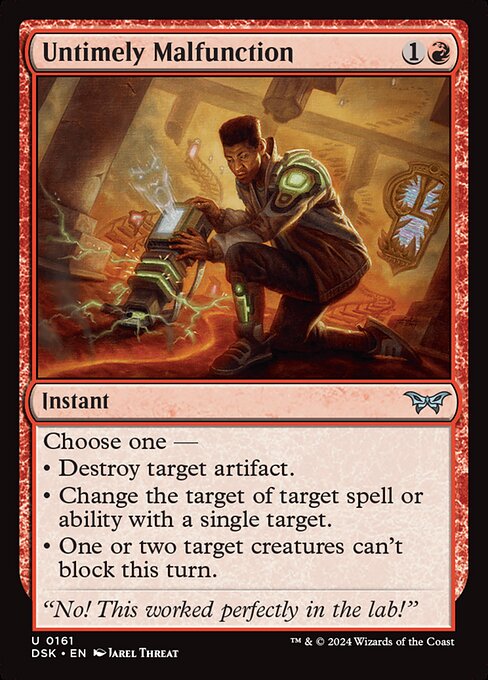
Untimely Malfunction card art
Live Play Data

Untimely Malfunction

{1} {R} · Instant · Duskmourn: House of Horror (DSK)
8%
Live Inclusion
Times Brought
1481
Decks Running
722
Median Cast Turn
6.0
Drawn → Played
58%
Format

8% of tracked Commander decks run Untimely Malfunction, and when drawn it reaches the stack 58% of the time, with a median first-cast turn of 6.0.

Untimely Malfunction is a flexible red instant from Duskmourn: House of Horror that shows up in 8% of Commander decks tracked on Playgroup Live. That modest share reflects its niche utility: the card earns a slot when a deck needs artifact removal, a redirect, or a last-minute combat trick, but it is not a universal auto-include the way format staples are.

Of 331 copies that reached a player's hand, 58% were cast before the game ended. That is a moderate conversion rate for an instant. Instants face a structural headwind: they can sit in hand waiting for the right target, and games that end quickly leave uncast copies behind. Median first cast lands on turn 6.0, well into the mid-game, which tracks with how situational the card is. Players are not slamming it early; they are holding it for the right moment.

The commander distribution is broad. 537 distinct players have brought the card to a tracked game, and the single heaviest contributor accounts for just 4% of all instances. The data is well-spread, giving the usage numbers meaningful signal across a wide range of red and red-adjacent strategies.

At a glance
  • 8% of tracked Commander decks include Untimely Malfunction
  • 22% draw rate across games where it was in the deck
  • 58% of drawn copies were cast before the game ended
  • T6.0 median first-cast turn, firmly mid-game
  • 537 distinct players have brought this card to a tracked game
  • 192 total times cast across all tracked games

First-cast turn

n=192
1%
T1
2%
T2
4%
T3
10%
T4
15%
T5
56%
T6-9
13%
T10+
Median 6.0 P25 5 · P75 8 · max 14
On curve 2% (3 / 192 cast on T2) Cast same turn as drawn 19%

The "good card" funnel

1487 brought · 537 players
Brought to game
1487
Ever drawn
331
Reached battlefield
192
Still on board at game end
15
58%

Of 1487 copies brought to games, 331 were drawn, 192 of those were cast, and most resolved directly to the graveyard, as instants do.

≥ -3.7pp

Players who cast this card win 30% of the time (n=181) , vs 27% when it never left the library (n=1019).

When players drew this card but left it in hand, they won 30% (n=124) — about the same as leaving it in the library. Those players survived long enough to draw it, so the gap above is about the card resolving, not just about surviving.

Observed gap +3.1pp; 95% confidence interval -3.7pp to +9.9pp. Correlational, not causal: powerful payoffs also get cast more often in games you are already winning.

Final zone distribution

375 instances
4.0%
Library
4.0%
Battlefield
57.9%
Graveyard
8.0%
Exile

The graveyard is the dominant final zone for Untimely Malfunction, as expected for an instant that resolves and goes straight to the bin. The small library remainder reflects copies that never found a target or a window before the game ended.

Commanders that played this card

in tracked games

The commander list spans mono-red aggro, red-black combo, and red-white strategies, with no single commander dominating. Untimely Malfunction is spread broadly across red color identities rather than concentrated in one archetype.

Card text
Untimely Malfunction card

Untimely Malfunction

{1} {R}
Instant
Choose one — • Destroy target artifact. • Change the target of target spell or ability with a single target. • One or two target creatures can't block this turn.
Duskmourn: House of Horror (DSK) · Uncommon · Illustrated by Jarel Threat

Frequently Asked

How often is Untimely Malfunction drawn in a Commander game?
Across 1389 tracked games where the card was in the deck, it was drawn 22% of the time. That is consistent with what you would expect from a singleton in a 100-card deck. Of 331 drawn copies, 58% were cast before the game ended. The remainder stayed in hand, most likely because the game ended before a good target appeared or the window to cast it closed.
What turn does Untimely Malfunction typically get cast?
The median first-cast turn is 6.0, with the bulk of casts distributed between turns 5 and 9. That mid-to-late timing reflects how the card is used: players hold it as a reactive answer rather than deploying it proactively early. The on-curve rate of 2% is low, but for an instant this mostly means players are drawing it after the turn they could cast it on curve and then waiting for the right moment rather than forcing it.
Does casting Untimely Malfunction correlate with winning?
The cast win rate is 30% across 181 observations, compared to 27% when the card sat in the library across 1019 observations. The gap is very small and the dataset is early-signal territory, so treat this as directional rather than conclusive. Reactive instants rarely show strong win-rate lifts because their value is situational: they matter enormously in some games and do nothing in others.
Which commanders most commonly run Untimely Malfunction?
On Playgroup Live the top spots go to Kuja, Genome Sorcerer and Krenko, Mob Boss, each leading a cluster of red and red-black strategies. The spread is wide: 537 unique players have contributed data, so the commander list reflects genuine format diversity rather than a single dominant archetype skewing the numbers.
Is Untimely Malfunction legal in Commander?
Yes. Untimely Malfunction is legal in Commander, as well as in Standard, Pioneer, Modern, Legacy, Vintage, Historic, and several other formats. It is not legal in Pauper or Pauper Commander, as it is an uncommon.
How does the modal flexibility of Untimely Malfunction affect how players use it?
The card offers three distinct modes: destroy an artifact, redirect a spell or ability, or tap down blockers. That flexibility is why it holds a spot in decks that would not otherwise run a dedicated combat trick or a redirect like Deflection. In practice, the mid-game median cast turn and moderate draw-to-play rate suggest players are waiting for a situation where one of the modes is genuinely impactful rather than casting it speculatively. Early data across 1389 tracked games points to a card that rewards patience.