collections_bookmark Part of Tales of Middle-earth
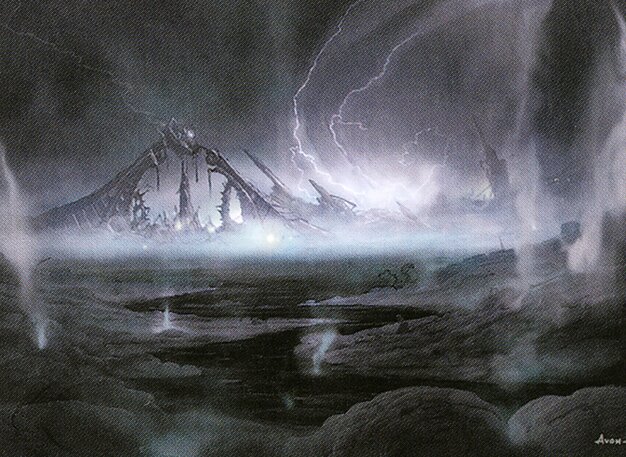
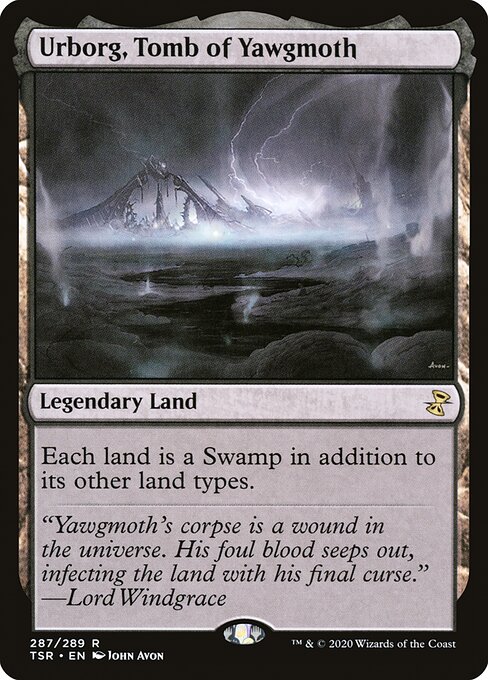
Urborg, Tomb of Yawgmoth card art
Live Play Data

Urborg, Tomb of Yawgmoth

Legendary Land · Time Spiral Remastered (TSR)
7%
Live Inclusion
Times Brought
818
Decks Running
519
Median Cast Turn
4.0
Drawn → Played
83%
Format

83% of drawn Urborg, Tomb of Yawgmoth copies are cast before the game ends, the highest draw-to-play rate among tracked lands on Playgroup Live, with a median first-cast turn of 4.0.

Urborg, Tomb of Yawgmoth earns its slot. When it reaches a player's hand, it is cast 83% of the time before the game ends, a strong signal that the card is almost never held back once drawn.

The card sits in 519 of the 7237 distinct decks tracked on Playgroup Live, an 7% inclusion rate that reflects its colorless identity and its usefulness in any black-adjacent shell. Because it costs zero mana to play, the on-curve concept does not apply. The median first cast lands on turn 4.0, pulled slightly later than turn 1 by games where it was not in the opening hand. Once it resolves, battlefield stickiness is 88%: Urborg is not a removal magnet, and most copies simply sit in play doing their job for the rest of the game.

The concentration numbers are a meaningful strength here. 343 distinct players have brought Urborg to a tracked game, and no single contributor accounts for more than a small slice of the data. That spread makes the play patterns we observe more reliable as an early signal of how the card actually behaves at real tables.

At a glance
  • 7% of tracked Commander decks include Urborg, Tomb of Yawgmoth
  • 83% of drawn copies are cast before the game ends
  • T4.0 median first-cast turn
  • 88% battlefield stickiness once cast
  • 343 distinct players have brought Urborg to a tracked game
  • 25% draw rate, typical for a singleton in a 100-card deck

First-cast turn

n=172
10%
T1
22%
T2
11%
T3
12%
T4
13%
T5
23%
T6-9
10%
T10+
Median 4.0 P25 2 · P75 6 · max 16
Cast same turn as drawn 46%

The "good card" funnel

822 brought · 343 players
Brought to game
822
Ever drawn
207
Reached battlefield
172
Still on board at game end
151
83%

Of 822 Urborgs brought to games, 207 were drawn, 172 of those were cast, and 88% of resolved copies stayed on the battlefield through end of game.

≥ -5.4pp

Players who cast this card win 25% of the time (n=169) , vs 24% when it never left the library (n=556).

When players drew this card but left it in hand, they won 37% (n=36) — about the same as leaving it in the library. Those players survived long enough to draw it, so the gap above is about the card resolving, not just about surviving.

Observed gap +1.2pp; 95% confidence interval -5.4pp to +7.8pp. Correlational, not causal: powerful payoffs also get cast more often in games you are already winning.

Final zone distribution

237 instances
2.1%
Library
63.7%
Battlefield
14.8%
Graveyard
7.6%
Exile

Most copies of Urborg never leave the library, a structural feature of 100-card singleton rather than a knock on the card. Of those that did reach play, the large majority finished on the battlefield, consistent with its near-zero removal profile.

Commanders that played this card

in tracked games

The top commanders running Urborg span mono-black, Dimir, Mardu, Grixis, and five-color shells, reflecting the card's empty color identity and its cross-archetype utility rather than concentration in any single strategy.

Frequently Asked

How often is Urborg, Tomb of Yawgmoth drawn in a Commander game?
Across 713 tracked games where Urborg was in the deck, it was drawn 25% of the time. That is consistent with a singleton in a 100-card deck. Of those 207 drawn copies, 83% were cast before the game concluded, one of the higher draw-to-play rates among tracked permanents. The median number of turns a copy spent in hand before being played was 1, so players generally cast it quickly once they find it.
What turn does Urborg typically hit the battlefield?
Median first-cast turn is 4.0. The distribution is front-loaded: a cluster of early casts in turns 1-3 for players who drew it in the opening hand, then a spread through turns 4-6 for those who drew it mid-game. The land-drop nature of Urborg means there is no mana cost to hold it back, so the delay mostly reflects when it was drawn rather than any strategic hesitation.
Does casting Urborg actually help you win?
The cast vs. library delta is +1.2 percentage points, essentially flat. That means games where Urborg resolved did not produce meaningfully different win rates from games where it sat unplayed. Both sample sizes are substantial, so this is a consistent signal rather than noise. The honest reading: Urborg is a mana-quality enabler, not a standalone win condition. Its value shows up in the decks and commanders that use its effect, not in raw win-rate lift.
Is Urborg, Tomb of Yawgmoth legal everywhere?
Urborg is legal in Commander, Legacy, Modern, Pioneer, Vintage, Historic, Brawl, Duel Commander, and several other formats. It is not legal in Standard, Pauper, or Pauper Commander. In Commander it is unrestricted and frequently run in any deck containing black or that can otherwise benefit from Swamp synergies, since it has no color identity of its own.
Why do so many different commander archetypes run Urborg?
Urborg has an empty color identity, so it fits into any Commander deck regardless of colors. Its effect makes every land a Swamp, which benefits black-heavy decks running Cabal Coffers, Filth, or Lashwrithe, but also shores up mana consistency for multicolor decks that need black sources. The top commanders running it on Playgroup Live span mono-black, Dimir, Mardu, Grixis, and five-color builds, which illustrates how broadly applicable the effect is.
How reliable is the Playgroup Live data for Urborg?
The dataset includes 713 tracked games and 822 instances brought to tables by 343 distinct players. No single player accounts for more than a small fraction of those instances, which is a positive sign for data spread. Sample sizes for the win-rate buckets are well above 15 observations each, so directional conclusions are reasonable, though Playgroup Live's dataset is still growing and these figures should be read as early signals rather than definitive benchmarks.