collections_bookmark Part of Commander Masters
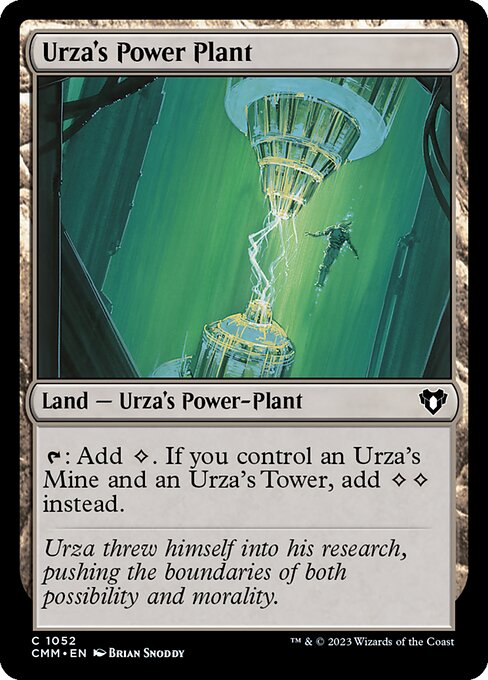
Urza's Power Plant card art
Live Play Data

Urza's Power Plant

Land — Urza's Power-Plant · Commander Masters (CMM)
2%
Live Inclusion
Times Brought
676
Decks Running
337
Median Cast Turn
3
Drawn → Played
88%
Format

2% of tracked Commander decks run Urza's Power Plant, and when a copy reaches a player's hand, 88% of the time it hits the battlefield, landing on turn 3 at the median.

Urza's Power Plant occupies a narrow but committed niche in Commander: 2% of the 16624 tracked decks include it, and the players who do are serious about assembling the Urza trifecta. Once the card reaches a hand, 88% of drawn copies reach the battlefield, one of the higher draw-to-play rates we see for any land.

The math behind that high rate is straightforward. Urza's Power Plant is a land, and lands carry almost no opportunity cost to play. Players who have committed three deck slots to the Urza lands are highly motivated to put each piece into play the moment they see it. Median first-play lands on turn 3, consistent with players deploying it as a land drop the same turn it arrives.

The concentration data is reassuring: 288 distinct players have brought the card to a tracked game, and the single heaviest contributor accounts for just 4% of all instances. The signal is well-spread across the dataset rather than driven by one prolific player.

At a glance
  • 2% of tracked Commander decks include Urza's Power Plant
  • 88% of drawn copies reach the battlefield, near the top of any land in the dataset
  • T3 median first-play turn
  • 91% battlefield stickiness once played
  • 288 distinct players have contributed data, keeping the sample well-spread
  • 337 of 16624 tracked decks run the card

First-cast turn

n=135
18%
T1
19%
T2
16%
T3
10%
T4
10%
T5
22%
T6-9
5%
T10+
Median 3 P25 2 · P75 6 · max 14
Cast same turn as drawn 57%

The "good card" funnel

679 brought · 288 players
Brought to game
679
Ever drawn
154
Reached battlefield
135
Still on board at game end
123
88%

Of 679 copies brought to tracked games, 154 were drawn, 135 of those were played, and 91% stayed on the battlefield through end of game, showing that once the card arrives it almost never leaves.

≥ +1.5pp

Players who cast this card win 33% of the time (n=122) , vs 23% when it never left the library (n=434).

When players drew this card but left it in hand, they won 44% (n=16) — about the same as leaving it in the library. Those players survived long enough to draw it, so the gap above is about the card resolving, not just about surviving.

Observed gap +10.0pp; 95% confidence interval +1.5pp to +18.5pp. Correlational, not causal: powerful payoffs also get cast more often in games you are already winning.

Final zone distribution

171 instances
2.3%
Library
71.9%
Battlefield
9.4%
Graveyard
5.8%
Exile

The vast majority of Urza's Power Plant copies finish games on the battlefield. Only a single copy ended in the library across all observed instances, reflecting how quickly players convert this card into a land drop once they see it.

Commanders that played this card

in tracked games

Colorless and artifact-heavy commanders dominate the distribution. Zhulodok leads with the largest deck count by a significant margin, and most of the top ten commanders have colorless or near-colorless identity, a natural home for a colorless land combo piece.

Card text
Urza's Power Plant card

Urza's Power Plant

Land — Urza's Power-Plant
{T}: Add {C}. If you control an Urza's Mine and an Urza's Tower, add {C}{C} instead.
Commander Masters (CMM) · Common · Illustrated by Brian Snõddy

Frequently Asked

How often is Urza's Power Plant drawn in a Commander game?
Across 650 tracked games where the card was in a deck, it was drawn 23% of the time. That figure reflects both the singleton constraint of a 100-card deck and the fact that many copies sit in the library all game without ever being encountered. Of 154 drawn copies, 88% were played before the game ended.
What turn does Urza's Power Plant typically hit the battlefield?
The median first-play turn is 3. The distribution runs from turn 1 through turn 11 in the tracked data, with a mode at turn 2. The earliest plays come from opening-hand copies deployed as a land drop; later plays reflect copies drawn mid-game. The hand-to-cast delay is very short, consistent with players treating it as an immediate land drop rather than holding it.
Does playing Urza's Power Plant actually improve your odds of winning?
The normalized win rate in participations where the card was played is 33%, versus 23% when it stayed in the library. That is a +10.0 percentage-point gap across 122 cast observations and 434 library observations. The confidence interval on this dataset crosses zero, so treat the directional lift as an early signal rather than a firm conclusion. Decks that run all three Urza lands tend to be purpose-built for the combo, which likely carries its own selection effect.
Which commanders most often pair with Urza's Power Plant?
On Playgroup Live, Zhulodok, Void Gorger leads by a wide margin, followed by Ulalek, Fused Atrocity, Omo, Queen of Vesuva, and Ultron, Artificial Malevolence. Colorless and artifact-heavy commanders dominate the top of the list, which makes sense: the Urza lands produce colorless mana and fit naturally into decks that want to cast large, colorless spells. Inclusion rates by deck archetype show Molecule Man and Ultron-style decks at the highest per-archetype rates.
Is Urza's Power Plant legal in Commander?
Yes. Urza's Power Plant is legal in Commander, Duel Commander, Legacy, Modern, Pauper, Vintage, Premodern, and Oathbreaker. It is not legal in Standard, Pioneer, Alchemy, Historic, Brawl, or Timeless. In Commander, there is no restriction on the number of Urza's Mine, Urza's Power Plant, or Urza's Tower copies across a deck, though singleton rules mean you can run only one of each.
How concentrated is the Urza's Power Plant data across players?
288 distinct players have brought the card to at least one tracked game. The single most frequent contributor accounts for 4% of all instances, well below the 15% threshold we watch for when assessing whether data is skewed by a single prolific player. That spread gives the draw and play-rate figures reasonable breadth, though the overall sample of 135 cast instances still warrants caution on fine-grained percentages.