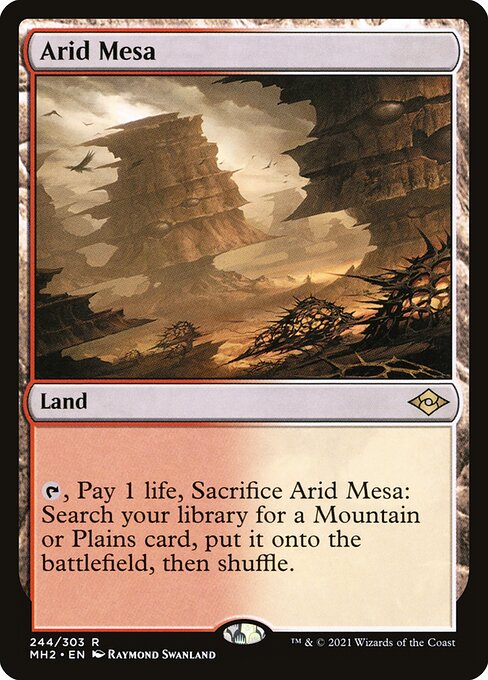
Arid Mesa card art
Live Play Data

Arid Mesa

Land · Modern Horizons 2 (MH2)
9%
Live Inclusion
Times Brought
1840
Decks Running
946
Median Cast Turn
3
Drawn → Played
71%
Format

Arid Mesa appears in 9% of tracked Commander decks on Playgroup Live, spread across 562 distinct players, with a median first activation on turn 3.

Arid Mesa sits in 9% of the Commander decks tracked in live Playgroup games, making it one of the more widely played fetchlands in the format. Its presence spans 946 decks across 10147 tracked, and 562 distinct players have brought it to a recorded game. The single heaviest contributor accounts for just 3% of all instances, so the data is well-distributed.

As a fetchland, Arid Mesa behaves differently from most cards in this dataset. It sacrifices itself on activation, so its "cast" event is actually a land-play event, and once activated it goes straight to the graveyard in nearly all cases. The 71% draw-to-play rate reflects how often a drawn copy reaches activation before the game ends. Players activate it on the same turn they draw it 61% of the time, consistent with a land that players want to play as soon as possible.

The commander distribution tells the broader story: Arid Mesa clusters around Naya, Mardu, and five-color commanders who need reliable access to white and red mana fixing. Its colorless identity means it slots into any deck that can fetch a Mountain or Plains.

At a glance
  • 9% of tracked Commander decks include Arid Mesa
  • 71% of drawn copies are activated before the game ends
  • T3 median first activation turn
  • 61% of drawn copies are activated on the same turn they are drawn
  • 562 distinct players have brought Arid Mesa to a tracked game

First-cast turn

n=337
27%
T1
12%
T2
11%
T3
11%
T4
11%
T5
24%
T6-9
3%
T10+
Median 3 P25 1 · P75 6 · max 12
Cast same turn as drawn 61%

The "good card" funnel

1842 brought · 562 players
Brought to game
1842
Ever drawn
472
Reached battlefield
337
Still on board at game end
18
71%

Of 1842 Arid Mesas brought to games, 472 were drawn, and 337 of those reached activation before the game ended.

≥ -4.4pp

Players who cast this card win 27% of the time (n=325) , vs 27% when it never left the library (n=1226).

When players drew this card but left it in hand, they won 32% (n=127) — about the same as leaving it in the library. Those players survived long enough to draw it, so the gap above is about the card resolving, not just about surviving.

Observed gap +0.4pp; 95% confidence interval -4.4pp to +5.2pp. Correlational, not causal: powerful payoffs also get cast more often in games you are already winning.

Final zone distribution

523 instances
3.1%
Library
3.4%
Battlefield
68.1%
Graveyard
11.5%
Exile

Graveyard is the expected final zone for a fetchland. Arid Mesa sacrifices itself on activation, so most copies land there by design. Library counts are copies that were never drawn or interacted with during the game.

Commanders that played this card

in tracked games

The top-commander list skews heavily toward Naya, Mardu, and five-color commanders, reflecting the card's role as white-and-red mana fixing for decks that need it most.

Frequently Asked

How often is Arid Mesa drawn in a Commander game?
Across 1409 tracked games where Arid Mesa was in the deck, it was drawn 26% of the time. That is in line with expectations for a singleton in a 100-card deck. Of those drawn copies, 71% were activated before the game concluded, and 61% were activated on the same turn they were drawn.
What turn does Arid Mesa usually get activated?
The median first activation lands on turn 3, with the 25th percentile at turn 1 and the 75th at turn 6. The mode is turn 1, reflecting copies kept in opening hands and played immediately. Later activations typically represent copies drawn after the early game, used for mid-game color fixing.
Does activating Arid Mesa actually improve your win rate?
The cast-vs-library delta is very small at this sample size, and the confidence interval crosses zero, so no reliable win-rate lift can be attributed to activating Arid Mesa specifically. The honest read: Arid Mesa is infrastructure. It improves mana consistency rather than generating direct card advantage, so its impact shows up in the power of the spells it enables rather than in its own isolated stats.
Why does Arid Mesa end up in the graveyard so often in the final-zone chart?
Fetchlands sacrifice themselves on activation. Activating Arid Mesa puts it in the graveyard by design. The graveyard is the expected and correct final zone for the vast majority of copies. A small number end up in exile due to effects like Rest in Peace or Leyline of the Void. The library count reflects copies that were in the deck but never drawn or interacted with during the game.
Which commanders run Arid Mesa most frequently on Playgroup Live?
The Ur-Dragon leads the top-commander list, followed by Mardu commanders like Mr. House, Kaalia of the Vast, and Edgar Markov, along with Naya commanders such as Baylen the Haymaker and Gishath. This pattern is consistent with Arid Mesa's fetchable targets: any deck that needs reliable Mountain or Plains access has an incentive to include it, and five-color and three-color decks feel that pressure most acutely.
Is Arid Mesa legal in Commander? What about other formats?
Arid Mesa is legal in Commander with no restrictions. It is also legal in Legacy, Modern, Vintage, Duel Commander, and several other formats. It is banned in Historic and not legal in Standard, Pioneer, Pauper, or Pauper Commander. Its Modern legality arrived with Modern Horizons 2, which reprinted the original Zendikar fetchlands into that format.