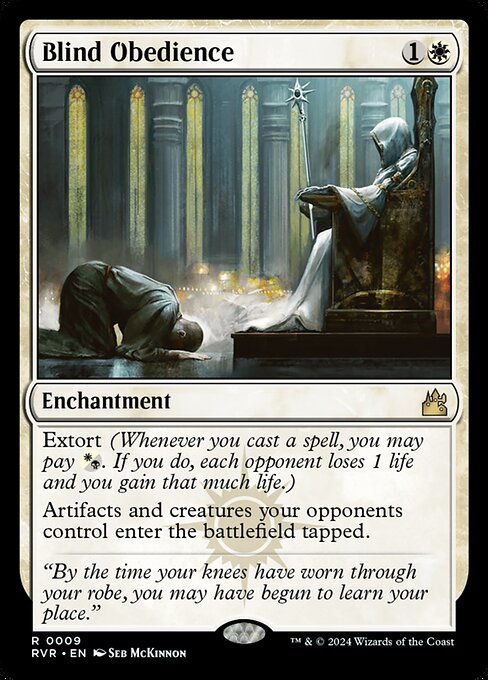
Blind Obedience card art
Live Play Data

Blind Obedience

{1} {W} · Enchantment · Ravnica Remastered (RVR)
5%
Live Inclusion
Times Brought
674
Decks Running
384
Median Cast Turn
5.0
Drawn → Played
73%
Format

73% of drawn Blind Obediences reach the battlefield, and the card sits in 384 of 8036 tracked Commander decks, with a median first-cast turn of 5.0.

Blind Obedience appears in 384 of the 8036 distinct Commander decks that have played a tracked game on Playgroup Live, an inclusion rate of 5%. When a copy enters a player's hand, 73% of those copies reach the battlefield before the game ends.

The card does two distinct jobs: its static ability forces all opposing artifacts and creatures to enter tapped, functioning as a persistent speed bump against aggressive and combo-oriented boards. Its extort trigger then converts every subsequent spell into incremental life-swing. That combination of passive disruption and ongoing drain makes it a natural fit across white-heavy control, life-gain, and tax strategies.

The top-commander list spans mono-white, Esper, Orzhov, and Azorius shells, confirming that white's color identity is the only real constraint. The commander distribution is well-spread across 327 unique players, which is a signal the card is not being carried by a single pilot's preference.

At a glance
  • 5% of tracked Commander decks include Blind Obedience
  • 73% of drawn copies reach the battlefield before the game ends
  • T5.0 median first-cast turn
  • 72% battlefield stickiness once cast
  • 327 unique players have brought this card to a tracked game
  • 25% draw rate, consistent with a singleton in a 100-card deck

First-cast turn

n=122
7%
T1
20%
T2
11%
T3
12%
T4
9%
T5
32%
T6-9
10%
T10+
Median 5.0 P25 2 · P75 7 · max 17
On curve 26% (24 / 122 cast on T2) Cast same turn as drawn 43%

The "good card" funnel

674 brought · 327 players
Brought to game
674
Ever drawn
168
Reached battlefield
122
Still on board at game end
88
73%

Of 674 Blind Obediences brought to tracked games, 168 were drawn, 122 of those were cast, and 72% of cast copies remained on the battlefield through the end of the game they resolved in.

≥ -5.9pp

Players who cast this card win 25% of the time (n=116) , vs 22% when it never left the library (n=422).

When players drew this card but left it in hand, they won 29% (n=41) — about the same as leaving it in the library. Those players survived long enough to draw it, so the gap above is about the card resolving, not just about surviving.

Observed gap +2.1pp; 95% confidence interval -5.9pp to +10.1pp. Correlational, not causal: powerful payoffs also get cast more often in games you are already winning.

Final zone distribution

181 instances
2.2%
Library
48.6%
Battlefield
18.2%
Graveyard
7.7%
Exile

The vast majority of Blind Obedience copies never leave the library, the expected structural reality for a singleton in a 100-card deck. Of the copies that were observed in play, the battlefield is the most common final resting zone, with the graveyard accounting for removal and combat losses.

Commanders that played this card

in tracked games

The commander list is spread across four distinct color identities within white's slice of the pie, from mono-white to full Esper, confirming that Blind Obedience earns its slot on the strength of its effect rather than synergy with a single commander archetype.

Card text
Blind Obedience card

Blind Obedience

{1} {W}
Enchantment
Extort (Whenever you cast a spell, you may pay {W/B}. If you do, each opponent loses 1 life and you gain that much life.) Artifacts and creatures your opponents control enter tapped.

Ravnica Remastered (RVR) · Rare · Illustrated by Seb McKinnon

Frequently Asked

How often is Blind Obedience drawn in a Commander game?
Across 661 tracked games where Blind Obedience was in the deck, it was drawn 25% of the time. That is in the normal range for a singleton in a 100-card deck. Of 168 instances that reached a hand, 73% were cast before the game ended. The median turn between drawing and casting is 1, so most players who draw it move on it quickly rather than holding it.
What turn does Blind Obedience usually land on the battlefield?
Median first-cast turn is 5.0. The distribution skews early: the mode is turn 2, which matches the card's mana value. Only 26% of casts landed exactly on curve, which is mostly a function of how often it shows up in the opening hand versus being drawn later. 43% of drawn-and-cast instances were cast on the same turn they were drawn, reinforcing that players treat it as a slam-when-you-see-it piece.
Does casting Blind Obedience actually correlate with winning?
In 116 participations where Blind Obedience was cast, the win rate is 25%, compared to 22% when it sat in the library unplayed. The delta is +2.2 percentage points. Both sample sizes are large enough to be directional, but the effect is modest and sits within normal variance. The card's value is likely more about slowing opponents than dramatically shifting win probability on its own.
Which commanders most often run Blind Obedience?
The top commander on Playgroup Live is Oloro, Ageless Ascetic, followed closely by Giada, Font of Hope and Y'shtola, Night's Blessed. The list covers Esper, mono-white, Orzhov, and Azorius identities. That breadth is consistent with Blind Obedience being a broadly useful piece in any white-inclusive strategy rather than a narrow combo enabler.
Is Blind Obedience legal in Commander?
Yes. Blind Obedience is legal in Commander. It is also legal in Legacy, Modern, Pioneer, Vintage, Historic, Duel Commander, and Oathbreaker, among others. It is not legal in Standard, Pauper, or Pauper Commander. The extort reminder symbol contains a black mana pip, but the card's color identity is white only because extort is a reminder text ability rather than a rules-text cost. This makes it legal in mono-white Commander decks.
How concentrated is the Blind Obedience data among individual players?
The dataset spans 327 unique players who have brought Blind Obedience to a tracked game. The heaviest single contributor accounts for a small share of total instances, and no one player dominates the results. That spread is a relative strength of this dataset and means the observed patterns reflect a genuine community preference rather than one pilot's dedicated volume.