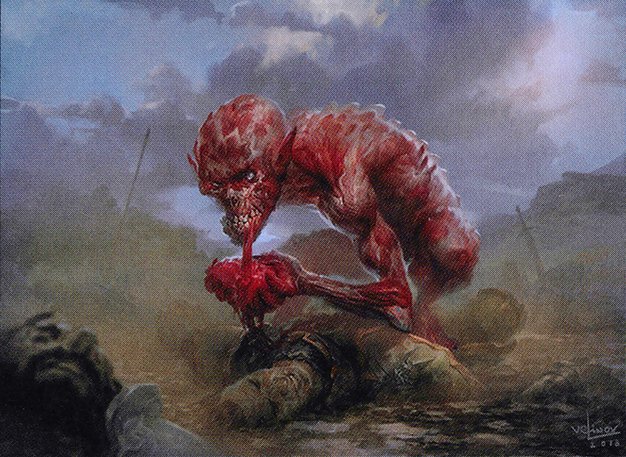
Carrion Feeder card art
Live Play Data

Carrion Feeder

{B} · Creature — Zombie · Modern Horizons (MH1)
4%
Live Inclusion
Times Brought
610
Decks Running
320
Median Cast Turn
5
Drawn → Played
77%
Format

77% of drawn Carrion Feeders are cast before the game ends, and decks that resolve it win 36% of the time compared to 25% when it stays buried in the library.

Carrion Feeder is a one-mana Zombie that turns surplus creatures into permanent +1/+1 counters, and Playgroup Live's multiplayer data backs up its long-standing reputation as a sacrifice-strategy staple. Found in 320 of 8560 tracked decks, it shows up wherever black wants a free, repeatable sacrifice outlet.

When a copy reaches a player's hand, it is cast 77% of the time. Median first cast lands on turn 5, though the distribution skews early: the single most common cast turn is turn 1, reflecting how often players keep it in their opening hand and deploy it immediately to set up an engine. The remaining casts spread across the mid-game as the card arrives off the top of the deck.

The commander spread is wide. 297 distinct players have brought Carrion Feeder to a tracked game, and no single player accounts for more than a small fraction of instances. That breadth reflects a card that earns its slot across many different sacrifice and graveyard archetypes rather than being carried by one popular deck.

At a glance
  • 4% of tracked Commander decks include Carrion Feeder
  • 77% of drawn copies are cast before the game ends
  • T5 median first-cast turn, with turn 1 the single most common cast turn
  • 49% battlefield stickiness once cast, reflecting how often it trades, sacrifices, or is removed
  • 36% win rate in games where Carrion Feeder resolved
  • 297 distinct players have brought it to a tracked game, a well-spread dataset

First-cast turn

n=113
15%
T1
6%
T2
10%
T3
11%
T4
11%
T5
42%
T6-9
5%
T10+
Median 5 P25 3 · P75 7 · max 13
On curve 15% (17 / 113 cast on T1) Cast same turn as drawn 61%

The "good card" funnel

612 brought · 297 players
Brought to game
612
Ever drawn
146
Reached battlefield
113
Still on board at game end
55
77%

Of 612 Carrion Feeders brought to multiplayer games, 146 were drawn, 113 of those were cast, and roughly half remained on the battlefield through the end of the game.

≥ +1.4pp

Players who cast this card win 36% of the time (n=104) , vs 25% when it never left the library (n=391).

When players drew this card but left it in hand, they won 34% (n=28) — about the same as leaving it in the library. Those players survived long enough to draw it, so the gap above is about the card resolving, not just about surviving.

Observed gap +10.8pp; 95% confidence interval +1.4pp to +20.1pp. Correlational, not causal: powerful payoffs also get cast more often in games you are already winning.

Final zone distribution

163 instances
3.1%
Library
33.7%
Battlefield
39.9%
Graveyard
8.6%
Exile

Most Carrion Feeders end the game in the graveyard or on the battlefield, a split that reflects the card's dual role as a sacrifice outlet that sometimes trades itself away and sometimes snowballs into a finisher.

Commanders that played this card

in tracked games

The commander list skews heavily toward black sacrifice and graveyard archetypes, with Sephiroth, Teysa Karlov, and Wilhelt leading a spread of 297 distinct players. No single commander dominates, signaling broad appeal across the archetype.

Card text
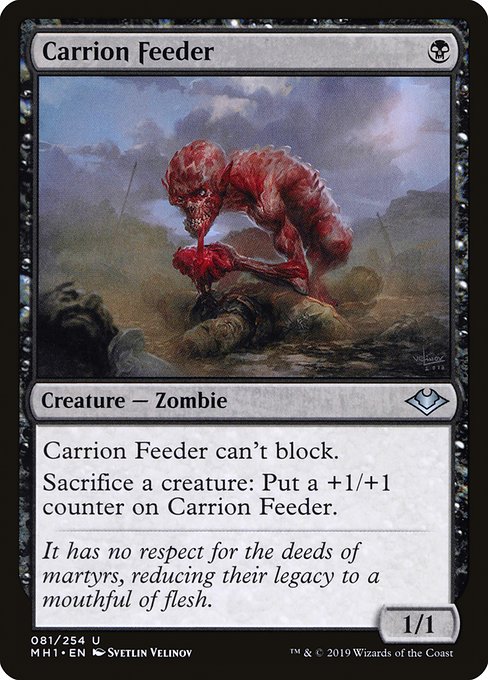
Carrion Feeder card

Carrion Feeder

{B}
Creature — Zombie
This creature can't block. Sacrifice a creature: Put a +1/+1 counter on this creature.
1 / 1
Modern Horizons (MH1) · Uncommon · Illustrated by Svetlin Velinov

Frequently Asked

How often is Carrion Feeder drawn and cast in a Commander game?
Across 596 tracked multiplayer games where Carrion Feeder was in a deck, it was drawn 24% of the time. Of those 146 drawn copies, 77% were cast before the game ended. That draw-to-play figure is on the higher end for a one-mana creature and reflects how immediately useful the card is whenever it arrives.
What turn does Carrion Feeder usually hit the battlefield?
Median first cast is turn 5 in multiplayer. The distribution is notably front-loaded: turn 1 is the mode, accounting for 14 of the 113 casts recorded. A second cluster appears in turns 5-8, representing copies drawn off the top and deployed mid-game. The interquartile range runs from turn 3 to turn 8, so the card's timing varies widely depending on whether it was in the opening hand.
Does casting Carrion Feeder actually improve your chances of winning?
In 104 participations where Carrion Feeder reached the battlefield, the caster won 36% of the time. In 391 participations where it stayed in the library, the win rate was 25%. That is a +10.8 percentage-point gap. The sample is in the right range to treat this as a meaningful directional signal, though Playgroup Live's dataset is still growing and the figure should be read as early evidence rather than a definitive proof.
How sticky is Carrion Feeder on the battlefield?
Battlefield stickiness sits at 49%, meaning roughly half of resolved copies are still in play at the end of the game. For a 1/1 with no evasion or protection, that is a reasonable rate. Carrion Feeder can grow large quickly in a dedicated sacrifice deck, but it also acts as a willing sacrifice target itself, which naturally pulls the stickiness figure down compared to more defensive permanents.
Which commanders most commonly run Carrion Feeder?
In the Playgroup Live dataset, Sephiroth leads the commander list with the most decks, followed by Teysa Karlov and Wilhelt, the Rotcleaver. Meren of Clan Nel Toth and Marchesa, the Black Rose round out the top five. The common thread is black-based sacrifice or graveyard recursion: archetypes that need a free, no-mana-cost outlet to trigger on demand. The spread across 297 unique players means no single playgroup is driving the numbers.
Is Carrion Feeder legal in Commander? What about other formats?
Carrion Feeder is legal in Commander, Duel Commander, Legacy, Modern, Pauper, Vintage, Oathbreaker, and Pauper Commander. It is not legal in Standard, Pioneer, Alchemy, Brawl, or Historic. Its combination of zero-mana activation and no restriction on sacrifice target makes it strong in any format that tolerates it, and its inclusion in Modern Horizons gave it wide competitive reach.