collections_bookmark Part of Duskmourn: House of Horror auto_awesome #13 in Orzhov Commander Staples
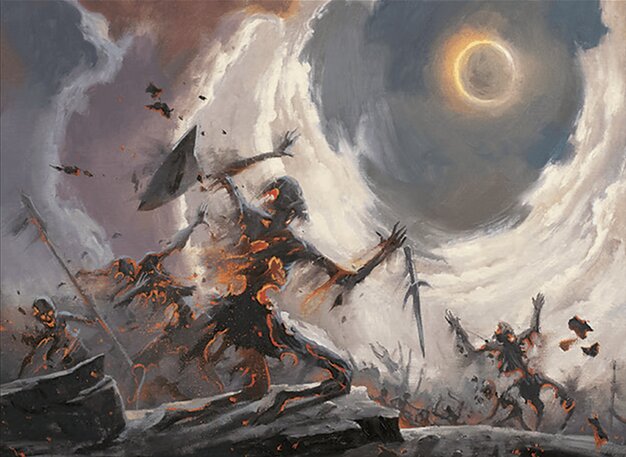
Damn card art
Live Play Data

Damn

{B} {B} · Sorcery · The Lost Caverns of Ixalan Commander (LCC)
12%
Live Inclusion
Times Brought
860
Decks Running
442
Median Cast Turn
7.0
Drawn → Played
61%
Format

Damn sits in 12% of tracked Commander decks and lands on turn 7.0 at the median, with 61% of drawn copies reaching the cast step before the game ends.

Damn earns its slot in 12% of the 3790 Commander decks tracked on Playgroup Live, a solid share for a two-mana removal spell that scales into a one-sided board wipe with Overload. It has appeared in 442 distinct decks across 836 tracked games.

The draw-to-play rate of 61% reflects how often a drawn copy reaches the cast step before the game concludes. That figure sits just below the format average for targeted removal, consistent with a spell players hold for the right moment rather than slamming on sight. Median first cast lands on turn 7.0, a touch later than pure single-target removal tends to resolve, which is consistent with players waiting for a high-value Overload window rather than using the 2-mana mode early.

The commander spread is notably healthy: 391 distinct players have brought Damn to a tracked game, and no single contributor accounts for more than a small slice of observations. Orzhov and Esper commanders dominate the top of the list, which tracks with the card's black-white color identity.

At a glance
  • 12% of tracked Commander decks run Damn
  • 23% draw rate across tracked participations
  • 61% of drawn copies were cast before the game ended
  • T7.0 median first-cast turn
  • 391 distinct players have brought Damn to a tracked game
  • 122 total times cast across all tracked games

First-cast turn

n=122
2%
T1
0%
T2
2%
T3
10%
T4
7%
T5
61%
T6-9
18%
T10+
Median 7.0 P25 6 · P75 9 · max 25
Cast same turn as drawn 31%

The "good card" funnel

861 brought · 391 players
Brought to game
861
Ever drawn
199
Reached battlefield
122
Still on board at game end
12
61%

Of 861 copies brought to tracked games, 199 were drawn and 122 of those were cast, with the large majority resolving to the graveyard as expected for a sorcery.

≥ -8.2pp

Players who cast this card win 28% of the time (n=104) , vs 27% when it never left the library (n=567).

When players drew this card but left it in hand, they won 24% (n=67) — about the same as leaving it in the library. Those players survived long enough to draw it, so the gap above is about the card resolving, not just about surviving.

Observed gap +0.4pp; 95% confidence interval -8.2pp to +9.0pp. Correlational, not causal: powerful payoffs also get cast more often in games you are already winning.

Final zone distribution

225 instances
3.1%
Library
5.3%
Battlefield
56.0%
Graveyard
8.9%
Exile

Most of Damn's tracked copies end the game in the graveyard, the expected final zone for a sorcery, while a small fraction remain in hand when games conclude, reflecting players holding for an Overload that never arrived.

Commanders that played this card

in tracked games

Edgar Markov, Temmet, and Kaalia of the Vast sit at the top, but the list spans Orzhov, Esper, and Mardu commanders, a spread consistent with Damn filling a role across the wider black-white slice of the format.

Card text
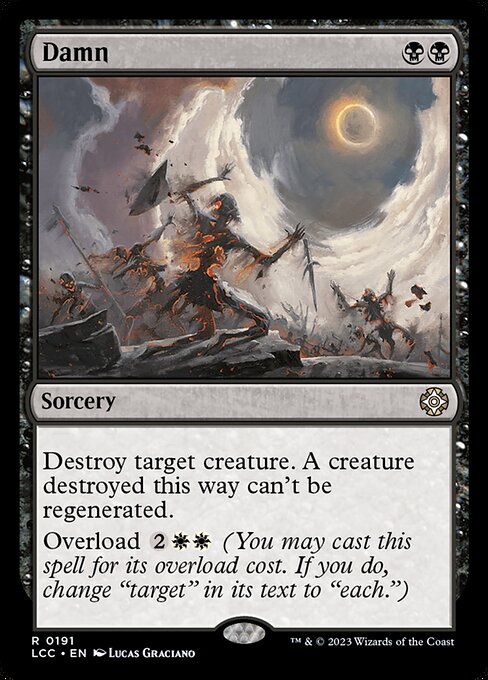
Damn card

Damn

{B} {B}
Sorcery
Destroy target creature. A creature destroyed this way can't be regenerated. Overload {2}{W}{W} (You may cast this spell for its overload cost. If you do, change "target" in its text to "each.")

The Lost Caverns of Ixalan Commander (LCC) · Rare · Illustrated by Lucas Graciano

Frequently Asked

How often is Damn drawn and cast in a Commander game?
Across 836 tracked Commander games where Damn was in a deck, it was drawn 23% of the time. That is expected for a singleton in a 100-card deck. Of the 199 copies that reached a player's hand, 61% were cast before the game ended. The remainder were most often held at end of game or the game concluded while the card sat in hand.
What turn does Damn typically get cast?
Median first cast is turn 7.0, with the 25th percentile at turn 6 and the 75th at turn 9. That spread reflects the dual nature of the card: the cheap 2-mana single-target mode gets cast earlier, while players holding for an Overload board wipe push the distribution toward later turns. The max observed cast in the dataset was turn 25, confirming some players wait a very long time for the right Overload window.
Does casting Damn actually improve your win rate?
In the current dataset, the win rate when cast is 28% versus 27% when the card stayed in the library. The delta is small and the sample on the cast side is 104 observations, well below a threshold for confident conclusions. Treat this as a directional signal only. The cast-vs-library delta is near zero, which is common for reactive removal spells: they prevent losses more than they generate wins, an effect this metric does not capture.
Is Damn legal in Commander?
Yes. Damn is legal in Commander, Legacy, Modern, Vintage, Historic, Timeless, and several other formats. It is not legal in Standard, Pioneer, Pauper, or Pauper Commander. Its color identity is black and white, which restricts it to commanders that include both colors.
Which commanders most often run Damn?
Among tracked decks on Playgroup Live, Edgar Markov, Temmet Naktamun's Will, and Kaalia of the Vast lead the count. All three commanders sit in black-white or black-white-adjacent color identities. The spread across 391 unique players and multiple commander archetypes suggests Damn is a broadly adopted removal option rather than a card concentrated in one niche build.
How does Damn compare to other board wipes in Commander?
Damn's edge over comparable board wipes is flexibility: the 2-mana mode handles a single problematic creature early, while Overload at 4 mana ({2}{W}{W}) acts as a full board wipe that skips regeneration. That flexibility justifies the inclusion in decks that would otherwise need two separate slots. What we see so far on Playgroup Live is a median cast on turn 7.0, suggesting players treat it primarily as a mid-game tool rather than an early interaction piece.