
collections_bookmark Part of Commander Legends: Battle for Baldur's Gate
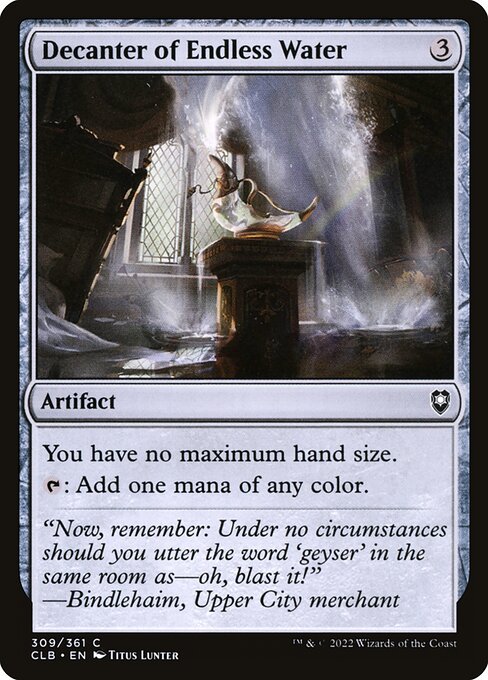
Decanter of Endless Water card art
Live Play Data

Decanter of Endless Water

{3} · Artifact · Commander Legends: Battle for Baldur's Gate (CLB)

3%
Live Inclusion
Times Brought
662
Decks Running
368
Median Cast Turn
5
Drawn → Played
66%
Format

3% of tracked Commander decks run Decanter of Endless Water. When drawn, 66% of copies reach the battlefield, with a median first-cast turn of 5.

Decanter of Endless Water sits in 3% of the 12310 Commander decks tracked on Playgroup Live. That is a niche slot, yet the card draws a notably consistent player base. 291 distinct players have brought it to a tracked game, and the single heaviest contributor accounts for just 4% of all instances, a well-spread signal.

The card pulls double duty: it removes your maximum hand size and taps for one mana of any color. At 3 mana, it competes with faster rocks, which explains why it tends to land later than curve. The median first-cast turn is 5, and only 33% of casts land exactly on curve. Most copies arrive after players have already established a mana base and are looking for the hand-size upside rather than raw acceleration. Once it resolves, 80% of cast copies survive through end of game, a strong retention number for a colorless artifact.

The top commander homes are hand-size and card-draw engines: Y'shtola, Nekusar, Ovika, Xyris, and Atemsis all reward flooding a large hand. That thematic clustering explains a lot about when and why players choose Decanter over a more conventional mana rock.

At a glance
  • 3% of tracked Commander decks include Decanter of Endless Water
  • 66% of drawn copies reach the battlefield before the game ends
  • T5 median first-cast turn, typically after the mana base is set
  • 80% battlefield stickiness once the Decanter resolves
  • 291 distinct players have brought this card to a tracked game
  • 33% of casts land exactly on the 3-mana curve turn

First-cast turn

n=123
2%
T1
10%
T2
21%
T3
12%
T4
15%
T5
33%
T6-9
8%
T10+
Median 5 P25 3 · P75 7 · max 14
On curve 33% (26 / 123 cast on T3) Cast same turn as drawn 34%

The "good card" funnel

662 brought · 291 players
Brought to game
662
Ever drawn
187
Reached battlefield
123
Still on board at game end
98
66%

Of 662 Decanters brought to games, 187 were drawn, 123 were cast, and the bulk of those resolved copies stayed on the battlefield through end of game.

≥ -0.5pp

Players who cast this card win 34% of the time (n=121) , vs 26% when it never left the library (n=422).

When players drew this card but left it in hand, they won 37% (n=62) — about the same as leaving it in the library. Those players survived long enough to draw it, so the gap above is about the card resolving, not just about surviving.

Observed gap +8.3pp; 95% confidence interval -0.5pp to +17.1pp. Correlational, not causal: powerful payoffs also get cast more often in games you are already winning.

Final zone distribution

201 instances
4.0%
Library
48.8%
Battlefield
14.9%
Graveyard
5.5%
Exile

Most Decanters never leave the library, a structural reality of 100-card singleton. Of those that do reach play, the vast majority end the game on the battlefield, consistent with low artifact removal rates in typical Commander pods.

Commanders that played this card

in tracked games

The commander list skews heavily toward blue and hand-size strategies. Y'shtola leads by a clear margin, followed by a cluster of draw-engine commanders. The spread across ten distinct names suggests the card is not a one-deck wonder.

Frequently Asked

How often is Decanter of Endless Water drawn in a Commander game?
Across 630 tracked games where the card was in the deck, it was drawn 28% of the time. That is consistent with what you expect from a singleton in a 100-card deck. Of 187 instances that reached a player's hand, 66% were cast before the game ended. The remainder were mostly stranded by a game ending before the player could act.
What turn does Decanter of Endless Water typically hit the battlefield?
The median first-cast turn is 5, with the distribution running from turn 2 through the mid-game. Only 33% of casts land exactly on turn 3. The majority of copies arrive after turn 3, suggesting players often pick it up later in a draw engine's value loop rather than deploying it as an opening accelerant. Check the hand-to-cast data: the median copy sits in hand for one turn before being cast.
Is Decanter of Endless Water legal in Commander?
Yes. Decanter of Endless Water is legal in Commander, Duel Commander, Oathbreaker, Pauper Commander, Legacy, Vintage, and Pauper. It is not legal in Standard, Pioneer, Modern, Alchemy, Historic, or Brawl. Its colorless identity means it fits into any Commander deck regardless of color restrictions.
Which commanders most often pair with Decanter of Endless Water?
The strongest theme across the top commander homes is hand size and card draw. Y'shtola (Night's Blessed), Nekusar (the Mindrazer), Ovika (Enigma Goliath), Xyris (the Writhing Storm), and Atemsis (All-Seeing) all appear prominently. Each of those commanders generates value from drawing extra cards or punishes opponents for drawing, making unlimited hand size a genuine strategic asset rather than a corner-case perk.
Does casting Decanter of Endless Water correlate with winning?
Participations where the Decanter was cast show a win rate of 34% across 121 observations. Participations where it stayed in the library show 26% across 422 observations. The gap is +8.3 percentage points. Both sample sizes are solid, but the confidence interval on this delta is wide enough that the lift should be read as a directional early signal rather than a firm conclusion.
How sticky is Decanter of Endless Water once it resolves?
80% of cast Decanters are still on the battlefield when the game ends. That is high for a 3-mana artifact with no protection. Artifacts are less commonly targeted than creatures, and the card's passive benefit means opponents have little reason to spend removal on it unless they are specifically fighting a hand-size strategy. The final zone data reflects that: most resolved copies simply stay put.