
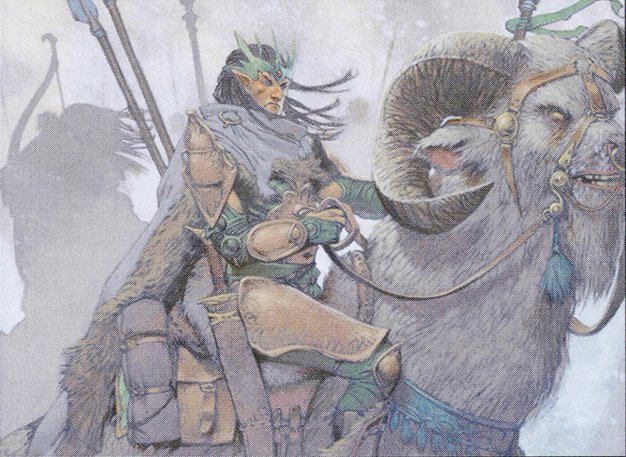
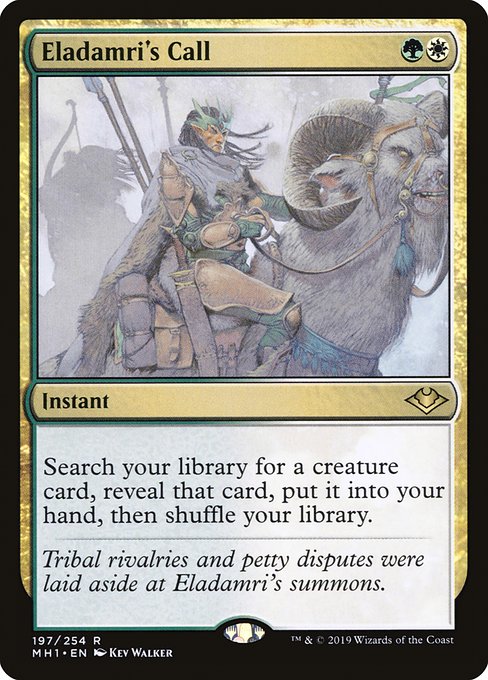
Eladamri's Call

 ·
Instant
·
Modern Horizons (MH1)
·
Instant
·
Modern Horizons (MH1)
Eladamri's Call lands in 8% of tracked Commander decks and is cast a median turn 5, with 64% of drawn copies reaching the stack before the game ends.
Eladamri's Call is the format's go-to creature tutor for Green-White strategies. Across 649 tracked multiplayer Commander games on Playgroup Live, it appears in 318 of 3756 distinct decks, a 8% inclusion rate that reflects how broadly creature-centric the format remains.
As an instant, it resolves and goes straight to the graveyard, so the key question is simply: when do players find it and pull the trigger? The median first cast lands on turn 5, with a wide spread from turn 1 through turn 11. Of 157 drawn copies, 64% were cast before the game concluded. The remaining copies mostly reflect games that ended while the card was still in hand, not players choosing to sit on it. The hand-to-cast data reinforces this: the median delay between drawing and casting is 1 turn, and 44% of cast copies were played on the same turn they were drawn.
The commander spread is notably wide. 272 distinct players have brought Eladamri's Call to a tracked game, and the single heaviest contributor accounts for only 5% of all instances, a healthy distribution that gives the numbers real breadth. The top commanders are a mix of five-color tribal piles and focused Green-White creature strategies, consistent with a card that rewards dense creature counts regardless of archetype.
- 8% of tracked Commander decks include Eladamri's Call
- 23% draw rate, expected for a singleton in a 100-card deck
- 64% of drawn copies were cast before the game ended
- T5 median first-cast turn across tracked games
- 44% of cast copies played on the same turn they were drawn
- 272 distinct players have brought this card to a tracked game
First-cast turn
n=101The "good card" funnel
684 brought · 272 playersOf 684 copies brought to games, 157 were drawn, 101 of those were cast, and nearly all resolved cleanly to the graveyard as the instant found its target.
Players who cast this card win 30% of the time (n=94) , vs 26% when it never left the library (n=467).
When players drew this card but left it in hand, they won 20% (n=52) — about the same as leaving it in the library. Those players survived long enough to draw it, so the gap above is about the card resolving, not just about surviving.
Observed gap +3.9pp; 95% confidence interval -5.1pp to +13.0pp. Correlational, not causal: powerful payoffs also get cast more often in games you are already winning.
Final zone distribution
171 instancesEladamri's Call is an instant that resolves to the graveyard, so the library share of final zones largely reflects copies that were never drawn in a 100-card singleton deck, not copies that were cast and returned.
Commanders that played this card
in tracked games-
1
Rin and Seri, Inseparable
 15 decks
-
2
Baylen, the Haymaker
12 decks
-
3
Avatar Aang // Aang, Master of Elements

 11 decks
-
4
The First Sliver
11 decks
-
5
Voja, Jaws of the Conclave
9 decks
-
6
Aragorn, the Uniter
7 decks
-
7
Cloud, Ex-SOLDIER
7 decks
-
8
Helga, Skittish Seer
7 decks
-
9
Najeela, the Blade-Blossom
7 decks
-
10
Ulalek, Fused Atrocity
7 decks
The top-commander list spans tribal five-color piles and focused Green-White creature strategies, showing that Eladamri's Call earns its slot wherever creature density is high and finding one specific creature matters.
Eladamri's Call