
collections_bookmark Part of Commander Legends: Battle for Baldur's Gate
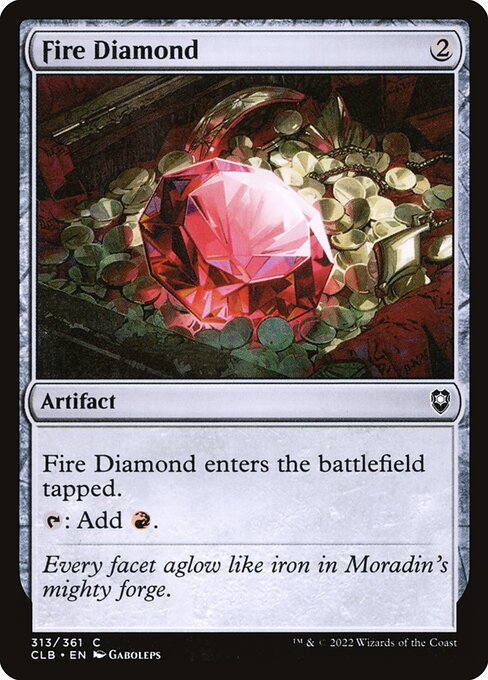
Fire Diamond card art
Live Play Data

Fire Diamond

{2} · Artifact · Commander Legends: Battle for Baldur's Gate (CLB)
3%
Live Inclusion
Times Brought
659
Decks Running
335
Median Cast Turn
3.0
Drawn → Played
78%
Format

78% of drawn Fire Diamonds are cast before the game ends, and once it resolves, 82% of copies stay on the battlefield through end of game.

Fire Diamond is a red mana rock that enters tapped, making it a turn-slower than the format's premium accelerants. Across 637 tracked multiplayer Commander games on Playgroup Live, it sits in 335 of 10538 distinct decks, a 3% inclusion rate that reflects its narrow color restriction: only red or red-adjacent decks can run it.

When players do draw it, 78% of copies reach the battlefield. Median first cast lands on turn 3.0, which is reasonable for a 2-mana rock that arrives tapped. The 82% stickiness figure tells the more useful story: artifact removal is sparse enough in most pods that Fire Diamond, once in play, almost always stays there.

The commander spread is heavily weighted toward mono-red and red-primary builds. Krenko, Mob Boss leads the list by a wide margin, reinforcing that Fire Diamond is a workhorse mana fixer for commanders who have no access to green ramp or blue card selection. Data is well-distributed across 307 unique players, with no single contributor accounting for more than a small fraction of tracked games.

At a glance
  • 3% inclusion rate across tracked Commander decks, gated by red color identity
  • T3.0 median first-cast turn, typical for a tapped 2-mana rock
  • 78% of drawn copies reach the battlefield before the game ends
  • 82% battlefield stickiness once cast
  • 307 unique players have brought Fire Diamond to a tracked game, a well-spread sample
  • 43% of casts land exactly on curve at turn 2

First-cast turn

n=138
20%
T1
24%
T2
11%
T3
12%
T4
7%
T5
25%
T6-9
2%
T10+
Median 3.0 P25 2 · P75 6 · max 24
On curve 43% (33 / 138 cast on T2) Cast same turn as drawn 57%

The "good card" funnel

659 brought · 307 players
Brought to game
659
Ever drawn
177
Reached battlefield
138
Still on board at game end
113
78%

Of 659 Fire Diamonds brought to games, 177 were drawn, 138 of those were cast, and the strong majority stayed on the battlefield through end of game.

≥ -4.1pp

Players who cast this card win 26% of the time (n=130) , vs 23% when it never left the library (n=401).

When players drew this card but left it in hand, they won 17% (n=36) — about the same as leaving it in the library. Those players survived long enough to draw it, so the gap above is about the card resolving, not just about surviving.

Observed gap +3.7pp; 95% confidence interval -4.1pp to +11.5pp. Correlational, not causal: powerful payoffs also get cast more often in games you are already winning.

Final zone distribution

193 instances
2.6%
Library
58.5%
Battlefield
20.2%
Graveyard
5.2%
Exile

The vast majority of Fire Diamonds never leave the library in a given game, which is structural for any singleton in a 100-card deck and not a knock on the card's usefulness when drawn.

Commanders that played this card

in tracked games

Krenko, Mob Boss leads by a wide margin, and the rest of the list is almost entirely mono-red or red-primary builds, confirming Fire Diamond is a color-restricted role-player rather than a format-wide staple.

Card text
Fire Diamond card

Fire Diamond

{2}
Artifact
This artifact enters tapped. {T}: Add {R}.
Commander Legends: Battle for Baldur's Gate (CLB) · Common · Illustrated by Gaboleps

Frequently Asked

How often is Fire Diamond drawn in a Commander game?
In 637 tracked multiplayer games where Fire Diamond was in the deck, it was drawn 27% of the time. That is consistent with what you expect from a singleton in a 100-card deck. Of 177 instances that reached a player's hand, 78% were cast before the game concluded. The remainder mostly reflects games that ended before the player had a good window to deploy it.
What turn does Fire Diamond typically hit the battlefield?
The median first-cast turn is 3.0. The distribution shows a cluster of early casts in turns 1-2 from opening-hand draws, then a second concentration in the mid-game. The card enters tapped, so its ramp payoff is always delayed one full turn relative to untapped alternatives like Arcane Signet. That tempo cost is why players who draw it late often wait for the right moment rather than casting it immediately.
Does casting Fire Diamond actually improve your win rate?
The early data shows a +3.7 percentage-point lift in win rate for games where Fire Diamond was cast versus games where it stayed in the library. Both sample buckets are reasonably sized (130 cast observations, 401 library observations), so this is a directional positive signal, though not conclusive at this dataset scale. Interpret it as consistent with the card doing its job rather than proof of outsized impact.
Which commanders most commonly run Fire Diamond?
Krenko, Mob Boss leads the tracked data by a clear margin. The broader list is almost entirely mono-red or red-primary commanders, which makes sense: Fire Diamond's color identity restricts it to decks that can access red, and those decks often lack green ramp. Commanders with access to green generally have faster, untapped alternatives, so Fire Diamond fills a specific niche for red-heavy builds.
Is Fire Diamond legal in Commander?
Yes. Fire Diamond is legal in Commander, Duel Commander, Pauper Commander, Oathbreaker, Legacy, Vintage, and several other formats. It is not legal in Standard, Pioneer, Modern, Historic, Brawl, or Alchemy. In Pauper Commander it is a common, so it sees play there as well.
How does Fire Diamond compare to other red mana rocks?
Fire Diamond enters tapped, which separates it from Arcane Signet and Talisman of Indulgence. That one-turn delay is a real cost in faster pods. Its advantage is availability: as a common with no color restrictions beyond red identity, it fills a slot when better options are unavailable or over budget. The 82% stickiness figure suggests that once it resolves, it does its job reliably for the rest of the game.