
bolt Game Changer on the MTG Commander Game Changers list
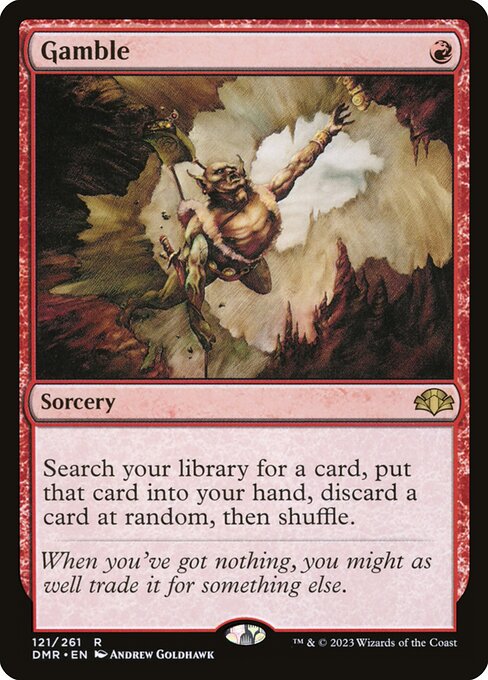
Gamble card art
Live Play Data

Gamble

{R} · Sorcery · Dominaria Remastered (DMR)
6%
Live Inclusion
Times Brought
723
Decks Running
372
Median Cast Turn
5
Drawn → Played
66%
Format

6% of tracked Commander decks run Gamble, and when it lands a player's hand it reaches the stack 66% of the time, with a median first cast on turn 5.

Gamble searches your entire library for any card, then makes you sweat: discard a card at random. That tension is the whole story. It appears in 372 of the 6114 distinct Commander decks tracked on Playgroup Live, an inclusion rate of 6%. That figure is narrow by design. Gamble is not a generalist; it earns its slot in decks built to mitigate the discard or to find a single specific combo piece worth the gamble.

Of the 176 times a copy reached a player's hand across 635 tracked games, 66% were cast before the game ended. Median first cast lands on turn 5, slightly later than you might expect for a one-mana spell. That timing reflects a real pattern: players often wait for a moment when the discard risk is lower, either because their hand is small or because they have a way to recover the discarded card. 54% of drawn copies that were eventually cast resolved on the same turn they were drawn, confirming that when players pull the trigger, they rarely wait.

The commander spread is genuinely wide. 292 distinct players have brought Gamble to a tracked game, and no single contributor accounts for more than a small fraction of instances, which gives the dataset real breadth. Red-primary combo and tutor-hungry shells dominate the top commander slots, from Krenko, Mob Boss to Mr. House, President and CEO.

At a glance
  • 6% of tracked Commander decks include Gamble
  • 66% of drawn Gambles reach the stack before the game ends
  • T5 median first-cast turn across all tracked instances
  • 54% of cast copies resolved on the same turn they were drawn
  • 292 distinct players have brought Gamble to a tracked game
  • 13% of casts landed on-curve for this 1-mana spell

First-cast turn

n=117
13%
T1
9%
T2
11%
T3
9%
T4
15%
T5
38%
T6-9
4%
T10+
Median 5 P25 3 · P75 6 · max 12
On curve 13% (15 / 117 cast on T1) Cast same turn as drawn 54%

The "good card" funnel

723 brought · 292 players
Brought to game
723
Ever drawn
176
Reached battlefield
117
Still on board at game end
4
66%

Of 723 Gambles brought to tracked games, 176 were drawn, 117 of those were cast, and nearly all resolved directly to the graveyard as expected for a sorcery.

≥ -1.7pp

Players who cast this card win 34% of the time (n=111) , vs 27% when it never left the library (n=462).

When players drew this card but left it in hand, they won 35% (n=55) — about the same as leaving it in the library. Those players survived long enough to draw it, so the gap above is about the card resolving, not just about surviving.

Observed gap +7.0pp; 95% confidence interval -1.7pp to +15.7pp. Correlational, not causal: powerful payoffs also get cast more often in games you are already winning.

Final zone distribution

199 instances
1.5%
Library
2.0%
Battlefield
68.3%
Graveyard
9.0%
Exile

Gamble is a sorcery that resolves to the graveyard, so the dominant final zone is graveyard; most copies that were never interacted with simply stayed in the library for the whole game, which is the normal fate of any singleton in a 100-card deck.

Commanders that played this card

in tracked games

The commander distribution is spread across many red-inclusive strategies, with Krenko, Mob Boss holding the largest single share at 17 decks, a relatively small concentration given the total pool of 372 decks running the card.

Frequently Asked

How often is Gamble drawn in a Commander game?
Across 635 tracked games where Gamble was in the deck, it was drawn 24% of the time. That's roughly in line with base rates for a singleton in a 100-card deck. Of those 176 drawn copies, 66% were cast. The remainder were mostly copies drawn late in a game that ended before the player could act.
What turn does Gamble typically get cast?
The median first-cast turn is 5, with a mean slightly below 5. For a one-mana spell that's late, and it reflects a genuine behavioral signal: players tend to hold Gamble until they have a specific target in mind or until their hand is small enough that a random discard is low-risk. 54% of cast copies resolved the same turn they were drawn, so hesitation is rare once a player decides to go.
Does casting Gamble actually improve your win rate?
In 111 participations where Gamble resolved, the normalized win rate was 34%. In participations where it stayed in the library, the rate was 27%. The gap is +7.0 percentage points. Both sample sizes are large enough to call this directional, but the confidence interval still crosses zero, so treat it as an early signal rather than a firm conclusion. Gamble finding your best card clearly helps; sometimes you also discard that card, which hurts.
Is Gamble legal in Commander?
Yes. Gamble is legal and unrestricted in Commander, as well as in Legacy, Vintage, Historic, Timeless, and several other formats. It is not legal in Modern, Pioneer, or Standard. In Commander it acts as a budget-accessible tutor that fits any red deck, trading the consistency of black tutors for a single-mana cost and the element of chance.
Why does Gamble have such a low on-curve rate for a one-mana spell?
13% of casts landed on turn 1, which is the on-curve turn for a 1-mana spell. Most copies that arrive in hand after the opening turns are cast later when a relevant target appears, not immediately. A low on-curve rate here almost entirely reflects 'card wasn't in the opening hand' rather than players choosing to wait. Cross-referencing with the 54% same-turn cast rate confirms that when players do draw it and have a use for it, they cast it right away.
Which commanders most often run Gamble?
Krenko, Mob Boss leads the multiplayer top-commanders list by deck count, followed by Mr. House, President and CEO, Zndrsplt, Eye of Wisdom, and Etali, Primal Conqueror. The common thread is red-heavy decks that want one specific card reliably, whether that's a combo enabler, a token doubler, or a key equipment. Gamble fills the tutor role for colors that normally lack reliable library search.