
collections_bookmark
Part of Duskmourn: House of Horror


 ·
Creature — Gremlin
·
Duskmourn: House of Horror (DSK)
Live Play Data
Irreverent Gremlin
·
Creature — Gremlin
·
Duskmourn: House of Horror (DSK)
0%
Live Inclusion
Times Brought
207
Decks Running
108
Median Cast Turn
4
Drawn → Played
78%
Format
First-cast turn
n=31
0%
T1
23%
T2
19%
T3
16%
T4
3%
T5
32%
T6-9
6%
T10+
Median
4
P25
3
· P75
7
· max
13
On curve
23%
(7 / 31 on or before T2)
Cast same turn as drawn
30%
The "good card" funnel
207 brought · 104 playersBrought to game
207
Ever drawn
40
Reached battlefield
31
Still on board at game end
14
Once cast, 45% of this card is still on the battlefield at game end. This reflects how often it survives removal, not just whether it's a permanent.
Final zone distribution
44 instances2.3%
Library
31.8%
Battlefield
45.5%
Graveyard
13.6%
Exile
Commanders that played this card
in tracked games-
1
Norin the Wary
49 decks
-
2
Arabella, Abandoned Doll
 26 decks
-
3
Vincent, Vengeful Atoner
15 decks
-
4
Rocco, Cabaretti Caterer
 7 decks
-
5
J. Jonah Jameson
2 decks
-
6
Alesha, Who Laughs at Fate
 1 decks
-
7
Alesha, Who Smiles at Death
1 decks
-
8
Duke Ulder Ravengard
1 decks
-
9
Jandor, Fortuned Traveler
1 decks
-
10
Mabel, Heir to Cragflame
1 decks
Card text
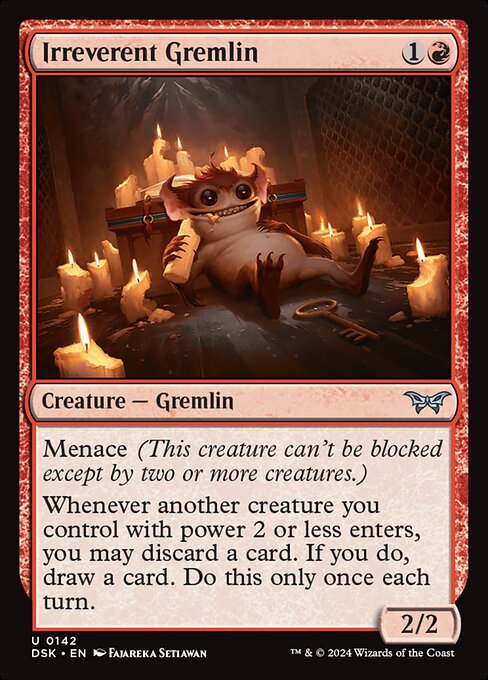
Irreverent Gremlin
Creature — Gremlin
Menace (This creature can't be blocked except by two or more creatures.)
Whenever another creature you control with power 2 or less enters, you may discard a card. If you do, draw a card. Do this only once each turn.
2 / 2
Duskmourn: House of Horror (DSK)
·
Uncommon
·
Illustrated by Fajareka Setiawan
Frequently Asked
Why isn't there more data on this card?
Playgroup Live collects per-card gameplay data from real Commander games. Play counts appear once a card reaches 100 tracked games, and the full charts need a sample of at least 25 observed games that is not dominated by a single pilot. Until this card clears those bars you're seeing only the basic counts. Stats refresh nightly.
How is Playgroup Live card data collected?
Players using Playgroup Live import their decklists before a game and log card actions as they play. Each cast, zone change, and resolution is recorded as a real game event. Stats on this site are computed from those events, not from decklist scrapes or theorycrafting. Playgroup has recorded 790,000+ Commander games overall, and this card-level play data comes from the Playgroup Live seats playing virtual cards, a subset of that corpus.