auto_awesome #21 in Colorless Commander Staples
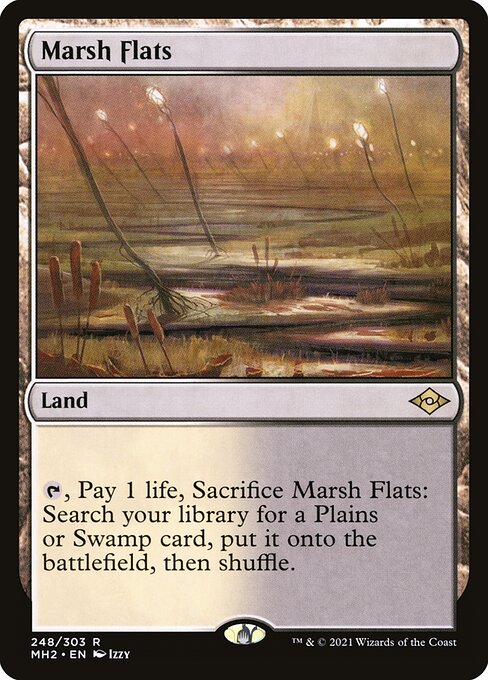
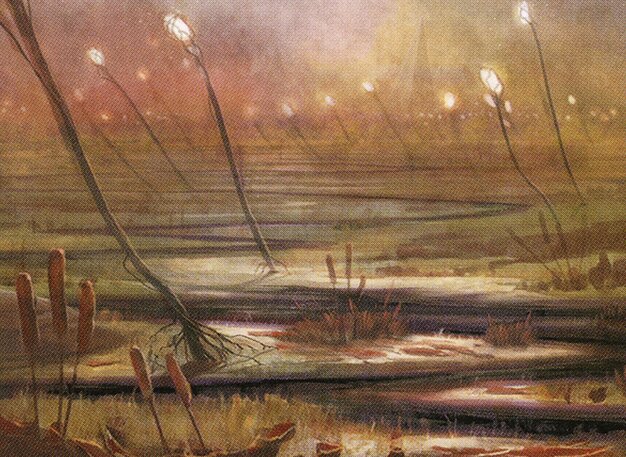
Marsh Flats card art
Live Play Data

Marsh Flats

Land · Modern Horizons 2 (MH2)
10%
Live Inclusion
Times Brought
3242
Decks Running
1655
Median Cast Turn
3.0
Drawn → Played
74%
Format

Marsh Flats appears in 10% of tracked Commander decks and, when drawn, reaches the battlefield 74% of the time, with a median first activation on turn 3.0.

Marsh Flats is one of the ten Zendikar fetchlands legal in Commander, and Playgroup Live's multiplayer data puts it in 10% of tracked decks. That means 1655 of 17176 distinct decks have brought it to a live game. Its colorless identity makes it eligible anywhere Plains or Swamp appear, keeping it a fixture of white-black, Esper, Mardu, and five-color lists.

The core behavioral story is how reliably a drawn copy gets used. 74% of drawn Marsh Flats are activated before the game ends. Most copies sit in hand for zero turns before being cracked: median hand-to-cast delay is 0 turns, and 59% of drawn copies are activated the same turn they are drawn. Fetchlands reward early play, and players act on that. Median first activation lands on turn 3.0.

The commander distribution is notably wide. 976 distinct players have brought Marsh Flats to a tracked game, and the single heaviest contributor accounts for only 2% of all instances. That spread means the data is not being skewed by one prolific pilot. The top commanders by raw deck count are dominated by five-color and white-black-red archetypes, consistent with what you would expect from a fetchland that hits Plains and Swamp.

At a glance
  • 10% of tracked Commander decks include Marsh Flats
  • 74% of drawn copies are activated before the game ends
  • 59% same-turn activation rate once drawn
  • T3.0 median turn of first activation
  • 976 distinct players have brought Marsh Flats to a tracked game
  • 24% draw rate per game, typical for a singleton in a 100-card deck

First-cast turn

n=564
26%
T1
14%
T2
10%
T3
12%
T4
10%
T5
23%
T6-9
5%
T10+
Median 3.0 P25 1 · P75 6 · max 16
Cast same turn as drawn 59%

The "good card" funnel

3245 brought · 976 players
Brought to game
3245
Ever drawn
765
Reached battlefield
564
Still on board at game end
54
74%

Of 3245 Marsh Flats brought to games, 765 were drawn, 564 of those were activated, and nearly all resolved copies ended in the graveyard as expected for a sacrifice-based fetchland.

≥ -0.5pp

Players who cast this card win 29% of the time (n=510) , vs 26% when it never left the library (n=2050).

When players drew this card but left it in hand, they won 29% (n=180) — about the same as leaving it in the library. Those players survived long enough to draw it, so the gap above is about the card resolving, not just about surviving.

Observed gap +3.4pp; 95% confidence interval -0.5pp to +7.4pp. Correlational, not causal: powerful payoffs also get cast more often in games you are already winning.

Final zone distribution

876 instances
3.1%
Library
6.2%
Battlefield
62.8%
Graveyard
12.8%
Exile

Fetchlands are designed to self-destruct: the graveyard is the dominant final zone by a wide margin, with only a small share of copies ending in exile (from effects like Soul-Guide Lantern) or stranded in hand when the game ends.

Commanders that played this card

in tracked games

The top-commander list spans five-color, Mardu, Esper, and white-black builds, reflecting Marsh Flats' broad eligibility across any deck with Plains or Swamp in its mana base rather than a concentration in one archetype.

Card text
Marsh Flats card

Marsh Flats

Land
{T}, Pay 1 life, Sacrifice this land: Search your library for a Plains or Swamp card, put it onto the battlefield, then shuffle.
Modern Horizons 2 (MH2) · Rare · Illustrated by Izzy

Frequently Asked

How often is Marsh Flats drawn in a Commander game?
Across 2598 tracked multiplayer games where Marsh Flats was in the deck, it was drawn 24% of the time. That is in line with the baseline expectation for a singleton in a 100-card deck. Of 765 drawn copies, 74% were activated before the game ended, which is high for a land that costs a life and sacrifices itself.
What turn does Marsh Flats usually get cracked?
The median first-activation turn is 3.0, with a clear cluster at turn 1 from opening-hand copies. The distribution extends to turn 16 in the dataset, but the 25th percentile sits at turn 1 and the 75th percentile at turn 6. Most players crack it early to fix mana rather than holding it.
Does activating Marsh Flats correlate with winning?
In 510 participations where Marsh Flats was activated, the normalized win rate is 29%. In participations where it stayed in the library, the rate is 26%. The delta is +3.4 percentage points. The confidence interval on that delta currently crosses zero, so treat this as a directional early signal rather than a proven edge. The more meaningful takeaway is that the card does its job quietly: it fixes mana and rarely puts its controller at a disadvantage.
Is Marsh Flats banned anywhere?
Marsh Flats is legal in Commander, Legacy, Modern, Vintage, Duel Commander, and several other formats. It is banned in Historic. It is not legal in Standard, Pioneer, Pauper, or Pauper Commander. Its absence from Pioneer is notable given the fetchland ban there, and its exclusion from Pauper is simply a rarity issue, as it is a rare.
Why does Marsh Flats appear in so many different Commander archetypes?
Fetchlands carry no color identity in Commander because their activation uses only generic mana and basic land types. Marsh Flats can go into any deck that runs Plains or Swamp, which covers white-black, Esper, Mardu, Abzan, Sultai-adjacent splashes, and five-color lists. That breadth explains the wide commander spread seen in the top-commanders chart, from The Ur-Dragon to Edgar Markov to Oloro, Ageless Ascetic.
How concentrated is the Marsh Flats data across players?
976 unique players have brought Marsh Flats to a tracked game on Playgroup Live. The single most active contributor accounts for 2% of all instances, well under the 15% threshold that would signal a concentration concern. The data is well-spread, which adds confidence to the directional signals we see in the usage patterns.