
collections_bookmark Part of Lorwyn Eclipsed

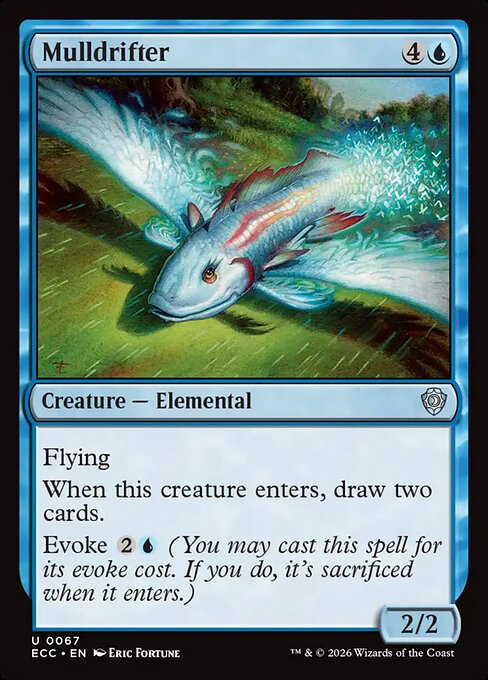
Mulldrifter card art
Live Play Data

Mulldrifter

{4} {U} · Creature — Elemental · Lorwyn Eclipsed Commander (ECC)
4%
Live Inclusion
Times Brought
480
Decks Running
285
Median Cast Turn
6
Drawn → Played
74%
Format

74% of drawn Mulldrifters are cast before the game ends, and the card shows a +7.7 percentage-point win-rate lift over games where it stayed in the library.

Mulldrifter appears in 285 of the 7783 Commander decks tracked on Playgroup Live, an inclusion rate of 4%. That modest share reflects its mono-blue color identity in a format full of multicolor builds, not any shortage of demand in the decks that can run it.

The clearest story in the data is draw-to-play: 74% of copies that reach a player's hand are cast before the game ends. Median first cast lands on turn 6, consistent with the card's dual nature. Players sometimes evoke it early for immediate card advantage and sometimes hard-cast it later to keep the 2/2 flyer on board. The +7.7 percentage-point win-rate gap between games where Mulldrifter resolved and games where it never left the library is the strongest directional signal in the dataset, though both sample sizes warrant treating it as an early trend rather than a settled conclusion.

Commander's enter-the-battlefield economy rewards flexible creatures, and Mulldrifter has been a blue staple across formats since Lorwyn. The data here is consistent with that reputation: it draws cards reliably, it fits a wide range of blue commanders, and it shows up across 252 distinct players in the tracked dataset with no single contributor dominating the sample.

At a glance
  • 4% of tracked Commander decks include Mulldrifter
  • 74% of drawn copies are cast before the game ends
  • T6 median first-cast turn across tracked games
  • +7.7pp win-rate lift in games where Mulldrifter resolved vs. stayed in library
  • 252 distinct players have brought Mulldrifter to a tracked game
  • 25% battlefield stickiness once cast, reflecting frequent evoke use

First-cast turn

n=127
0%
T1
2%
T2
7%
T3
9%
T4
21%
T5
45%
T6-9
16%
T10+
Median 6 P25 5 · P75 8 · max 18
On curve 39% (27 / 127 cast on T5) Cast same turn as drawn 34%

The "good card" funnel

480 brought · 252 players
Brought to game
480
Ever drawn
171
Reached battlefield
127
Still on board at game end
32
74%

Of 480 Mulldrifters brought to games, 171 were drawn and 127 of those were cast, with the majority ending the game in the graveyard consistent with heavy evoke use.

≥ -1.1pp

Players who cast this card win 32% of the time (n=120) , vs 25% when it never left the library (n=267).

When players drew this card but left it in hand, they won 29% (n=42) — about the same as leaving it in the library. Those players survived long enough to draw it, so the gap above is about the card resolving, not just about surviving.

Observed gap +7.7pp; 95% confidence interval -1.1pp to +16.5pp. Correlational, not causal: powerful payoffs also get cast more often in games you are already winning.

Final zone distribution

185 instances
3.8%
Library
17.3%
Battlefield
47.6%
Graveyard
10.8%
Exile

Most resolved Mulldrifters end in the graveyard rather than on the battlefield, a direct consequence of evoke being the dominant play pattern. Cards that stay in the library overwhelmingly do so because the singleton was never drawn in a 100-card deck.

Commanders that played this card

in tracked games

Ashling, the Limitless dominates the raw deck count by volume, but the commander list spans mono-blue through five-color builds, showing Mulldrifter earns its slot across a genuinely wide range of strategies rather than concentrating in one archetype.

Frequently Asked

How often is Mulldrifter drawn in a Commander game?
In 471 tracked multiplayer games where Mulldrifter was in the deck, it was drawn 36% of the time. That is above average for a singleton in a 100-card deck and reflects a mana cost that lets players find and cast it across a wide range of game states. Of 171 instances that reached a hand, 74% were cast before the game ended.
What turn does Mulldrifter usually get cast?
Median first-cast turn is 6, with the middle 50% of casts landing between turns 5 and 8. The distribution skews slightly earlier than a pure 5-mana card would suggest, likely because evoke lets players spend just 3 mana for the draw-two effect when they need cards more than a creature. The mode of the distribution sits at turn 5, the on-curve turn for the full 5-mana cost.
Does casting Mulldrifter actually improve your win rate?
Games where Mulldrifter resolved show a 32% normalized win rate across 120 observations. Games where it never left the library show 25% across 267 observations. That is a +7.7 percentage-point gap. The lower bound of the confidence interval sits above zero, which makes this a meaningful directional signal, but the sample is still growing and the figure should be read as early evidence rather than a definitive claim.
Is Mulldrifter usually evoked or hard-cast?
The data does not split casts by mode directly, but battlefield stickiness sits at 25%, meaning roughly one in four resolved Mulldrifters ends the game on the battlefield. A hard-cast Mulldrifter that survives would contribute to that number; an evoked copy goes straight to the graveyard. The low stickiness figure is a consistent signal that evoke sees heavy use. The median hand-to-cast delay is 1 turn, and 34% of drawn-and-cast copies were cast on the same turn they were drawn, suggesting players move quickly when they have the mana.
Which commanders run Mulldrifter most often?
Ashling, the Limitless leads the tracked dataset by a wide margin, reflecting its five-color identity and appetite for enter-the-battlefield value. Beyond Ashling, the list spans Simic, Bant, Dimir, and mono-blue commanders, which matches Mulldrifter's broad appeal in any deck that can cast blue spells. The spread across 252 unique players and a max single-player share of 2% means the data is not skewed by one prolific contributor.
Is Mulldrifter legal in Commander and other formats?
Mulldrifter is legal in Commander, Duel Commander, Pauper Commander, Pauper, Legacy, Modern, Vintage, Historic, Timeless, Brawl, Gladiator, Oathbreaker, and several other formats. It is not legal in Standard, Pioneer, Alchemy, or Old School. Its cross-format presence, especially in Pauper where it is a defining card, speaks to how efficiently it converts mana into cards at common rarity.