
collections_bookmark Part of Commander Legends: Battle for Baldur's Gate

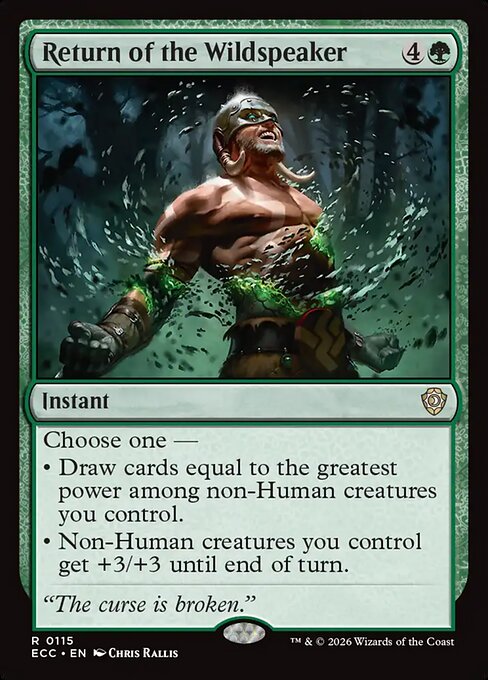
Return of the Wildspeaker card art
Live Play Data

Return of the Wildspeaker

{4} {G} · Instant · Lorwyn Eclipsed Commander (ECC)
12%
Live Inclusion
Times Brought
1701
Decks Running
871
Median Cast Turn
7.0
Drawn → Played
48%
Format

36% of multiplayer games where Return of the Wildspeaker resolved ended in a win for the caster, a +12.6 percentage-point lift over the 24% baseline when it stayed in the library.

Return of the Wildspeaker sits in 12% of the 7200 decks tracked on Playgroup Live, a focused green staple that concentrates in creature-heavy strategies built around large non-Human threats. Across 1569 tracked multiplayer games, it has been cast 172 times and resolves on a median first-cast turn of 7.0.

The win-rate signal is notable. Games where Wildspeaker reached the stack resolved in a win 36% of the time, versus 24% when the card never moved. That +12.6 percentage-point gap has a lower bound above zero in the current dataset, which makes it one of the stronger early signals we track. Both buckets are well-sampled (162 and 1148 observations respectively), so treat it as directional but consistent rather than conclusive.

The draw-to-play rate of 48% reflects how an instant with a 5-mana cost behaves in practice: players who draw it mid-game often don't get the mana or the right board state before the game ends. The modal cast turn is 7, skewing later than its mana value suggests. When players do find the right window, median hand time before casting is 3 turns, and only 25% slam it the turn it's drawn.

At a glance
  • 12% of tracked Commander decks include Return of the Wildspeaker
  • 36% win rate in games where Wildspeaker resolved, versus 24% when it never left the library
  • T7.0 median first-cast turn, with most casts landing between turns 6 and 9
  • 48% of drawn copies were cast before the game ended
  • 676 distinct players have brought this card to a tracked game, with no single player exceeding 4% of instances

First-cast turn

n=172
0%
T1
0%
T2
2%
T3
3%
T4
10%
T5
66%
T6-9
18%
T10+
Median 7.0 P25 6 · P75 9 · max 15
On curve 16% (18 / 172 cast on T5) Cast same turn as drawn 25%

The "good card" funnel

1707 brought · 676 players
Brought to game
1707
Ever drawn
362
Reached battlefield
172
Still on board at game end
18
48%

Of 1707 copies brought to tracked multiplayer games, 362 were drawn and 172 of those were cast, a draw-to-play rate of 48% that reflects the late-game timing required to get maximum value from a 5-mana instant.

≥ +5.4pp

Players who cast this card win 36% of the time (n=162) , vs 24% when it never left the library (n=1148).

When players drew this card but left it in hand, they won 24% (n=182) — about the same as leaving it in the library. Those players survived long enough to draw it, so the gap above is about the card resolving, not just about surviving.

Observed gap +12.6pp; 95% confidence interval +5.4pp to +19.8pp. Correlational, not causal: powerful payoffs also get cast more often in games you are already winning.

Final zone distribution

404 instances
2.5%
Library
4.5%
Battlefield
51.5%
Graveyard
4.2%
Exile

The vast majority of Return of the Wildspeaker copies that finish a game end up in the graveyard (where resolved instants go) or in hand, which is expected for a non-permanent; the tiny battlefield count reflects a handful of tokens or unusual interactions, not the card itself staying in play.

Commanders that played this card

in tracked games

Pantlaza and Ashling lead by deck count, but the spread across 676 distinct players with no single player above 4% of instances shows this card's adoption is broad rather than driven by one or two dedicated grinders.

Frequently Asked

How often is Return of the Wildspeaker drawn in a Commander game?
In 1569 tracked multiplayer games where the card was in a deck, it was drawn 21% of the time. That is consistent with a 5-mana singleton in a 100-card deck. Of those 362 drawn copies, 48% were cast before the game concluded. The remainder largely reflects games that ended before the player found the mana or an ideal board state to pull the trigger.
What turn does Return of the Wildspeaker usually get cast?
Median first-cast turn in multiplayer is 7.0, with the 25th-to-75th-percentile range spanning turns 6 through 9. The mode of the distribution sits at turn 7. That late window is consistent with the card's role: players hold it until they have a wide or tall board of non-Human creatures to maximize the draw or pump mode. Only 16% of casts land exactly on-curve at turn 5.
Does casting Return of the Wildspeaker actually improve your win rate?
The data shows a +12.6 percentage-point lift: 36% win rate in the 162-game cast bucket versus 24% in the 1148-game library bucket. The lower confidence bound on that delta is above zero in the current dataset. That makes this one of the more consistent positive signals we track on Playgroup Live, though we'd still call it directional given the overall sample size of 1569 games.
Which commanders most commonly run Return of the Wildspeaker?
Pantlaza, Sun-Favored and Ashling, the Limitless lead the tracked dataset, each appearing in the top two slots. The list also includes Rin and Seri (Inseparable), Ulalek (Fused Atrocity), and Ghalta (Primal Hunger), reflecting the card's home in creature-type tribal decks and green stompy strategies that reliably field large non-Human bodies. The commander spread is wide, with 676 distinct players contributing data and no single player exceeding 4% of all instances.
Is Return of the Wildspeaker legal in Commander?
Yes. Return of the Wildspeaker is legal and unrestricted in Commander, as well as in Legacy, Modern, Pioneer, Vintage, Historic, and Duel Commander. It is not legal in Standard, Pauper, or Pauper Commander. Its color identity is mono-green, so it can only appear in decks whose commander has green in their color identity.
How does the draw mode compare to the pump mode in practice?
The card text scales the draw mode off the greatest power among your non-Human creatures, which in green stompy decks routinely means drawing 5 to 10 cards off a single 5-mana instant. That potential swing is why the card shows up across such a wide range of creature commanders, from Dinosaur tribal (Gishath, Pantlaza) to beast and beast-adjacent strategies. The pump mode serves as a combat finisher, but the overwhelming play pattern Playgroup Live sees is the draw mode used to refuel after a board development phase.