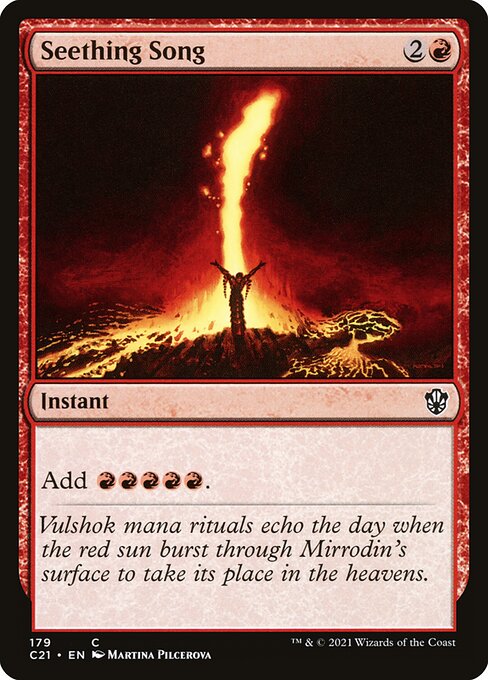
Seething Song card art
Live Play Data

Seething Song

{2} {R} · Instant · Commander 2021 (C21)
7%
Live Inclusion
Times Brought
579
Decks Running
322
Median Cast Turn
5
Drawn → Played
78%
Format

78% of drawn Seething Songs are cast before the game ends, and the median first cast lands on turn 5, signaling players treat it as fuel to be spent, not held.

Seething Song is a narrow but deliberate inclusion: found in 322 of 4868 tracked decks for a 7% inclusion rate, it is almost never an accident. Red players who put it in their 100 intend to use it, and the data reflects that intent.

When a copy reaches a player's hand, 78% of the time it gets cast. Median first cast arrives on turn 5, consistent with the burst-mana role the card is built for. For a 3-mana instant that produces 5 red mana, the window to use it productively is real but finite, and players are finding it. The draw-to-play figure is high relative to many instants, likely because Seething Song only enters decks with a clear payoff in mind.

The commander distribution tells the same story. Zada, Hedron Grinder and Krenko, Mob Boss top the list alongside Fire Lord Azula, all commanders that reward dumping resources fast. Seething Song fits a specific Red archetype and shows up there reliably across 266 distinct players in the dataset, a well-spread sample that reduces single-player bias.

At a glance
  • 7% of tracked Commander decks include Seething Song
  • 78% of drawn copies are cast before the game ends
  • T5 median first-cast turn
  • 22% draw rate, typical for a singleton in a 100-card deck
  • 266 distinct players have brought Seething Song to a tracked game

First-cast turn

n=101
2%
T1
9%
T2
12%
T3
16%
T4
15%
T5
37%
T6-9
10%
T10+
Median 5 P25 4 · P75 7 · max 15
On curve 23% (12 / 101 cast on T3) Cast same turn as drawn 31%

The "good card" funnel

583 brought · 266 players
Brought to game
583
Ever drawn
129
Reached battlefield
101
Still on board at game end
9
78%

Of 583 Seething Songs brought to tracked games, 129 were drawn, 101 of those were cast, and almost all resolved directly to the graveyard, consistent with an instant that converts mana rather than staying in play.

≥ -4.0pp

Players who cast this card win 36% of the time (n=98) , vs 30% when it never left the library (n=404).

When players drew this card but left it in hand, they won 32% (n=24) — about the same as leaving it in the library. Those players survived long enough to draw it, so the gap above is about the card resolving, not just about surviving.

Observed gap +5.5pp; 95% confidence interval -4.0pp to +15.0pp. Correlational, not causal: powerful payoffs also get cast more often in games you are already winning.

Final zone distribution

143 instances
2.8%
Library
6.3%
Battlefield
62.2%
Graveyard
11.9%
Exile

The vast majority of Seething Songs end in the graveyard after resolving, exactly what you expect from an instant that produces mana and immediately goes to the bin. The small battlefield count reflects a handful of copies that were somehow stranded in hand at game's end.

Commanders that played this card

in tracked games

Fire Lord Azula and Zada, Hedron Grinder sit at the top, both Red-heavy commanders built to spend large bursts of mana in a single turn. The list spans 322 decks across a wide spread of commanders, with no single commander dominating the distribution.

Frequently Asked

How often is Seething Song drawn in a Commander game?
Across 549 tracked games where Seething Song was in the deck, it was drawn 22% of the time. That is expected for any singleton in a 100-card deck. Of 129 copies that reached a player's hand, 78% were cast before the game concluded. The remainder mostly reflects games that ended before the player found a window to use it.
What turn does Seething Song typically get cast?
The median first-cast turn is 5, with the middle 50% of casts falling between turns 4 and 7. A small cluster hits as early as turns 2 and 3, likely thanks to additional mana acceleration. The mode is turn 4, which aligns with the pattern of players resolving their commander and then using Seething Song to immediately activate or re-cast it the same turn.
Is Seething Song banned anywhere?
Yes. Seething Song is banned in Modern and Historic, where its ability to produce 5 mana from a 3-mana investment proved too powerful in combination with high-impact payoffs. It remains legal in Commander, Legacy, Vintage, Pauper, Timeless, and several other formats. Its Commander legality is part of why it shows up consistently in Red storm and combo strategies.
Does casting Seething Song improve your win rate?
The win rate in participations where Seething Song was cast is 36%, compared to 30% in participations where it stayed in the library. The gap is a directional early signal, but with 98 cast observations the confidence interval is wide enough to treat this as a trend rather than a conclusion. The lift is plausible given that Seething Song is typically cast to execute a game-ending or board-defining play.
Which commanders run Seething Song most often?
Fire Lord Azula, Zada, Hedron Grinder, and Krenko, Mob Boss lead the tracked dataset. All three reward generating large amounts of Red mana quickly. Zada in particular benefits from casting many instants in a single turn, and Seething Song funds exactly that kind of explosive turn. The spread across 266 unique players suggests the pattern is not driven by a single group's preferences.
How does Seething Song's inclusion rate compare to a typical card?
At 7%, Seething Song is a specialist inclusion rather than a format staple. It is locked to Red color identity and only fits decks that have a specific mana-hungry payoff. That constraint keeps the ceiling low relative to colorless staples, but among Red decks with the right gameplan it is a deliberate, high-intent inclusion. The 78% draw-to-play rate reflects that players who bring it almost always find a use for it.