
collections_bookmark Part of Tales of Middle-earth

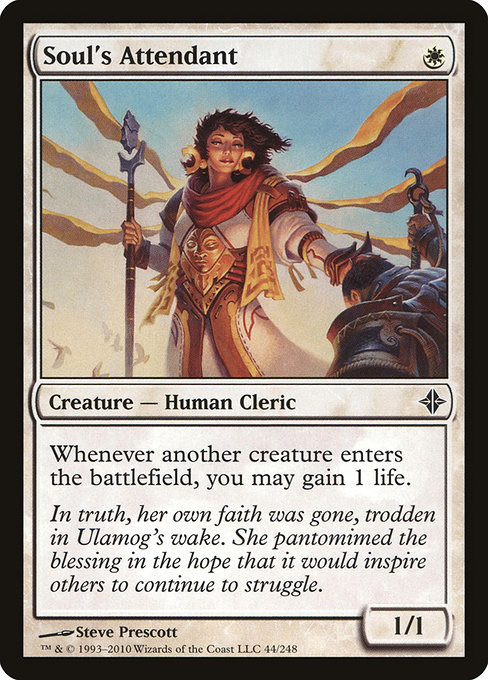
Soul's Attendant card art
Live Play Data

Soul's Attendant

{W} · Creature — Human Cleric · Rise of the Eldrazi (ROE)
3%
Live Inclusion
Times Brought
554
Decks Running
288
Median Cast Turn
4.5
Drawn → Played
88%
Format

88% of drawn Soul's Attendants are cast before the game ends, a median first-cast turn of 4.5, across 542 tracked multiplayer Commander games on Playgroup Live.

Soul's Attendant converts creature-dense boards into a life total advantage one trigger at a time. Across 542 multiplayer Commander games tracked on Playgroup Live, it appears in 288 of 8978 distinct decks, an inclusion rate of 3%. That number reflects a niche but dedicated audience: players who build explicitly around lifegain synergies.

The standout behavioral stat is draw-to-play rate. 88% of drawn copies reach the battlefield before the game ends. That is an early signal that players treat this as a slam-on-sight piece rather than something to hold in hand. The median first-cast turn is 4.5, consistent with a 1-mana creature that rewards early deployment. The mode of the distribution is turn 1, confirming that opening-hand copies go down immediately.

The data is well-distributed across players. 252 distinct players have brought Soul's Attendant to a tracked game, and the single heaviest contributor accounts for just 5% of all instances. That spread gives the numbers reasonable credibility as a cross-table picture of how the card actually plays.

At a glance
  • 3% of tracked Commander decks include Soul's Attendant
  • 88% of drawn copies are cast before the game ends
  • T4.5 median first-cast turn, with turn 1 as the mode
  • 46% battlefield stickiness once cast
  • 252 distinct players have brought this card to a tracked game
  • 32% normalized win rate in games where Soul's Attendant was cast

First-cast turn

n=134
23%
T1
10%
T2
8%
T3
8%
T4
10%
T5
30%
T6-9
10%
T10+
Median 4.5 P25 2 · P75 8 · max 14
On curve 23% (31 / 134 cast on T1) Cast same turn as drawn 73%

The "good card" funnel

554 brought · 252 players
Brought to game
554
Ever drawn
152
Reached battlefield
134
Still on board at game end
62
88%

Of 554 Soul's Attendants brought to games, 152 were drawn, 134 of those were cast, and 46% of cast copies stayed on the battlefield through end of game.

≥ -2.6pp

Players who cast this card win 32% of the time (n=131) , vs 26% when it never left the library (n=343).

When players drew this card but left it in hand, they won 33% (n=15) — about the same as leaving it in the library. Those players survived long enough to draw it, so the gap above is about the card resolving, not just about surviving.

Observed gap +6.1pp; 95% confidence interval -2.6pp to +14.7pp. Correlational, not causal: powerful payoffs also get cast more often in games you are already winning.

Final zone distribution

171 instances
2.9%
Library
36.3%
Battlefield
36.3%
Graveyard
13.5%
Exile

The library bucket is unusually small here: most Soul's Attendants either reach the battlefield or end in the graveyard, a sign that this card is actively sought out and cast when drawn rather than sitting unplayed.

Commanders that played this card

in tracked games

The commander list is spread across lifegain payoffs and token-flood strategies, with Oloro, Ageless Ascetic the clear anchor at 28 decks, nearly double the next entry.

Card text
Soul's Attendant card

Soul's Attendant

{W}
Creature — Human Cleric
Whenever another creature enters, you may gain 1 life.
1 / 1
Rise of the Eldrazi (ROE) · Common · Illustrated by Steve Prescott

Frequently Asked

How often is Soul's Attendant drawn in a Commander game?
In 542 tracked games where Soul's Attendant was in the deck, it was drawn 27% of the time. That is on the higher end for a singleton in a 100-card deck, reflecting that many of these decks skew toward card draw or lower average CMC. Of 152 instances that reached a player's hand, 88% were cast before the game concluded.
What turn does Soul's Attendant usually hit the battlefield?
Median first-cast turn is 4.5, with a mean of 4.61. The distribution has a strong early cluster: turn 1 is the mode, driven by opening-hand copies going down immediately. The 75th percentile sits at turn 7, so late-drawn copies still find a use in longer games, though a meaningful share of drawn copies never make it to the battlefield because the game ends first.
Is Soul's Attendant banned anywhere relevant to Commander players?
No. Soul's Attendant is legal in Commander, Duel Commander, Oathbreaker, Pauper Commander, Legacy, Modern, Vintage, and Pauper. It is not legal in Standard, Pioneer, Historic, Alchemy, or Brawl. Its common rarity means it is also a staple in Pauper, where lifegain synergies are a recognized archetype.
Which commanders run Soul's Attendant most often in the tracked data?
Oloro, Ageless Ascetic leads the top-commanders list with 28 decks, followed by Darien, King of Kjeldor at 15 and Hope Estheim at 13. The pattern is consistent: commanders that either reward lifegain directly or generate creatures at a high rate. Amalia Benavides Aguirre and Liesa, Shroud of Dusk round out the top five, both White-Black lifegain strategies.
Does casting Soul's Attendant actually improve win rate?
The normalized win rate when Soul's Attendant was cast is 32%, compared to 26% in games where it stayed in the library. The delta is +6.1 percentage points. Both sample sizes are above 15 observations, but the confidence interval around the delta crosses zero, so treat this as a directional signal rather than a conclusive finding. The card is built for synergy density, not raw win-rate lift in isolation.
How sticky is Soul's Attendant once it hits the battlefield?
46% of cast copies are still on the battlefield at the end of the game they were cast in. For a 1/1 with no built-in protection, that reflects both its low threat profile and the fact that opponents rarely prioritize removing it unless a lifegain engine is visibly assembling. Graveyard is the most common off-battlefield final zone, consistent with board wipes rather than targeted removal being the primary exit.