
collections_bookmark Part of Commander Masters
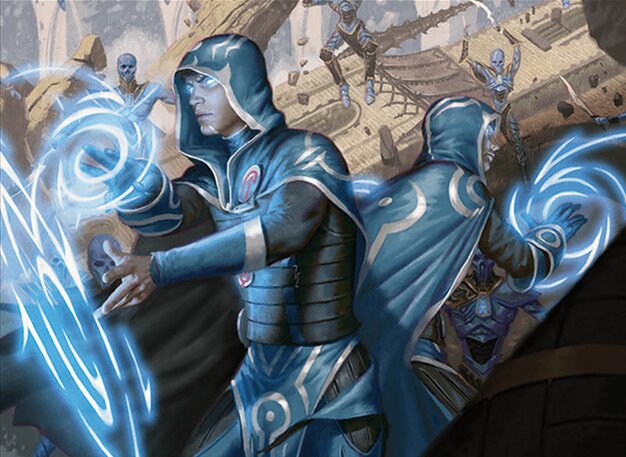
Spark Double card art
Live Play Data

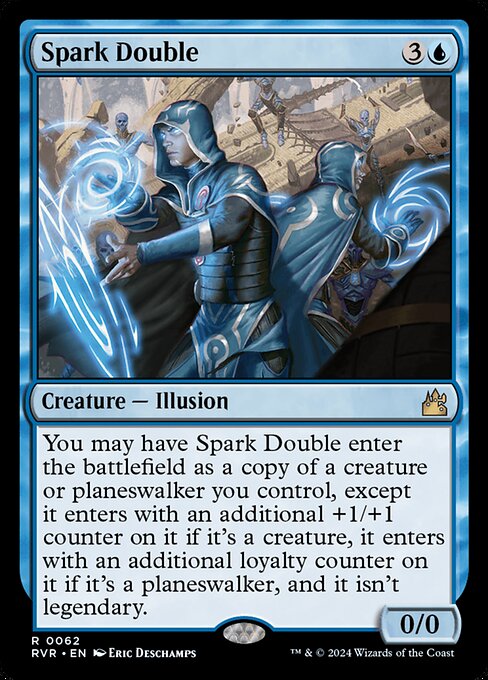
Spark Double

{3} {U} · Creature — Illusion · Ravnica Remastered (RVR)
7%
Live Inclusion
Times Brought
1010
Decks Running
530
Median Cast Turn
7.0
Drawn → Played
64%
Format

Spark Double appears in 7% of tracked multiplayer Commander decks, and when drawn it reaches the battlefield 64% of the time, with a median first cast on turn 7.0.

Spark Double sits in 7% of the 7624 distinct decks that have played a tracked multiplayer game on Playgroup Live, placing it firmly in niche-staple territory rather than universal auto-include. Its power is entirely contingent on having something worth copying, which explains both who runs it and when it shows up.

Of 264 drawn copies across 964 tracked games, 64% were cast before the game ended. Median first cast lands on turn 7.0, later than its 4-mana cost alone would suggest. That delay reflects how the card is used: players tend to hold it until a high-value target is already on the battlefield. The hand-to-cast data bears this out. On average a drawn copy sits in hand for roughly two turns before being played, and only 29% of instances are cast on the same turn they are drawn.

Spark Double is legal in Commander, Legacy, Modern, Pioneer, Vintage, Historic, and Timeless. It is not legal in Pauper or Pauper Commander. The concentration data is a genuine strength of the dataset: 459 distinct players have brought this card to a tracked game, and no single player accounts for more than a small fraction of the observations.

At a glance
  • 7% of tracked multiplayer Commander decks include Spark Double
  • T7.0 median first-cast turn, reflecting deliberate timing around a copy target
  • 64% of drawn copies reach the battlefield before the game ends
  • 54% battlefield stickiness once cast, lower than many permanents due to it being a high-value removal target
  • 459 distinct players have brought Spark Double to a tracked game, giving broad data coverage
  • 8% of casts land exactly on curve at turn 4, most copies are held and played later

First-cast turn

n=168
0%
T1
0%
T2
2%
T3
6%
T4
10%
T5
66%
T6-9
16%
T10+
Median 7.0 P25 6 · P75 9 · max 16
On curve 8% (10 / 168 cast on T4) Cast same turn as drawn 29%

The "good card" funnel

1010 brought · 459 players
Brought to game
1010
Ever drawn
264
Reached battlefield
168
Still on board at game end
91
64%

Of 1010 Spark Double copies brought to multiplayer games, 264 were drawn, 168 of those were cast, and the remainder reflect games that ended before the card could be played or further interacted with.

≥ +2.1pp

Players who cast this card win 31% of the time (n=155) , vs 22% when it never left the library (n=608).

When players drew this card but left it in hand, they won 26% (n=85) — about the same as leaving it in the library. Those players survived long enough to draw it, so the gap above is about the card resolving, not just about surviving.

Observed gap +9.5pp; 95% confidence interval +2.1pp to +16.9pp. Correlational, not causal: powerful payoffs also get cast more often in games you are already winning.

Final zone distribution

289 instances
5.2%
Library
31.5%
Battlefield
31.8%
Graveyard
8.0%
Exile

Most Spark Double instances never leave the library, a structural reality of 100-card singleton. Of those that did reach play, the graveyard is the most common final destination, reflecting how aggressively opponents remove a card that can duplicate their biggest threats.

Commanders that played this card

in tracked games

Doctor Doom, King of Latveria dominates the top-commanders list by a wide margin, underscoring that Spark Double's strongest home right now is decks built around a single powerful legendary creature that benefits from a non-legendary second copy.

Frequently Asked

How often is Spark Double drawn in a Commander game?
Across 964 tracked multiplayer games where Spark Double was in the deck, it was drawn 26% of the time. That is consistent with what you would expect from a singleton in a 100-card deck. Of 264 instances that reached a player's hand, 64% were cast before the game concluded.
What turn does Spark Double typically get cast?
Median first-cast turn is 7.0 in multiplayer games. The distribution skews later than the card's 4-mana cost would imply. Most copies sit in hand for one or two turns while the player waits for a worthy copy target to be on the battlefield. Only 29% of drawn copies are cast on the same turn they are drawn, which is a clear early signal of deliberate holding.
Does casting Spark Double correlate with winning?
Games where Spark Double was cast show a win rate of 31%, compared to 22% in games where it stayed in the library. That is a +9.5 percentage-point gap across 155 cast observations and 608 library observations. Both sample sizes are meaningful, so this is a directional positive signal rather than a noise artifact, though Playgroup Live's overall dataset is still growing.
Why does Spark Double see so much play in Doctor Doom decks?
Doctor Doom, King of Latveria is the single most common commander paired with Spark Double in tracked games. Doom's ability to generate Monarch tokens and accumulate card advantage scales well with having a non-legendary second copy on the battlefield, bypassing the legend rule that would otherwise prevent running two Dooms simultaneously. Spark Double's clause removing the legendary supertype from the copy is the exact text that makes this work.
Is Spark Double banned anywhere?
Spark Double is legal in Commander, Legacy, Modern, Pioneer, Vintage, Historic, Timeless, Brawl, and Gladiator. It is not legal in Standard, Pauper, Pauper Commander, or PreDH. There are no bans or restrictions in any of the formats where it is legal.
How reliable is the Spark Double data on Playgroup Live?
The dataset covers 964 tracked multiplayer games with 1010 instances brought and 289 observed instances where the card was meaningfully interacted with. Data comes from 459 distinct players, and no single contributor dominates the sample, which reduces individual-bias risk. Read all win-rate figures as directional rather than statistically definitive given the format's overall sample size.