
bolt Game Changer on the MTG Commander Game Changers list

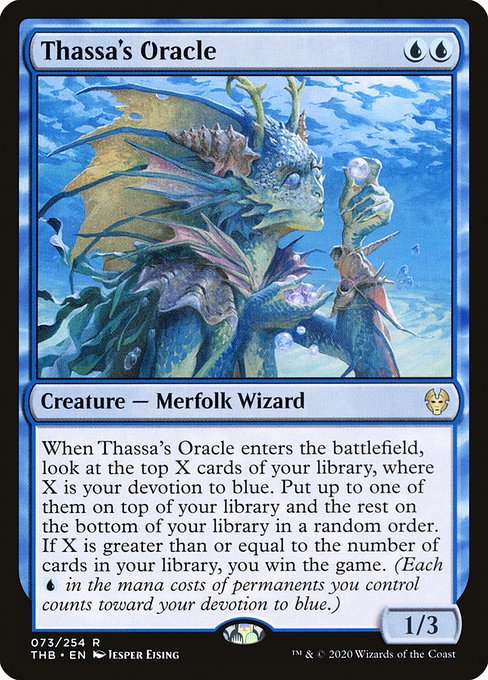
Thassa's Oracle card art
Live Play Data

Thassa's Oracle

{U} {U} · Creature — Merfolk Wizard · Theros Beyond Death (THB)
3%
Live Inclusion
Times Brought
612
Decks Running
322
Median Cast Turn
6
Drawn → Played
59%
Format

50% of games where Thassa's Oracle resolved ended in a win for the caster. That's a +29.3 percentage-point lift over the baseline, across 115 observed participations on Playgroup Live.

Thassa's Oracle wins games at a rate that stands well above the field. Across 115 participations where the Oracle resolved, the normalized win rate sits at 50%. Decks where it stayed buried in the library won at 20%. That +29.3 percentage-point delta is the clearest signal in our live dataset that casting this card actively shifts the outcome.

The card is selective rather than ubiquitous: 3% of tracked Commander decks run it, reflecting how purpose-built an Oracle list needs to be. When it does land in hand, 59% of drawn copies reach the battlefield before the game ends. Median first cast arrives on turn 6, well after the opening ramp phase, consistent with players assembling the devotion or library-emptying combo pieces first.

The data is well-spread across 280 distinct players, with the single heaviest contributor accounting for just 3% of all tracked instances. That breadth gives the win-rate signal real weight for a card with this inclusion rate.

At a glance
  • 50% win rate in games where Thassa's Oracle resolved (normalized to 4-player baseline)
  • +29.3pp win-rate lift over games where Oracle stayed in the library
  • 3% of tracked Commander decks include Thassa's Oracle
  • T6 median first-cast turn, reflecting combo assembly before firing
  • 59% of drawn copies reached the battlefield before game end
  • 74% battlefield stickiness once cast

First-cast turn

n=133
2%
T1
7%
T2
6%
T3
15%
T4
16%
T5
46%
T6-9
9%
T10+
Median 6 P25 4 · P75 7 · max 14
On curve 8% (9 / 133 cast on T2) Cast same turn as drawn 49%

The "good card" funnel

613 brought · 280 players
Brought to game
613
Ever drawn
227
Reached battlefield
133
Still on board at game end
99
59%

Of 613 Oracles brought to games, 227 were drawn, 133 of those were cast, and 74% of resolved copies stayed on the battlefield through end of game.

≥ +20.0pp

Players who cast this card win 50% of the time (n=115) , vs 20% when it never left the library (n=307).

When players drew this card but left it in hand, they won 21% (n=91) — about the same as leaving it in the library. Those players survived long enough to draw it, so the gap above is about the card resolving, not just about surviving.

Observed gap +29.3pp; 95% confidence interval +20.0pp to +38.6pp. Correlational, not causal: powerful payoffs also get cast more often in games you are already winning.

Final zone distribution

257 instances
3.5%
Library
38.5%
Battlefield
16.0%
Graveyard
8.6%
Exile

Most Thassa's Oracle copies that were observed ended on the battlefield or hand, a sharp contrast to typical 100-card singleton cards where the library dominates. The low library count reflects how purposefully Oracle decks set up the win before casting it.

Commanders that played this card

in tracked games

The commander list spans a wide range of color identities and archetypes, from Yuriko tempo to Kenrith goodstuff, confirming that Oracle's appeal is the game-ending ETB trigger rather than any single tribal or mechanical synergy.

Card text
Thassa's Oracle card

Thassa's Oracle

{U} {U}
Creature — Merfolk Wizard
When this creature enters, look at the top X cards of your library, where X is your devotion to blue. Put up to one of them on top of your library and the rest on the bottom of your library in a random order. If X is greater than or equal to the number of cards in your library, you win the game. (Each {U} in the mana costs of permanents you control counts toward your devotion to blue.)
1 / 3
Theros Beyond Death (THB) · Rare · Illustrated by Jesper Ejsing

Frequently Asked

How strong is the win-rate signal when Thassa's Oracle resolves?
In 115 participations where Thassa's Oracle reached the battlefield, the normalized win rate is 50%. Decks where it never left the library show 20% across 307 participations. The delta of +29.3 percentage points is large. Both sample sizes exceed 100 observations, which makes this the most statistically grounded result we can quote from Playgroup Live's current dataset. Still, treat it as a strong directional signal rather than a final verdict.
How often is Thassa's Oracle drawn in a Commander game?
In 557 tracked multiplayer games where Oracle was in the deck, it was drawn 37% of the time. That draw rate is elevated relative to many Commander staples, reflecting that Oracle players tend to run significant card draw and library-manipulation to set up the win condition. Of 227 drawn copies, 59% were cast before the game ended.
What turn does Thassa's Oracle typically hit the battlefield?
Median first-cast turn is 6, with the interquartile range spanning turns 4 through 8. The distribution has a modest early cluster from turns 2 to 3, which almost certainly represents combo lines where the deck empties its library quickly. The bulk of casts land mid-game, after players have assembled the supporting pieces. Only 8% of casts land exactly on curve for a 2-mana card, which reflects that Oracle is rarely cast the moment it's drawn.
Is Thassa's Oracle banned in Commander?
Thassa's Oracle is legal and unrestricted in the Commander format. It is banned in Duel Commander (the 1v1 variant) and in Historic on MTG Arena, where its combination with Demonic Consultation proved too consistent. In multiplayer Commander it remains legal, though it is a known combo-win engine and frequently draws political attention at the table.
Why does Thassa's Oracle appear in so many different commander pairings?
The top commanders in our data span multiple color identities: Yuriko, Tymna, Najeela, Kenrith, and others. Oracle's win condition requires only blue devotion and an empty or near-empty library, making it slottable into any blue-inclusive list that can assemble a library-exile combo. It functions as a two-mana win condition that needs no combat step, which is why cEDH and high-power piles across all archetypes adopt it regardless of their primary game plan.
How concentrated is the Thassa's Oracle data among players?
The 557 tracked games represent 280 distinct players who brought Oracle to a game. The single heaviest contributor accounts for just 3% of all tracked instances. That spread is a genuine strength of this dataset and means the win-rate numbers are not inflated by one pilot's results.