collections_bookmark Part of Bloomburrow
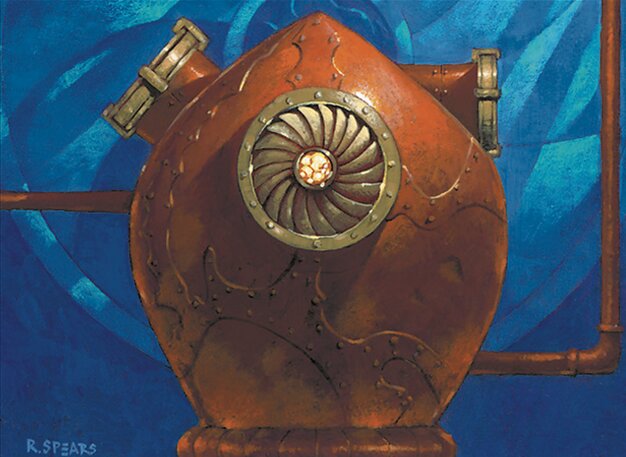
Thran Dynamo card art
Live Play Data

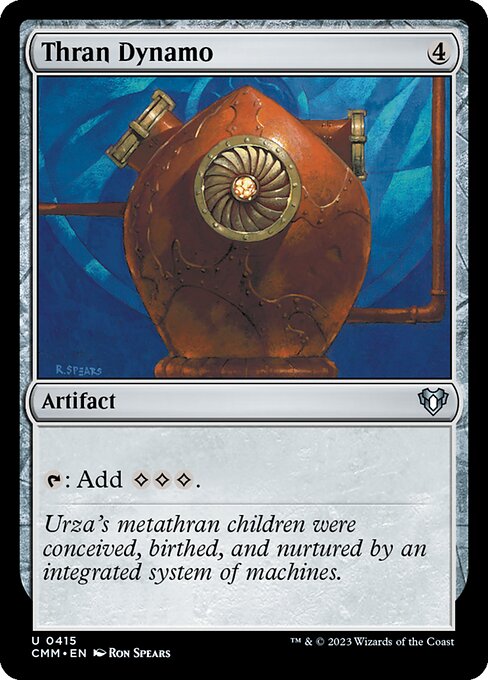
Thran Dynamo

{4} · Artifact · Commander Masters (CMM)
5%
Live Inclusion
Times Brought
536
Decks Running
325
Median Cast Turn
5
Drawn → Played
78%
Format

41% of games where Thran Dynamo resolved ended in a win for the caster, a +14.7 percentage-point lift over the 26% baseline when the card stayed in the library.

Thran Dynamo sits in 5% of the 6164 Commander decks tracked on Playgroup Live, a niche but deliberate slot occupied by players who need colorless mana acceleration to fuel high-cost spells and activated abilities. The dataset now covers 492 tracked games, with 272 distinct players contributing, and no single contributor accounting for more than 2% of all tracked instances. That spread gives the numbers reasonable breadth.

The headline story is the win-rate lift. Participations where Thran Dynamo reached the battlefield finished at 41%, compared to 26% for participations where it never left the library. That +14.7 percentage-point gap is directional and consistent with what you would expect from a mana engine that lets you deploy your entire hand faster. Both sample sizes clear 15 observations, so treat the direction as an early signal worth watching. Draw-to-play sits at 78%: most copies that reach a hand get cast before the game ends.

Thran Dynamo's colorless identity puts it in every Commander deck regardless of color. It clusters most in big-mana and artifact-matter strategies. Median first cast lands on turn 5, one turn after its printed cost, which reflects how often it is drawn mid-game rather than opened in hand.

At a glance
  • 5% of tracked Commander decks include Thran Dynamo
  • 78% of drawn copies are cast before the game ends
  • T5 median first-cast turn
  • 41% win rate in games where Thran Dynamo resolved
  • +14.7pp win-rate lift over the never-cast baseline
  • 88% battlefield stickiness once it resolves

First-cast turn

n=103
2%
T1
6%
T2
12%
T3
26%
T4
12%
T5
37%
T6-9
6%
T10+
Median 5 P25 4 · P75 7 · max 17
On curve 46% (27 / 103 cast on T4) Cast same turn as drawn 36%

The "good card" funnel

539 brought · 272 players
Brought to game
539
Ever drawn
132
Reached battlefield
103
Still on board at game end
91
78%

Of 539 Thran Dynamos brought to tracked games, 132 were drawn, 103 of those were cast, and the large majority stayed on the battlefield through the end of the game.

≥ +5.5pp

Players who cast this card win 41% of the time (n=102) , vs 26% when it never left the library (n=357).

When players drew this card but left it in hand, they won 27% (n=29) — about the same as leaving it in the library. Those players survived long enough to draw it, so the gap above is about the card resolving, not just about surviving.

Observed gap +14.6pp; 95% confidence interval +5.5pp to +23.8pp. Correlational, not causal: powerful payoffs also get cast more often in games you are already winning.

Final zone distribution

149 instances
2.0%
Library
61.1%
Battlefield
16.1%
Graveyard
5.4%
Exile

Most observed Thran Dynamo copies end the game on the battlefield, consistent with an 88% stickiness rate. Cards that never leave the library make up a much smaller share here because the dataset counts only observed participations, not every deck that happened to not draw the card.

Commanders that played this card

in tracked games

The commander spread is wide: top slots are split between green-based midrange piles, colorless eldrazi builds, and artifact-matter commanders, confirming that colorless mana acceleration is a broadly useful tool rather than a single-archetype staple.

Frequently Asked

How often is Thran Dynamo drawn in a Commander game?
Across 492 tracked games where Thran Dynamo was in the deck, it was drawn 24% of the time. That rate is typical for a singleton in a 100-card deck. Of 132 instances that reached a player's hand, 78% were cast before the game ended. The gap between drawn and cast is mostly a game-length effect: copies drawn in the late turns sometimes never get the opportunity to resolve.
What turn does Thran Dynamo usually land on the battlefield?
Median first-cast turn is 5, one turn after its printed mana cost of 4. The interquartile range runs from turn 4 to turn 7, so the cast window is wide. Only 46% of casts land exactly on curve, which tells you most players draw it mid-game rather than in their opening hand. When they do draw it, about 36% cast it the same turn it enters their hand.
Does casting Thran Dynamo actually help you win?
The data shows a +14.7 percentage-point win-rate lift when Thran Dynamo resolves versus when it stays in the library for the whole game. Both buckets have meaningful sample sizes (102 cast participations, 357 library participations). Treat this as a directional early signal rather than a proven causal claim. Decks that include Thran Dynamo tend to be big-mana strategies that already skew toward winning with expensive spells, so some of the lift is deck-quality selection.
Which commanders play Thran Dynamo most?
The top raw counts on Playgroup Live go to Bello, Bard of the Brambles and T'Challa, the Black Panther, each with a cluster of decks. Colorless commanders like Zhulodok, Void Gorger and Molecule Man also appear near the top, where the three colorless mana per activation covers costs that would otherwise require multiple mana sources. The commander list is notably spread across many color identities, reinforcing that colorless mana rocks are format-agnostic tools.
Is Thran Dynamo legal in Commander?
Yes. Thran Dynamo is legal and unrestricted in Commander, Duel Commander, Vintage, Legacy, Premodern, and Oathbreaker. It is not legal in Modern, Pioneer, Standard, Pauper, or Brawl. Its colorless identity means it fits into any Commander deck regardless of color combination, which is a key driver of its continued play.
How concentrated is the Thran Dynamo data among a few players?
The data spans 272 distinct players on Playgroup Live. The single heaviest contributor accounts for 2% of all tracked instances, well below the 15% threshold that would indicate a concentrated sample. That spread means the draw, cast, and win-rate numbers reflect a genuine cross-section of how the broader Playgroup Live community runs this card, rather than one player's outlier experience.