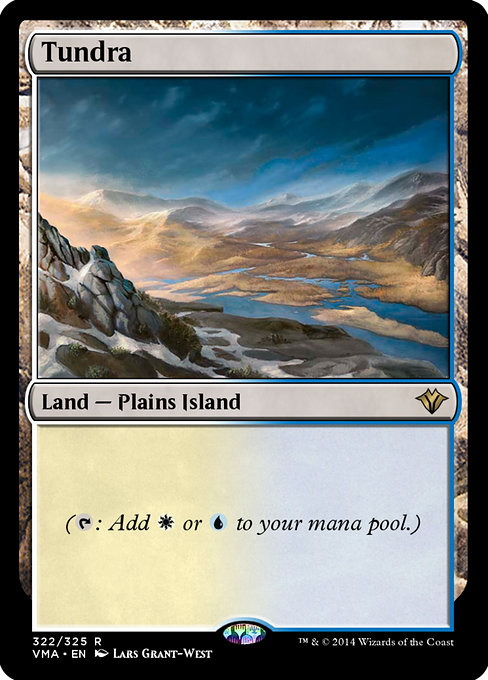
Tundra card art
Live Play Data

Tundra

Land — Plains Island · Vintage Masters (VMA)
10%
Live Inclusion
Times Brought
481
Decks Running
237
Median Cast Turn
3
Drawn → Played
91%
Format

91% of drawn Tundras are played before the game ends, and the median first-play turn is 3, making it one of the most reliably deployed lands tracked on Playgroup Live.

Tundra reaches the battlefield in 91% of games where it enters a player's hand, an early signal that blue-white mana fixing is treated as a near-automatic play whenever the card surfaces. Across 422 tracked multiplayer games, it appears in 237 of the 2314 distinct decks in the dataset, good for a 10% inclusion rate on Playgroup Live.

For a land, the behavioral data is unusually clean. Most cards that enter a player's hand face genuine hold decisions. Tundra does not: players put it into play as soon as they can, with a median first-play turn of 3 and a mode of turn 1. Once it resolves, it stays: 91% battlefield stickiness reflects how rarely opponents invest removal in a basic-type dual land.

The card's color identity (White, Blue) keeps it out of mono-color and most non-WU builds, which explains why five-color commanders dominate the top-commander list. Tundra is legal in Commander, Vintage, Legacy, Duel Commander, Oathbreaker, and PreDH, but not in Modern, Pioneer, or Standard.

At a glance
  • 10% of tracked Commander decks include Tundra
  • 91% of drawn copies are played before the game ends
  • T3 median first-play turn, with mode on turn 1
  • 91% battlefield stickiness once in play
  • 176 distinct players have brought Tundra to a tracked game, with no single player exceeding 4% of all instances

First-cast turn

n=151
29%
T1
12%
T2
10%
T3
15%
T4
9%
T5
21%
T6-9
4%
T10+
Median 3 P25 1 · P75 6 · max 12
Cast same turn as drawn 65%

The "good card" funnel

481 brought · 176 players
Brought to game
481
Ever drawn
166
Reached battlefield
151
Still on board at game end
137
91%

Of 481 Tundras brought to tracked games, 166 were drawn, 151 of those were played onto the battlefield, and the strong 91% stickiness rate means most stayed there through end of game.

≥ -0.2pp

Players who cast this card win 32% of the time (n=147) , vs 24% when it never left the library (n=291).

When players drew this card but left it in hand, they won 25% (n=15) — about the same as leaving it in the library. Those players survived long enough to draw it, so the gap above is about the card resolving, not just about surviving.

Observed gap +7.9pp; 95% confidence interval -0.2pp to +16.0pp. Correlational, not causal: powerful payoffs also get cast more often in games you are already winning.

Final zone distribution

176 instances
2.8%
Library
77.8%
Battlefield
9.1%
Graveyard
3.4%
Exile

The vast majority of Tundra instances end the game on the battlefield, a rare result for a singleton land and a direct reflection of how infrequently opponents answer a basic-type dual.

Commanders that played this card

in tracked games

Five-color commanders hold three of the top four slots, with The Ur-Dragon leading at 19 decks. The spread across blue-white, Esper, and five-color builds confirms Tundra's role as a cross-archetype fixing piece rather than a card tied to one strategy.

Frequently Asked

How often is Tundra drawn in a Commander game?
In 422 tracked multiplayer games where Tundra was in the deck, it was drawn 35% of the time. That figure is on the higher end for a singleton in a 100-card deck, partly because many Tundra decks are smoother, lower-curve builds that keep more opening hands. Of 166 instances that reached a hand, 91% were played before the game concluded.
What turn does Tundra usually enter the battlefield?
The median first-play turn is 3, and the mode is turn 1, meaning more Tundra copies hit the battlefield on turn 1 than any other single turn. That is consistent with opening-hand keeps in lower-curve WU lists. The mean sits higher at around turn 4, reflecting copies drawn later in longer games.
Does casting Tundra correlate with winning?
There is a directional positive signal. Win rate in participations where Tundra reached the battlefield is 32%, versus 24% in participations where it stayed in the library. That is a +7.9 percentage-point gap. Both samples are reasonably sized (147 cast, 291 library), but the 4-player normalized baseline is 25%, so read this as an early signal rather than a proven causal effect.
Is Tundra banned anywhere relevant?
Tundra is legal and unrestricted in Commander, Duel Commander, Vintage, Legacy, Oathbreaker, and PreDH. It is not legal in Modern, Pioneer, Standard, Pauper, Brawl, or any of the Arena formats. Its absence from Modern and Pioneer is structural: those formats' card pools simply do not reach back to the original Revised-era dual lands.
Which commanders run Tundra most often?
The Ur-Dragon leads the tracked dataset with 19 decks, followed by Esika, God of the Tree at 12 and Kenrith, the Returned King at 10. All three are five-color commanders, which require the most fixing. Further down the list, blue-white and blue-black-white commanders like Y'shtola, Marneus Calgar, and Aminatou Veil Piercer also appear, reflecting Tundra's core WU identity.
How concentrated is the Tundra data among a few players?
The dataset is well-spread. 176 distinct players have brought Tundra to at least one tracked game, and no single player accounts for more than 4% of all instances. That breadth gives the draw and play-rate figures more credibility than if the card were dominated by one or two heavy contributors.