collections_bookmark Part of Modern Horizons 3

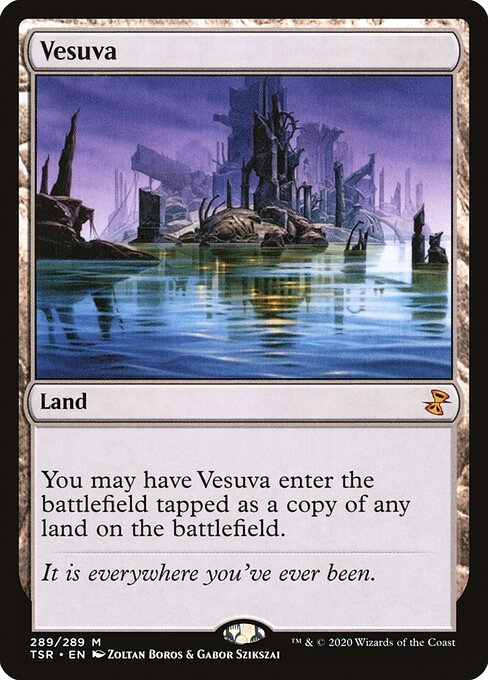
Vesuva card art
Live Play Data

Vesuva

Land · Time Spiral Remastered (TSR)
2%
Live Inclusion
Times Brought
732
Decks Running
326
Median Cast Turn
5.0
Drawn → Played
76%
Format

76% of drawn Vesuvas reach the battlefield, and games where it resolved show a +19.7 percentage-point win-rate lift over games where it stayed in the library, across 135 observed casts on Playgroup Live.

Vesuva is a niche, build-around land that earns its mythic rarity: it enters as a copy of any land on the battlefield, offering everything from a second copy of a utility land to a mirror of an opponent's bomb. Across 708 tracked multiplayer Commander games on Playgroup Live, 76% of drawn copies reached the battlefield, an early signal that players who draw it almost always find a use for it.

The win-rate picture is the most striking figure we have so far. Games where Vesuva resolved produced a 40% win rate, compared to 21% in games where it never left the library. That +19.7 percentage-point gap is a directional signal, not a controlled proof of causation. Players who build around Vesuva likely have stronger land packages overall. Still, the consistency is notable given the sample.

With colorless identity, Vesuva slots into any Commander deck. The strongest draws are commanders that care about land types, legendary lands, or generating value from specific utility lands. Omo, Queen of Vesuva leads the top-commanders list here by a meaningful margin, which makes thematic sense. The card sits at 2% inclusion among tracked decks, meaning it remains a deliberate choice rather than a format staple.

At a glance
  • 2% of tracked Commander decks include Vesuva, a deliberate build-around choice
  • 76% of drawn Vesuvas are played before the game ends
  • T5.0 median turn Vesuva first hits the battlefield
  • 64% battlefield stickiness once Vesuva resolves
  • +19.7pp win-rate lift in games where Vesuva resolved vs. stayed in library
  • 290 distinct players have brought Vesuva to a tracked game, spreading the data well

First-cast turn

n=142
5%
T1
6%
T2
11%
T3
21%
T4
11%
T5
37%
T6-9
9%
T10+
Median 5.0 P25 4 · P75 8 · max 15
Cast same turn as drawn 55%

The "good card" funnel

733 brought · 290 players
Brought to game
733
Ever drawn
186
Reached battlefield
142
Still on board at game end
91
76%

Of 733 Vesuvas brought to tracked games, 186 were drawn, 142 of those were cast, and 64% of cast copies remained on the battlefield at game's end.

≥ +11.3pp

Players who cast this card win 40% of the time (n=135) , vs 21% when it never left the library (n=473).

When players drew this card but left it in hand, they won 21% (n=38) — about the same as leaving it in the library. Those players survived long enough to draw it, so the gap above is about the card resolving, not just about surviving.

Observed gap +19.7pp; 95% confidence interval +11.3pp to +28.1pp. Correlational, not causal: powerful payoffs also get cast more often in games you are already winning.

Final zone distribution

200 instances
1.5%
Library
45.5%
Battlefield
24.0%
Graveyard
10.5%
Exile

Most Vesuvas that enter a tracked game end up on the battlefield or in the graveyard, with very few stranded in the library. That pattern reflects how actively players deploy it when drawn.

Commanders that played this card

in tracked games

Omo, Queen of Vesuva holds a clear lead at the top of the list, but the remaining commanders span many colors and strategies, showing Vesuva's appeal extends well beyond its namesake commander.

Card text
Vesuva card

Vesuva

Land
You may have this land enter tapped as a copy of any land on the battlefield.
Time Spiral Remastered (TSR) · Mythic · Illustrated by Zoltan Boros & Gabor Szikszai

Frequently Asked

How often is Vesuva drawn and cast in a Commander game?
In 708 tracked multiplayer games where Vesuva was in the deck, it was drawn 25% of the time. That is consistent with expectations for a singleton in a 100-card deck. Of the 186 copies that reached a player's hand, 76% were played before the game ended. The median first-cast turn is 5.0, with the spread running from turns 1 through 13 in the observed data.
Does casting Vesuva actually improve your chances of winning?
What we see so far is directional: games where Vesuva resolved showed a 40% win rate across 135 observations, versus 21% in games where it never interacted with play. The +19.7 percentage-point gap is large enough to be interesting, but the sample is not large enough to rule out deck-quality confounding. Players building around Vesuva tend to run stronger land packages in general, which may explain part of the lift.
What turn does Vesuva typically enter the battlefield?
Median first-cast turn is 5.0 in multiplayer games. The distribution is broad: a small cluster of very early plays exists when it appears in the opening hand, and the bulk of casts are spread across turns 3 through 9. The mean is pulled later by occasional draws in the double-digit turns.
Which commanders most often pair with Vesuva?
Omo, Queen of Vesuva leads the list with the most tracked decks, which is an obvious thematic pairing given the shared name and land-type synergy. Colorless commanders like Zhulodok, Void Gorger also appear prominently, consistent with Vesuva's colorless identity making it accessible in any color combination. The top ten commanders span green, blue, red, white, and colorless shells.
Is Vesuva legal in Commander and other formats?
Vesuva is legal in Commander, Legacy, Vintage, Modern, Duel Commander, Oathbreaker, and several other sanctioned formats. It is not legal in Standard, Pioneer, Pauper, Alchemy, or Brawl. It has not been banned in Commander.
How concentrated is the Vesuva data among specific players?
The data is well-spread. 290 distinct players have brought Vesuva to a tracked game on Playgroup Live, and the single heaviest contributor accounts for only 25% of all instances, well under the threshold where one player could meaningfully skew results. That breadth adds confidence to the directional patterns we observe.