collections_bookmark Part of Final Fantasy
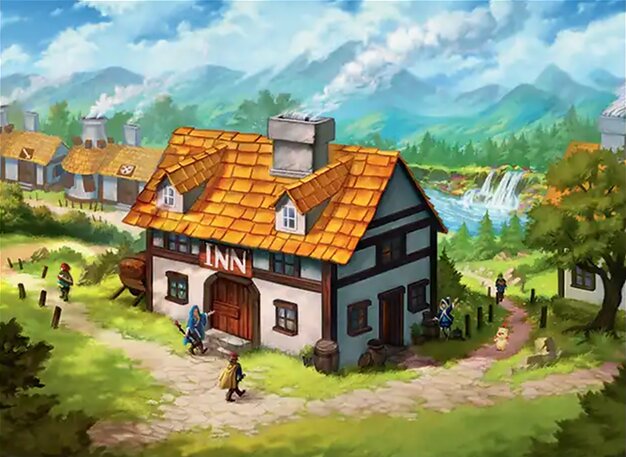
Adventurer's Inn card art
Live Play Data

Adventurer's Inn

Land — Town · Final Fantasy (FIN)
1%
Live Inclusion
Times Brought
550
Decks Running
283
Median Cast Turn
4.0
Drawn → Played
80%
Format

80% of drawn Adventurer's Inn copies are played before the game ends, and the land stays on the battlefield 91% of the time once it resolves.

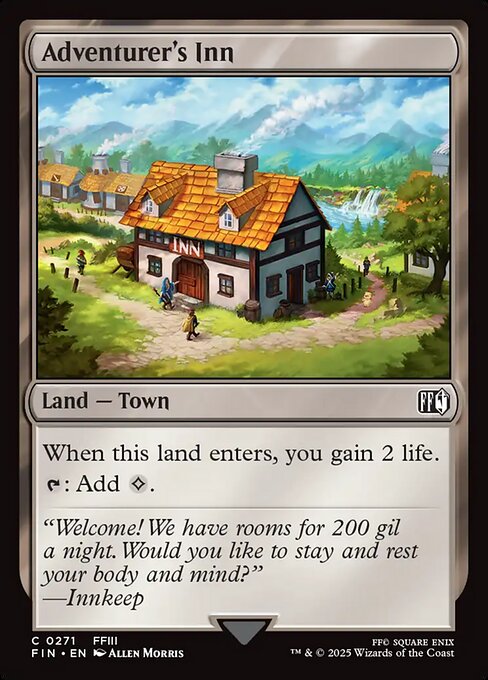
Adventurer's Inn is a colorless common land from the Final Fantasy set that enters the battlefield tapped, adds one colorless mana, and hands its controller 2 life on arrival. Across 540 multiplayer Commander games tracked on Playgroup Live, 283 of 22539 distinct decks have brought it to the table, for an inclusion rate of 1%.

The standout figure is draw-to-play rate. When a copy reaches a player's hand, 80% of the time it is played before the game ends. That is high for a utility land competing against lands with more impactful enters-the-battlefield effects. Median first play lands on turn 4.0, with a notable cluster on turn 1, suggesting many copies are kept in opening hands and deployed immediately. Once it hits the battlefield, it stays there 91% of the time, consistent with lands facing little targeted removal.

The commander distribution is notably wide. 255 distinct players have brought the card to a tracked game, and the single heaviest contributor accounts for just 3% of all instances. That spread adds confidence that the play patterns here reflect broad deckbuilding choices rather than one pilot's habits. As a colorless land, Adventurer's Inn fits any deck regardless of color identity, which explains its presence across commanders ranging from five-color goodstuff to mono-white aggro.

At a glance
  • 1% of tracked Commander decks include Adventurer's Inn
  • 80% of drawn copies are played before the game ends
  • T4.0 median first-play turn
  • 91% battlefield stickiness once it resolves
  • 255 distinct players have brought it to a tracked game
  • 112 total times played across all tracked games

First-cast turn

n=112
22%
T1
12%
T2
14%
T3
12%
T4
6%
T5
26%
T6-9
8%
T10+
Median 4.0 P25 2 · P75 7 · max 13
Cast same turn as drawn 48%

The "good card" funnel

557 brought · 255 players
Brought to game
557
Ever drawn
140
Reached battlefield
112
Still on board at game end
102
80%

Of 557 copies brought to tracked games, 140 were drawn, 112 of those were played, and the large majority remained on the battlefield at end of game.

≥ -4.4pp

Players who cast this card win 29% of the time (n=103) , vs 24% when it never left the library (n=352).

When players drew this card but left it in hand, they won 31% (n=25) — about the same as leaving it in the library. Those players survived long enough to draw it, so the gap above is about the card resolving, not just about surviving.

Observed gap +4.8pp; 95% confidence interval -4.4pp to +14.0pp. Correlational, not causal: powerful payoffs also get cast more often in games you are already winning.

Final zone distribution

157 instances
1.9%
Library
65.0%
Battlefield
12.1%
Graveyard
7.6%
Exile

The vast majority of Adventurer's Inn copies end each game on the battlefield rather than in the library, which is unusual for a singleton land and reflects how reliably it gets played once drawn.

Commanders that played this card

in tracked games

The top-commander list spans five-color, Azorius, mono-white, and colorless commanders, a natural consequence of Adventurer's Inn fitting any color identity in the format.

Card text
Adventurer's Inn card

Adventurer's Inn

Land — Town
When this land enters, you gain 2 life. {T}: Add {C}.

Final Fantasy (FIN) · Common · Illustrated by Allen Morris

Frequently Asked

How often is Adventurer's Inn drawn in a Commander game?
Across 540 tracked multiplayer games where the card was in the deck, it was drawn 25% of the time. That is broadly typical for a singleton in a 100-card deck. Of 140 instances that reached a player's hand, 80% were played before the game concluded. The median first-play turn is 4.0, though a meaningful cluster hits on turn 1 when the land is kept in an opening hand.
Does casting Adventurer's Inn correlate with winning?
In the 103 participations where the card reached the battlefield, the normalized win rate is 29%. In participations where it stayed in the library, the rate is 24%. The delta is +4.8 percentage points. Both sample buckets are reasonably sized, but the confidence interval on this delta still crosses zero, so treat it as an early directional signal rather than a firm conclusion.
Which commanders run Adventurer's Inn most often?
Among Playgroup Live's tracked multiplayer games, The Wandering Minstrel (five-color) and Hope Estheim (Azorius) lead the deck count. Because Adventurer's Inn is a colorless land, it slots cleanly into any color identity, and the top-commander list is genuinely diverse, spanning five-color, mono-white, and colorless commanders. No single archetype dominates the data.
Is Adventurer's Inn legal in Commander?
Yes. Adventurer's Inn is legal in Commander, as well as in Standard, Pioneer, Modern, Legacy, Vintage, Pauper, Brawl, Pauper Commander, and most other sanctioned formats. It is not legal in Old School or Premodern, which restrict cards to older print runs.
Why does a simple 2-life land see Commander play at all?
In Commander's 40-life format, 2 life is a modest but real buffer. More importantly, Adventurer's Inn costs nothing beyond a land drop and produces colorless mana every turn afterward. Decks running it tend to either value incidental life gain for synergy (drain effects, life-matters commanders) or simply want a cheap, colorless land slot that does something the turn it enters. Its common rarity also means it is widely available and inexpensive to acquire.
How concentrated is the Adventurer's Inn data across players?
The data is well-spread. 255 distinct players have brought Adventurer's Inn to at least one tracked game, and the single heaviest contributor accounts for just 3% of all instances. That low concentration is a strength of the dataset: the patterns here are not being driven by one or two prolific players skewing the numbers.