
collections_bookmark Part of Teenage Mutant Ninja Turtles
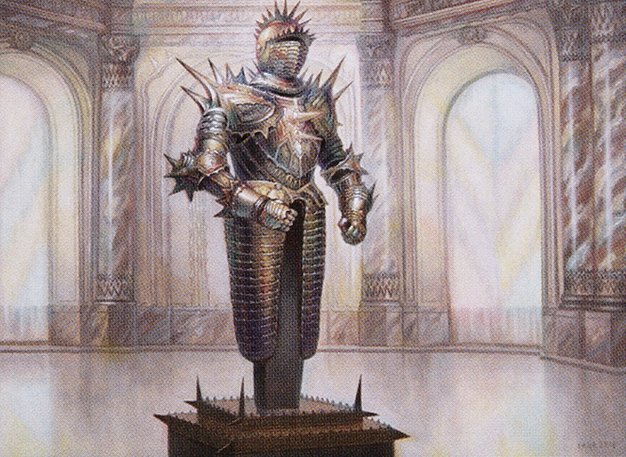
Commander's Plate card art
Live Play Data

Commander's Plate

{1} · Artifact — Equipment · Commander Legends (CMR)
3%
Live Inclusion
Times Brought
575
Decks Running
315
Median Cast Turn
5
Drawn → Played
85%
Format

85% of drawn Commander's Plates are cast before the game ends, and decks that resolve it win 38% of the time on a 4-player normalized baseline, a +12.4 percentage-point lift over the 26% baseline for decks that never see it.

Commander's Plate shows up in 3% of the 9388 tracked multiplayer Commander decks on Playgroup Live. That is a niche number by design: the card earns its slot only when a commander benefits from broad color-based protection, and that restricts the pool of eligible decks.

When the Plate does land in a hand, players move quickly. 85% of drawn copies reach the battlefield before the game ends, with a median first-cast turn of 5. The win-rate picture is the more striking finding: decks that resolve the Plate win 38% of games in normalized terms, compared with 26% for decks where it stays buried. That +12.4 pp lift is directional and consistent with what the card is built to do, though both sample sizes should grow before drawing firm conclusions.

The commander spread is notably wide: 254 distinct players have brought it to a tracked game, and no single player accounts for more than a small fraction of observations. The top commanders skew toward mono- and two-color strategies where the Plate's protection clause covers the most colors, commanders like Kratos, God of War and Giada, Font of Hope sitting near the top of the list.

At a glance
  • 3% of tracked multiplayer Commander decks include Commander's Plate
  • 85% of drawn copies reach the battlefield before the game ends
  • T5 median first-cast turn across all tracked games
  • 38% normalized win rate in games where the Plate resolves
  • 79% battlefield stickiness once the Plate hits play
  • 254 distinct players have brought Commander's Plate to a tracked game

First-cast turn

n=133
20%
T1
8%
T2
6%
T3
10%
T4
12%
T5
38%
T6-9
7%
T10+
Median 5 P25 2 · P75 7 · max 13
On curve 20% (26 / 133 cast on T1) Cast same turn as drawn 68%

The "good card" funnel

575 brought · 254 players
Brought to game
575
Ever drawn
156
Reached battlefield
133
Still on board at game end
105
85%

Of 575 Plates brought to multiplayer games, 156 were drawn and 133 of those were cast, with 79% of resolved copies surviving to the end of the game.

≥ +3.9pp

Players who cast this card win 38% of the time (n=131) , vs 26% when it never left the library (n=369).

When players drew this card but left it in hand, they won 29% (n=23) — about the same as leaving it in the library. Those players survived long enough to draw it, so the gap above is about the card resolving, not just about surviving.

Observed gap +12.4pp; 95% confidence interval +3.9pp to +20.9pp. Correlational, not causal: powerful payoffs also get cast more often in games you are already winning.

Final zone distribution

164 instances
3.7%
Library
64.0%
Battlefield
16.5%
Graveyard
3.7%
Exile

The vast majority of Commander's Plates never leave the library, which is structural for a 3%-inclusion singleton in a 100-card deck. Among observed copies, most finish on the battlefield, consistent with the card's high stickiness once it resolves.

Commanders that played this card

in tracked games

The top-commander list is spread across mono-color, two-color, and colorless commanders, reflecting how broadly Commander's Plate slots into any strategy that wants to protect a single key creature from opposing interaction.

Frequently Asked

How often is Commander's Plate drawn in a tracked game?
Across 541 tracked multiplayer games where the Plate was in the deck, it was drawn 27% of the time. That is typical for a singleton in a 100-card deck. Of the 156 copies that reached a player's hand, 85% were cast before the game concluded. The median time spent in hand before being cast is zero turns, meaning players tend to cast it the same turn they draw it when they do cast it at all.
What turn does Commander's Plate typically hit play?
Median first-cast turn is 5 in multiplayer games. The distribution is spread across the early and mid game: a cluster of casts land on turn 1 (drawn in the opening hand and played immediately), with most of the remainder spread between turns 4 and 8. The 1-mana cast cost is deceptive because the equip cost is 3 mana for your commander or 5 for anything else, so the Plate often sits on the board a turn or two before the equipment actually protects anyone.
Does resolving Commander's Plate actually correlate with winning?
In 131 participations where the Plate reached the battlefield, the normalized win rate is 38%. In 369 participations where it stayed in the library, the rate is 26%. That is a +12.4 pp difference. The signal is consistent and the lower bound of the confidence interval is positive, but the dataset is still growing. Treat this as a directional early finding rather than a definitive claim.
Is Commander's Plate legal in Commander?
Yes. Commander's Plate is legal in Commander, Duel Commander, Brawl, Legacy, Vintage, Historic, Timeless, Gladiator, and Oathbreaker. It is not legal in Modern, Pioneer, Standard, Pauper, or Pauper Commander. No bans apply in the formats where it is legal.
Which commanders most commonly run Commander's Plate?
On Playgroup Live, Tony Stark // The Invincible Iron Man leads with the most decks including the Plate, followed by Ultron, Artificial Malevolence, Giada, Font of Hope, and Kratos, God of War. The list spans multiple color identities, but mono- and two-color commanders tend to benefit most because the Plate grants protection from every color outside the commander's identity, which is a wider protective net the fewer colors your commander has.
How concentrated is the Commander's Plate data across players?
The data is well-spread. 254 distinct players have brought Commander's Plate to at least one tracked game, and the single heaviest contributor accounts for only 27% of all instances. That breadth is a meaningful signal: the card's performance numbers reflect a genuine cross-section of the player base rather than one prolific pilot's results skewing the averages.