
collections_bookmark Part of Commander Masters
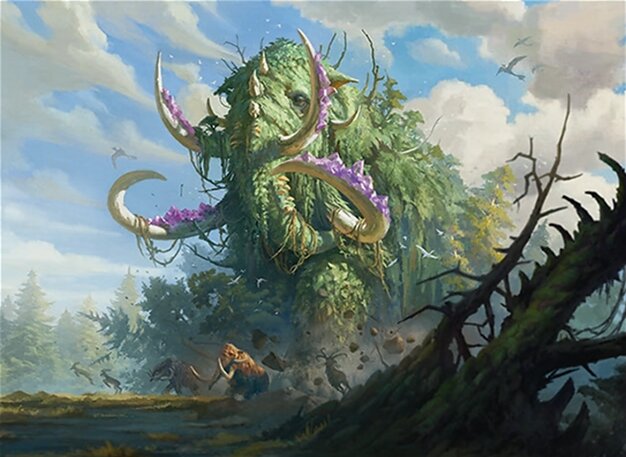
Craterhoof Behemoth card art
Live Play Data

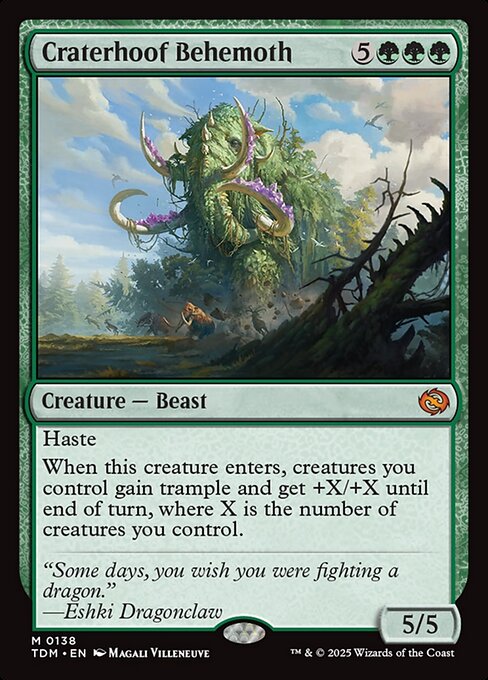
Craterhoof Behemoth

{5} {G} {G} {G} · Creature — Beast · Tarkir: Dragonstorm (TDM)
8%
Live Inclusion
Times Brought
831
Decks Running
408
Median Cast Turn
7.0
Drawn → Played
62%
Format

58% of multiplayer games where Craterhoof Behemoth resolved ended in a win for the caster, a +32.3 percentage-point lift over decks where it never left the library.

Craterhoof Behemoth converts resolved casts into wins at a rate that stands out even in a format built around explosive finishers. Across 778 tracked multiplayer Commander games, the Behemoth posted a 58% win rate when cast, against 25% for participations where it never surfaced. That +32.3 percentage-point delta is among the largest we observe for any creature in the dataset, and with 129 cast observations and 528 library observations, the sample is large enough to treat as a strong directional signal.

The card earns its reputation as a creature-deck finisher. Its 8-mana cost means it lands late, with a median first-cast turn of 7.0 in multiplayer games. Ramp is clearly doing heavy lifting: 71% of casts arrive on or ahead of curve, with the majority cheated in before turn 8 through mana acceleration. Once it resolves, 79% of copies survive to end of game, which is telling for a card that typically closes the game on the spot.

The commander spread is broad. 340 distinct players have brought Craterhoof to a tracked game, and the single heaviest contributor accounts for just 6% of all instances, so the data reflects genuine cross-meta usage rather than one pilot's repeated runs. Token and creature-swarm commanders dominate the top slots, consistent with how the card functions: it scales directly with board width.

At a glance
  • 58% win rate when Craterhoof Behemoth resolves in multiplayer games
  • +32.3pp win-rate lift over games where it never leaves the library
  • T7.0 median first-cast turn in multiplayer Commander
  • 71% of casts land on or ahead of the 8-mana curve, driven by ramp
  • 79% battlefield stickiness once the Behemoth resolves
  • 340 distinct players have brought this card to a tracked game

First-cast turn

n=138
0%
T1
0%
T2
0%
T3
4%
T4
10%
T5
69%
T6-9
17%
T10+
Median 7.0 P25 6 · P75 9 · max 16
On curve 71% (25 / 138 cast on T8) Cast same turn as drawn 28%

The "good card" funnel

831 brought · 340 players
Brought to game
831
Ever drawn
223
Reached battlefield
138
Still on board at game end
109
62%

Of 831 Craterhoof Behemoths brought to multiplayer games, 223 were drawn and 138 of those were cast, with 79% of resolved copies surviving to end of game.

≥ +24.2pp

Players who cast this card win 58% of the time (n=129) , vs 25% when it never left the library (n=528).

When players drew this card but left it in hand, they won 25% (n=78) — about the same as leaving it in the library. Those players survived long enough to draw it, so the gap above is about the card resolving, not just about surviving.

Observed gap +32.3pp; 95% confidence interval +24.2pp to +40.4pp. Correlational, not causal: powerful payoffs also get cast more often in games you are already winning.

Final zone distribution

245 instances
5.3%
Library
44.5%
Battlefield
15.5%
Graveyard
3.7%
Exile

Most Craterhoof Behemoths never leave the library in a given game, the expected result for an 8-mana singleton in a 100-card deck, but the copies that do resolve show one of the strongest win-rate correlations in the dataset.

Commanders that played this card

in tracked games

The commander list skews heavily toward token generators and creature-wide strategies across green and Golgari builds, consistent with a card that scales its power directly off board width.

Frequently Asked

How often does Craterhoof Behemoth win the game when cast?
In 129 multiplayer participations where Craterhoof Behemoth reached the battlefield, the caster won 58% of the time. That is normalized to a 4-player baseline, so it accounts for table size. Compare that to 25% when the card never left the library. The +32.3 percentage-point gap is a strong directional signal that resolving the Behemoth materially improves your chances, though we note the dataset is play-tracked rather than exhaustive.
What turn does Craterhoof Behemoth typically hit the battlefield?
Median first-cast turn is 7.0 in multiplayer games. The distribution runs from turn 4 on the early end to turn 16 at the extreme. The interquartile range sits between turns 6 and 9, reflecting how much the cast window depends on whether a player drew meaningful ramp. 71% of casts landed on or ahead of the natural 8-mana curve, meaning ramp spells are accelerating the Behemoth into play more often than not.
How often is Craterhoof Behemoth drawn and then cast?
Of 223 instances drawn in multiplayer games, 62% were cast before the game ended. A drawn copy can go uncast because the game concluded first or because conditions were not yet right, so this number reflects outcomes rather than player intent. Players who do cast it tend to hold it for a few turns first: median hand-to-cast delay is 3 turns, and just 28% of drawn copies were cast on the same turn they were drawn.
Is Craterhoof Behemoth legal in Commander?
Yes, Craterhoof Behemoth is legal and unrestricted in Commander (multiplayer and duel). It is also legal in Legacy, Vintage, Modern, Pioneer, and several other formats. It is not legal in Pauper or Pauper Commander due to its mythic rarity, and it is not legal in Old School or Premodern.
Which commanders most often run Craterhoof Behemoth?
Across the tracked dataset, the card appears most frequently alongside token-generating and creature-swarm commanders. The top live-game pairings include Witherbloom, the Balancer and The Unbeatable Squirrel Girl at the head of the list, followed by The Astonishing Ant-Man and Lathril, Blade of the Elves. The spread across 340 unique players and across Golgari, Simic, and mono-green strategies confirms this is a broadly adopted finisher rather than a niche pick.
Does Craterhoof Behemoth stay on the battlefield after resolving?
79% of resolved copies were still on the battlefield at game end. That figure is high for an 8-mana creature, and the most likely explanation is that the Behemoth's attack trigger ends the game on the same turn it resolves, leaving it standing on an empty board. Fewer copies are bounced, exiled, or destroyed than you might expect for a card this threatening, because opponents rarely get another turn to answer it.