
collections_bookmark Part of Tarkir Dragonstorm
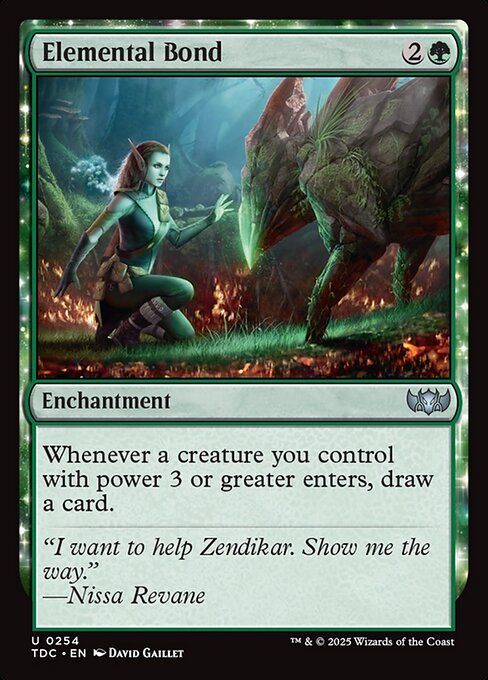
Elemental Bond card art
Live Play Data

Elemental Bond

{2} {G} · Enchantment · Tarkir: Dragonstorm Commander (TDC)
6%
Live Inclusion
Times Brought
845
Decks Running
417
Median Cast Turn
5
Drawn → Played
68%
Format

36% of games where Elemental Bond resolved ended in a win for its controller. That's +12.2 percentage points above the baseline win rate when the card never leaves the library, across 101 tracked participations.

Elemental Bond sits in 6% of the 7011 distinct Commander decks tracked in Playgroup Live games. A {2}{G} enchantment that draws a card whenever a creature with power 3 or greater enters under your control, it earns its slot in any deck that puts large bodies on the battlefield consistently.

The clearest signal in the data is the win-rate spread. Games where Elemental Bond was cast show a 36% win rate. Games where it stayed in the library show 24%. That +12.2 percentage-point lift, measured across 101 cast participations and 580 library participations, clears its own standard error, making it a directionally reliable effect rather than noise. The card does not replace threats. It turns a stream of threats into card advantage, which is what green stompy decks historically lack.

The commander distribution tells the broader story: Ureni of the Unwritten, Ashling the Limitless, The Ur-Dragon, Miirym, Gishath, and Atarka all appear at the top of the list. These are creature-heavy, high-power strategies. Elemental Bond's 355 unique tracked players and a single-player concentration of just 3% of all instances confirm the data is well-spread, not driven by one active user's games.

At a glance
  • 6% of tracked Commander decks include Elemental Bond
  • 68% of drawn copies were cast before the game ended
  • T5 median first-cast turn
  • 36% win rate in games where Elemental Bond resolved
  • +12.2pp win-rate lift over games where it never left the library
  • 78% battlefield stickiness once cast

First-cast turn

n=111
1%
T1
8%
T2
14%
T3
18%
T4
14%
T5
35%
T6-9
10%
T10+
Median 5 P25 4 · P75 7 · max 16
On curve 23% (16 / 111 cast on T3) Cast same turn as drawn 27%

The "good card" funnel

848 brought · 355 players
Brought to game
848
Ever drawn
163
Reached battlefield
111
Still on board at game end
87
68%

Of 848 Elemental Bonds brought to tracked games, 163 were drawn, 111 were cast, and the large majority remained on the battlefield through the end of the game.

≥ +3.6pp

Players who cast this card win 36% of the time (n=101) , vs 24% when it never left the library (n=580).

When players drew this card but left it in hand, they won 32% (n=48) — about the same as leaving it in the library. Those players survived long enough to draw it, so the gap above is about the card resolving, not just about surviving.

Observed gap +12.2pp; 95% confidence interval +3.6pp to +20.8pp. Correlational, not causal: powerful payoffs also get cast more often in games you are already winning.

Final zone distribution

181 instances
2.2%
Library
48.1%
Battlefield
25.4%
Graveyard
2.8%
Exile

Most Elemental Bond copies that never leave the library reflect the structural reality of 100-card singleton. The copies that do get cast stick around: 78% remain on the battlefield at game's end, confirming opponents rarely prioritize removing a draw engine over board threats.

Commanders that played this card

in tracked games

Ureni of the Unwritten sits atop the list, but the spread across dragons, dinosaurs, elementals, and big-green strategies shows Elemental Bond is format glue rather than a build-around for a single archetype.

Frequently Asked

How often is Elemental Bond drawn in a Commander game?
Across 798 tracked multiplayer Commander games where Elemental Bond was in the deck, it was drawn 19% of the time. That is in line with what you'd expect for a singleton in a 100-card deck. Of the 163 copies that reached a player's hand, 68% were cast before the game ended. The remainder is mostly a function of game length: copies drawn late sometimes never find a window.
What turn does Elemental Bond usually get cast?
The median first-cast turn is 5, with a mean of 5.7. The p25 lands on turn 4 and the p75 on turn 8, so most casts cluster in the mid-game. Only a small fraction land on turn 3 (its natural mana-value turn), which is consistent with the card arriving in hand after the opening draw rather than in the starting seven. The 23% on-curve rate reinforces that: Elemental Bond is usually cast when drawn rather than held, but it tends to be drawn mid-game.
Does casting Elemental Bond actually improve your chances of winning?
In 101 tracked games where the card was cast, the normalized win rate is 36%. In 580 games where it sat in the library untouched, the win rate is 24%. The +12.2 percentage-point delta exceeds its standard error, so this is a directional positive signal. Both sample sizes are large enough to treat the lift as meaningful rather than incidental, though the broader dataset and format variety always introduce noise.
Which commanders pair most often with Elemental Bond?
Ureni of the Unwritten leads with 417 total decks in the dataset including the card. Close behind are Ashling the Limitless, The Ur-Dragon, Miirym Sentinel Wyrm, and Pantlaza Sun-Favored. The common thread is high-power creature strategies: dragons, dinosaurs, and big green stompy builds that enter multiple large creatures per turn and want to convert those enters into cards drawn.
Is Elemental Bond legal in Commander?
Yes. Elemental Bond is legal in Commander with no restrictions. It is also legal in Legacy, Modern, Pioneer, Vintage, Historic, and several other formats. It is not legal in Standard, Pauper, Pauper Commander, or Premodern. The card sees its heaviest play in Commander, where the density of large creatures across a typical game and the longer game length create the most triggers per casting.
How concentrated is the Elemental Bond data among a small group of players?
The data spans 355 unique players who have brought this card to a tracked game. The single most active contributor accounts for just 3% of all tracked instances, which is well below the threshold where one player's preferences could skew the numbers. That spread means the win rates, cast turns, and commander pairings reflect a broad cross-section of the player base rather than a single pilot's results.