
bolt Game Changer on the MTG Commander Game Changers list collections_bookmark Part of Secrets of Strixhaven
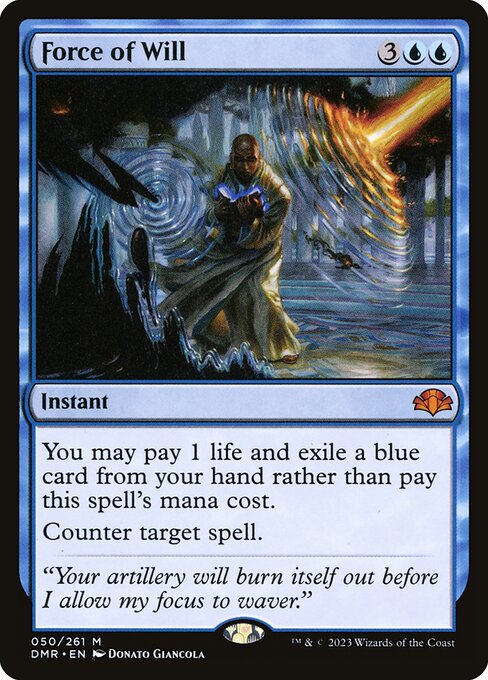
Force of Will card art
Live Play Data

Force of Will

{3} {U} {U} · Instant · Dominaria Remastered (DMR)
6%
Live Inclusion
Times Brought
797
Decks Running
372
Median Cast Turn
6
Drawn → Played
61%
Format

6% of tracked Commander decks run Force of Will. When drawn, 61% of copies reach the cast step, with a median first-cast turn of 6.

Force of Will sits in 6% of the 5779 Commander decks that have played a tracked game on Playgroup Live. That selective presence, far below a staple like Sol Ring, reflects its hard constraint: only blue decks can run it, and even within blue it competes for a slot against cheaper, more reliably castable interaction.

61% of drawn copies are cast before the game ends. That figure is lower than you might expect for a free-pitch counterspell, but Force of Will has two real costs: a life payment and a card in exile. Players sitting on a dead hand, or who never see a blue card to pitch, may end the game holding it. The median first cast lands on turn 6, squarely in the mid-game window where counter wars tend to matter most in multiplayer.

Across 652 tracked games, Force of Will was brought to the table 801 times and cast 127 times. Data comes from 264 distinct players, and the single heaviest contributor accounts for 9% of all instances, comfortably below the 30% threshold where individual bias becomes a concern. The commander distribution is wide and blue-heavy, as expected for a card that requires blue in the command zone.

At a glance
  • 6% of tracked Commander decks include Force of Will
  • 61% of drawn copies reach the cast step
  • T6 median first-cast turn
  • 26% draw rate, typical for a singleton in a 100-card deck
  • 264 distinct players have brought Force of Will to a tracked game
  • 34% normalized win rate in games where Force of Will was cast

First-cast turn

n=127
3%
T1
3%
T2
9%
T3
14%
T4
15%
T5
43%
T6-9
13%
T10+
Median 6 P25 4 · P75 8 · max 14
On curve 44% (19 / 127 cast on T5) Cast same turn as drawn 34%

The "good card" funnel

801 brought · 264 players
Brought to game
801
Ever drawn
208
Reached battlefield
127
Still on board at game end
12
61%

Of 801 copies brought to games, 208 were drawn, 127 of those were cast, and the card resolved to the graveyard in the vast majority of cases, as expected for a one-shot counterspell.

≥ +0.7pp

Players who cast this card win 34% of the time (n=122) , vs 25% when it never left the library (n=498).

When players drew this card but left it in hand, they won 37% (n=80) — about the same as leaving it in the library. Those players survived long enough to draw it, so the gap above is about the card resolving, not just about surviving.

Observed gap +9.0pp; 95% confidence interval +0.7pp to +17.3pp. Correlational, not causal: powerful payoffs also get cast more often in games you are already winning.

Final zone distribution

240 instances
4.6%
Library
5.0%
Battlefield
55.4%
Graveyard
8.8%
Exile

Force of Will is an instant that resolves to the graveyard, so the bulk of tracked copies end there. Most copies that never leave the library simply were not drawn in 652 observed games, the baseline expectation for any singleton.

Commanders that played this card

in tracked games

The top-commander list peaks at 6 decks for several different commanders, a flat and even spread that confirms Force of Will is not the signature piece of any single archetype but a generic blue staple scattered across the meta.

Frequently Asked

How often is Force of Will drawn in a Commander game?
In 652 tracked games where Force of Will was in the deck, it was drawn 26% of the time. That is normal for a singleton in a 100-card deck. Of the 208 instances that reached a player's hand, 61% were cast before the game ended. The remainder stayed in hand, often because the game concluded before a suitable target appeared or because the player lacked a blue card to pitch.
What turn does Force of Will usually get cast?
Median first cast lands on turn 6, with the middle half of casts falling between turns 4 and 8. Its nominal mana cost is 5, but the alternate pitch cost means many casts happen earlier than curve would suggest: 44% of cast instances landed on or ahead of the mana-value curve. The distribution runs all the way to turn 14, reflecting late-game reactive casts against combo finishers.
Is Force of Will banned anywhere relevant to Commander players?
Force of Will is legal in Commander and Oathbreaker. It is banned in Duel Commander, which uses a stricter banned list tuned for 1-on-1 play where free counterspells are considerably more oppressive. It is also banned in Brawl and Historic. Legacy and Vintage both allow it, and it is a format-defining card in both. It is not legal in Modern, Pioneer, or Standard.
Does casting Force of Will actually correlate with winning?
In 122 participations where Force of Will was cast, the normalized win rate was 34%. In 498 participations where it stayed in the library, the rate was 25%. The raw delta is +9.0 percentage points. The sample sizes here are large enough to call this a consistent directional signal, though the confidence interval is wide enough to treat it as preliminary rather than definitive.
How concentrated is the Force of Will data among specific players?
264 distinct players have brought Force of Will to at least one tracked game, and the single heaviest contributor accounts for 9% of all instances. That spread is healthy. When one player accounts for less than 15% of the data and more than 100 players contribute, the aggregate numbers are more representative of the broader blue-deck population than of any individual's play patterns.
Why does Force of Will show up across so many different commanders?
Force of Will only needs blue in the color identity, which covers a massive portion of the Commander card pool. Any blue-containing commander is a potential home. The top commanders in the tracked data span mono-blue, Dimir, Simic, Jeskai, and five-color strategies, which reflects how broadly the card is adopted rather than clustering in any single archetype. Its pitch cost also makes it attractive in high-card-quality decks that can afford to exile blue cards without losing too much value.