collections_bookmark Part of Bloomburrow
Game Trail card art
Live Play Data

Game Trail

Land · Murders at Karlov Manor Commander (MKC)
15%
Live Inclusion
Times Brought
1612
Decks Running
747
Median Cast Turn
4
Drawn → Played
75%
Format

15% of tracked Gruul-accessible Commander decks on Playgroup Live run Game Trail, and 75% of drawn copies reach the battlefield, with a median first-cast turn of 4.

Game Trail is a consistent mana-fixing staple in Gruul and three-color green-red Commander decks. Across 1528 tracked multiplayer games on Playgroup Live, 15% of decks in the dataset include it, spread across 747 distinct tracked lists.

The card's conditional entry mechanic rewards early land-drop sequencing. When Game Trail shows up in hand, players play it at a rate of 75%, and the median first-cast turn lands on turn 4. The mode of the first-cast distribution is turn 1, reflecting the strong incentive to lead with a Forest or Mountain and drop this untapped immediately. Once it reaches the battlefield, it sticks: 91% stickiness signals that players almost never lose it to removal, as expected for a basic dual land.

The commander spread is wide. Cloud, Ex-SOLDIER and Pantlaza, Sun-Favored head the list by raw deck count, but the data covers 655 distinct players with no single contributor exceeding 24% of instances, suggesting the numbers are not driven by any one pod or playgroup.

At a glance
  • 15% of tracked Commander decks include Game Trail
  • 75% of drawn copies reach the battlefield
  • T4 median first-cast turn across all observed casts
  • 91% battlefield stickiness once played
  • 655 distinct players have brought Game Trail to a tracked game
  • 24% draw rate, consistent with a singleton in a 100-card deck

First-cast turn

n=293
30%
T1
12%
T2
8%
T3
7%
T4
8%
T5
28%
T6-9
7%
T10+
Median 4 P25 1 · P75 7 · max 14
Cast same turn as drawn 66%

The "good card" funnel

1613 brought · 655 players
Brought to game
1613
Ever drawn
389
Reached battlefield
293
Still on board at game end
267
75%

Of 1613 Game Trail copies brought to tracked games, 389 were drawn, 293 of those were cast, and 91% of cast copies stayed on the battlefield through the end of the game.

≥ -2.1pp

Players who cast this card win 23% of the time (n=278) , vs 20% when it never left the library (n=1018).

When players drew this card but left it in hand, they won 29% (n=86) — about the same as leaving it in the library. Those players survived long enough to draw it, so the gap above is about the card resolving, not just about surviving.

Observed gap +2.9pp; 95% confidence interval -2.1pp to +8.0pp. Correlational, not causal: powerful payoffs also get cast more often in games you are already winning.

Final zone distribution

432 instances
3.7%
Library
61.8%
Battlefield
15.0%
Graveyard
4.2%
Exile

The vast majority of Game Trail copies never leave the library across all participations, a natural consequence of 100-card singleton variance. Of the copies that were observed, most finished on the battlefield, reflecting how reliably it sticks once played.

Commanders that played this card

in tracked games

Cloud, Ex-SOLDIER and Pantlaza lead by deck count, but the spread across ten distinct commanders spanning pure Gruul to Naya shows Game Trail is a format-wide mana-fixing choice rather than a card narrowly tied to any one archetype.

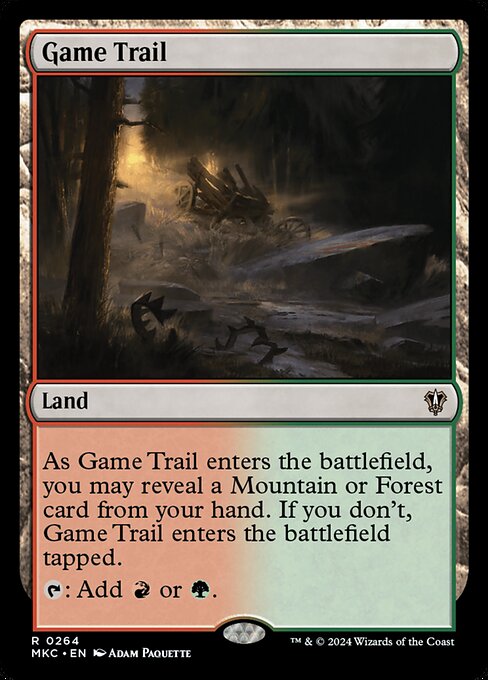
Card text
Game Trail card

Game Trail

Land
As this land enters, you may reveal a Mountain or Forest card from your hand. If you don't, this land enters tapped. {T}: Add {R} or {G}.

Murders at Karlov Manor Commander (MKC) · Rare · Illustrated by Adam Paquette

Frequently Asked

How often is Game Trail drawn in a Commander game?
Across 1528 tracked multiplayer games where Game Trail was in the deck, it was drawn 24% of the time. That figure is normal for any singleton in a 100-card deck. Of the 389 instances that entered a player's hand, 75% were played before the game ended. A portion of unplayed copies reflects games that ended before the land could be laid down, not a deliberate choice to hold it.
What turn does Game Trail usually enter the battlefield?
The median first-cast turn is 4 in multiplayer games. The distribution is front-loaded: turn 1 is the single most common cast turn, driven by players who keep an opening hand containing a Mountain or Forest and drop the land untapped immediately. The p75 sits at turn 7, so there is a long tail of late-game plays. Same-turn play rate after drawing is 66%, meaning most players who draw it do not hold it long before putting it into play.
Does casting Game Trail correlate with winning?
In 278 participations where Game Trail reached the battlefield, the normalized win rate was 23%. In participations where it stayed in the library, the rate was 20%. The delta is small and the confidence interval crosses zero, so this is directional at best. What the data does not show is that resolving Game Trail dramatically swings win probability on its own. It is a mana-fixing piece, not a win condition, so a flat delta is the expected result.
Is Game Trail legal in Commander?
Yes. Game Trail is legal in Commander, as well as Legacy, Modern, Pioneer, Vintage, Historic, Timeless, Duel Commander, and Oathbreaker. It is not legal in Standard, Pauper, Pauper Commander, or Premodern. There are no bans or restrictions on it in any format where it is legal.
Which commanders most often run Game Trail?
Among tracked decks, Cloud, Ex-SOLDIER (Naya) leads by raw deck count, followed by Pantlaza, Sun-Favored (also Naya) and Bello, Bard of the Brambles (pure Gruul). The presence of three-color Naya commanders in the top spots reflects that Game Trail's color identity fits any deck containing both green and red, making it a natural inclusion even when white is the third color. Pure GR commanders like Bello and Atarka, World Render also appear prominently.
How concentrated is Game Trail's data among players?
The 1528 multiplayer games tracked for Game Trail draw from 655 distinct players, which is a well-spread sample for a card at this inclusion rate. The single heaviest contributor accounts for a small fraction of total instances, so the aggregate numbers are not skewed by one prolific playgroup. This breadth adds confidence to the draw rate and cast-turn figures as representative of real Playgroup Live behavior.