collections_bookmark Part of Bloomburrow
Golgari Rot Farm card art
Live Play Data

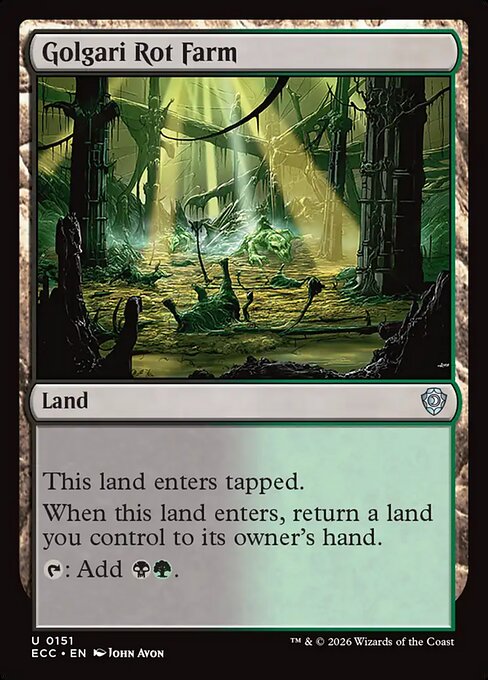
Golgari Rot Farm

Land · Lorwyn Eclipsed Commander (ECC)
19%
Live Inclusion
Times Brought
648
Decks Running
356
Median Cast Turn
4
Drawn → Played
66%
Format

19% of tracked Golgari-shell Commander decks run Golgari Rot Farm, and 66% of drawn copies reach the battlefield, with a median first-cast turn of 4.

Golgari Rot Farm shows up in 19% of decks that have played a tracked game on Playgroup Live, appearing in 356 of the 1904 distinct decks in the dataset. That places it as a consistent staple in black-green mana bases rather than a fringe inclusion.

The draw-to-play figure is the most telling number: 66% of drawn copies get played before the game ends. For a land that enters tapped and asks you to bounce another land on arrival, that rate signals players are treating it as a reliable two-mana source worth the tempo cost. Median first cast lands on turn 4, which fits neatly into the early ramp window where an extra {B}{G} opens options.

The data is well-spread across 296 distinct players, with no single contributor accounting for more than 28% of instances. That breadth adds confidence to the directional signals here, even on a dataset of this size.

At a glance
  • 19% of tracked Commander decks include Golgari Rot Farm
  • 66% of drawn copies are played before the game ends
  • T4 median first-cast turn
  • 88% battlefield stickiness once played
  • 296 distinct players have brought this card to a tracked game
  • 28% draw rate per game in which it is included

First-cast turn

n=119
15%
T1
13%
T2
12%
T3
14%
T4
10%
T5
29%
T6-9
6%
T10+
Median 4 P25 2 · P75 7 · max 14
Cast same turn as drawn 54%

The "good card" funnel

648 brought · 296 players
Brought to game
648
Ever drawn
181
Reached battlefield
119
Still on board at game end
105
66%

Of 648 Golgari Rot Farms brought to tracked games, 181 were drawn, 119 of those were played, and 88% of played copies remained on the battlefield by game's end.

≥ +1.1pp

Players who cast this card win 30% of the time (n=116) , vs 21% when it never left the library (n=420).

When players drew this card but left it in hand, they won 24% (n=58) — about the same as leaving it in the library. Those players survived long enough to draw it, so the gap above is about the card resolving, not just about surviving.

Observed gap +9.5pp; 95% confidence interval +1.1pp to +17.9pp. Correlational, not causal: powerful payoffs also get cast more often in games you are already winning.

Final zone distribution

201 instances
1.0%
Library
52.2%
Battlefield
19.4%
Graveyard
5.0%
Exile

The vast majority of Golgari Rot Farms never leave the library in a given game, which is expected for any singleton land in a 100-card deck. Among observed copies, most finished on the battlefield, pointing to low removal pressure on basic mana fixers.

Commanders that played this card

in tracked games

The commander spread is wide: ten different commanders each lead multiple decks running Rot Farm, spanning pure Golgari builds to three- and five-color shells that share black and green. No single commander dominates the list.

Frequently Asked

How often is Golgari Rot Farm drawn in a Commander game?
Across 606 tracked multiplayer games where Golgari Rot Farm was in the deck, it was drawn 28% of the time. That is typical for a singleton land in a 100-card deck. Of 181 instances that reached a player's hand, 66% were played before the game concluded.
What turn does Golgari Rot Farm usually enter the battlefield?
The median first-cast turn is 4, with the distribution spread from turn 1 through the mid-game. The p25 sits at turn 2 and the p75 at turn 7, so roughly half of all casts land in that early-to-mid window. Because lands have no mana cost, the on-curve metric does not apply here. Check hand-to-cast patterns instead: about half of played copies go down the same turn they are drawn.
Does casting Golgari Rot Farm correlate with winning?
Win rate when cast is 30% versus 21% when the card never left the library, a delta of +9.5 percentage points. Both buckets have healthy sample sizes (116 and 420 observations respectively), but the confidence interval on this delta crosses zero in the current dataset, so treat it as a directional signal rather than a proven edge. Decks that cast the card tend to win slightly more often, consistent with Rot Farm being a functional mana fixer rather than a dead card.
Is the bounce-a-land drawback a real cost in practice?
The data is indirect here, but stickiness is a useful proxy: 88% of Rot Farms that hit the battlefield are still there at end of game. That suggests it is not being destroyed or exiled at a high rate once it resolves. The bigger cost, entering tapped plus returning a land, is a turn-one tempo hit. The median cast turn of 4 suggests most players are not deploying it on the first turn despite it being a land, which is consistent with holding it for a turn where the tempo loss is less punishing.
Which commanders most commonly run Golgari Rot Farm?
In the multiplayer dataset, Auntie Ool, Cursewretch leads with the most decks, followed by Hazel of the Rootbloom and Teval, the Balanced Scale. The list spans pure Golgari ({B}{G}) and three-color shells that include both black and green. The spread across 296 unique players indicates this is broad format adoption rather than a card propped up by a single archetype or player cluster.
Is Golgari Rot Farm legal in Commander?
Yes. Golgari Rot Farm is legal in Commander (and also in Legacy, Modern, Pauper, Vintage, Duel Commander, Oathbreaker, Pauper Commander, and PreDH). It is not legal in Standard, Pioneer, Historic, Alchemy, or Brawl. Its black-green color identity restricts it to decks whose commanders share those colors.