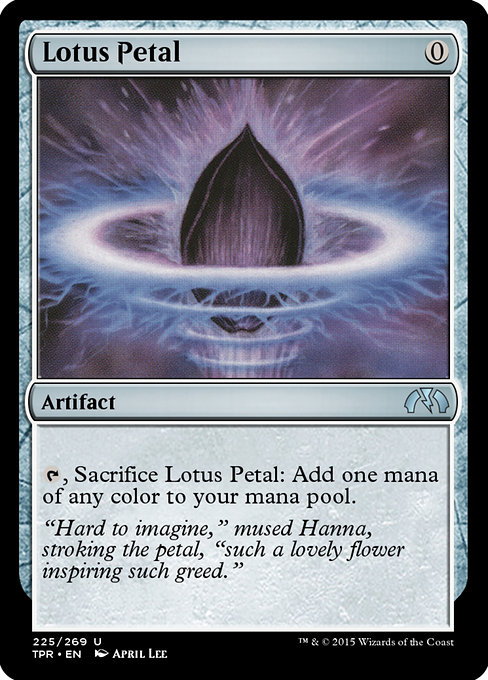

Lotus Petal card art
Live Play Data

Lotus Petal

{0} · Artifact · Tempest Remastered (TPR)
5%
Live Inclusion
Times Brought
818
Decks Running
408
Median Cast Turn
3
Drawn → Played
83%
Format

83% of drawn Lotus Petals are cast before the game ends, and the most common first-cast turn is turn 1. That's the signature of a card played exclusively for speed.

Lotus Petal sits in 5% of tracked Commander decks on Playgroup Live, a deliberately narrow niche that reflects its role as a pure fast-mana piece rather than a generalist inclusion. When a copy reaches a player's hand, 83% of those copies are cast before the game concludes.

The cast-turn distribution tells the real story. The single most common turn to cast Lotus Petal is turn 1, and the median sits at turn 3. Players are not holding it for value. They tap it the moment it serves a combo or ramp line. The same-turn cast rate of 79% reinforces this: three-quarters of drawn copies go to the stack on the very turn they are drawn.

Because Lotus Petal is a zero-mana one-shot mana source, it is essentially invisible to anyone not building around storm counts, artifact synergies, or fast combo lines. Its colorless identity means any commander can run it, but in practice it clusters in blue and artifact-heavy strategies where every half-turn of acceleration matters. It is legal in Commander and restricted in Vintage, a useful data point on the card's ceiling.

At a glance
  • 5% of tracked Commander decks include Lotus Petal
  • 83% of drawn copies are cast before the game ends
  • T3 median first-cast turn, with turn 1 as the single most common cast turn
  • 79% of drawn copies are cast on the same turn they are drawn
  • 252 distinct players have brought Lotus Petal to a tracked game, well spread across the dataset
  • 22% battlefield stickiness, expected for a sacrifice-on-use mana rock

First-cast turn

n=181
34%
T1
12%
T2
8%
T3
13%
T4
9%
T5
19%
T6-9
4%
T10+
Median 3 P25 1 · P75 5 · max 15
Cast same turn as drawn 79%

The "good card" funnel

818 brought · 252 players
Brought to game
818
Ever drawn
217
Reached battlefield
181
Still on board at game end
39
83%

Of 818 Lotus Petals brought to tracked games, 217 were drawn and 181 of those were cast, a draw-to-play rate of 83% that is among the highest of any card in the dataset.

≥ -2.4pp

Players who cast this card win 32% of the time (n=177) , vs 27% when it never left the library (n=542).

When players drew this card but left it in hand, they won 32% (n=36) — about the same as leaving it in the library. Those players survived long enough to draw it, so the gap above is about the card resolving, not just about surviving.

Observed gap +4.5pp; 95% confidence interval -2.4pp to +11.4pp. Correlational, not causal: powerful payoffs also get cast more often in games you are already winning.

Final zone distribution

244 instances
4.9%
Library
16.0%
Battlefield
58.2%
Graveyard
8.2%
Exile

The large graveyard share reflects Lotus Petal's design: it sacrifices itself to produce mana, so most resolved copies end their game in the bin rather than sitting on the battlefield or cycling back to the library.

Commanders that played this card

in tracked games

The top-commander list spans five different color identities, from mono-blue Emry to colorless Kozilek, a direct consequence of Lotus Petal's own colorless identity making it a fit for any deck that values a zero-cost mana burst.

Frequently Asked

How often is Lotus Petal drawn in a Commander game?
Across 636 tracked multiplayer Commander games where Lotus Petal was in the deck, it was drawn 27% of the time. That is consistent with a singleton in a 100-card deck. Of 217 drawn copies, 83% were cast before the game ended. The remainder stayed in hand when the game concluded or were still waiting for the right moment.
What turn does Lotus Petal usually get cast?
Median first cast is turn 3, but the distribution has a strong early spike. Turn 1 is the single most common cast turn in the tracked dataset, which is exactly the use case the card is built for: accelerating a powerful turn-1 or turn-2 play. The hand-to-cast same-turn rate is 79%, meaning most players don't sit on it once they draw it.
Does casting Lotus Petal actually correlate with winning?
The data shows a +4.5 percentage-point lift in win rate when Lotus Petal is cast versus when it stays in the library all game. Both sample sizes are reasonable, but the confidence interval on this delta is wide enough that we call it a directional early signal rather than a firm conclusion. What we can say cleanly: decks that include and successfully deploy Lotus Petal are, so far, winning at 32% in tracked games.
Is Lotus Petal banned anywhere relevant to Commander players?
Lotus Petal is legal and unrestricted in Commander. It is restricted in Vintage (limited to one copy per deck), which gives a sense of its raw power ceiling. It is banned in Duel Commander, the two-player variant that runs a 20-life starting total and stricter ban list. It is not legal in Modern, Pioneer, Standard, or Historic. Pauper players may encounter it as a legal uncommon.
Which commanders most often run Lotus Petal on Playgroup Live?
In the multiplayer dataset, Kinnan, Bonder Prodigy leads with 818 total instances brought across all decks. The broader list spans Emry, Urza, Kenrith, Kozilek, K'rrik, and Rograkh, reflecting how colorless mana acceleration fits any color identity. The spread across 252 distinct players means the data is not dominated by a single user's choices.
Why is Lotus Petal's battlefield stickiness so low?
Lotus Petal's oracle text requires you to sacrifice it to add mana. A low stickiness rate is the expected outcome for any one-shot mana source: the card goes to the graveyard the moment it does its job. The 22% figure simply confirms that players are using it rather than holding it as a static artifact. It is not a sign that the card is being destroyed by opponents.